Pennsylvania Telemarketing Law 2026: Insurance Agent Guide
Pennsylvania's Act 47 of 2026 narrows telemarketing hours to 9am-7pm, bans Sunday calls, and adds new consent rules for insurance agents by October 18, 2026.

Starting October 18, 2026, a Pennsylvania insurance agency loses two hours of legal calling time every weekday and all of Sunday. Governor Josh Shapiro signed Senate Bill 992 into law on July 20, 2026, and it became Act No. 47 of 2026. The act narrows the state’s telemarketing calling window from 8 a.m.-9 p.m. to 9 a.m.-7 p.m., bans solicitation calls on Sundays and legal holidays outright, and writes a written-consent standard into state law that now explicitly covers text messages and ringless voicemail, not just live and automated calls. None of that is theoretical. It is the enacted text of a bill that already passed both chambers unanimously and is sitting on a 90-day countdown to enforcement.
If your agency calls Pennsylvania leads, whether they are ACA, Medicare, life, or P&C prospects, this changes the math on when a call can legally go out and what has to be on file before it does. This piece walks through exactly what changed, what stayed the same, what a licensed agent is and is not exempt from, and how to get a calling operation ready before the countdown runs out.
The short version
- Pennsylvania's Act 47 of 2026 (formerly Senate Bill 992) narrows the legal telemarketing window to 9 a.m.-7 p.m., adds a full Sunday ban, and takes effect October 18, 2026, 90 days after the Governor's July 20, 2026 signature.
- The law now expressly covers text messages and ringless voicemail, not just phone calls, and writes a TCPA-style written-consent standard directly into Pennsylvania statute.
- A licensed insurance agency is likely exempt from the state's telemarketer registration requirement, but that exemption does not touch the calling-hour, consent, or do-not-call rules, which apply regardless of registration status.
- Violations carry a state civil penalty of up to $1,000 (up to $3,000 for a person 60 or older), separate from and stackable with federal TCPA statutory damages of $500 to $1,500 per violation.
- Using an AI voice caller does not move any of this liability off the licensed agent or agency. It can enforce the legal window and log consent automatically, which is a operational advantage, not a compliance shortcut.
What Pennsylvania’s Act 47 of 2026 actually changes
Act 47 of 2026 amends the Telemarketer Registration Act, a Pennsylvania statute that has governed telemarketing in the state since December 1996, and it changes four things that matter to an insurance agency: the calling-hour window, the definition of what counts as a regulated “telephone solicitation,” the written-consent standard, and the list of prohibited practices. The enacted bill text, on file with the Pennsylvania General Assembly as Printer’s Number 1649, shows every change against the prior statutory language, which is the clearest way to see exactly what moved.
The calling-hour change is the one every agency will feel first. The prior rule barred solicitation calls “after 9 p.m. or before 8 a.m.” The amended rule bars a telephone solicitation “on a Sunday or after 7 p.m. or before 9 a.m.” That is a two-hour reduction on the evening end, a one-hour reduction on the morning end, and an entirely new blanket restriction covering every Sunday of the year, a day the prior law did not touch at all.
| Rule | Before October 18, 2026 | From October 18, 2026 |
|---|---|---|
| Legal calling window | 8:00 a.m. to 9:00 p.m. | 9:00 a.m. to 7:00 p.m. |
| Sunday calls | Permitted within the daily window | Banned entirely |
| Legal holidays | Already prohibited | Still prohibited, wording clarified to cover text and voicemail too |
| Covered channels | Telephone calls only, by statutory definition | Calls, voicemail, ringless voicemail, and text messages |
| Written consent standard | Not separately defined in the state act | New statutory definition modeled on the federal TCPA standard |
| Robocalls without consent | Not separately prohibited by name in the act | Explicitly prohibited absent prior express written consent |
The second change is the definition of “telephone solicitation” itself. The prior statute defined the regulated act narrowly as a call. The amended act defines it as “a telephone call, voicemail, ringless voicemail or text message made to a residential, business or wireless telephone subscriber for the purpose of soliciting the sale of any consumer goods or services.” That single definitional change pulls SMS drip campaigns and ringless voicemail blasts, both common tools in insurance lead follow-up, fully inside the same calling-hour window, the same do-not-call list obligation, and the same consent requirement that already governed live calls.
The third change writes an actual written-consent definition into Pennsylvania law for the first time. The new “prior express written consent” language requires a signed agreement, electronic signatures included, that names the phone number, discloses that the person is agreeing to receive solicitations, and states plainly that consent is not a condition of any purchase. Anyone who has looked at a TCPA-compliant consent checkbox before will recognize the shape immediately, because it borrows the federal standard almost directly rather than inventing a separate state test.
Why this is happening: the mechanism behind the new rule
A state legislature amending a telemarketing statute is not unusual on its own. What makes this one worth an insurance agency’s attention is the specific gap it closes and the specific group most exposed to that gap: businesses running high call and text volume through platforms that did not exist, or were not common, when the underlying 1996 act was written.
Start with the term that does the most work in this statute: telemarketer. The amended act defines it as “any person or business which, in connection with telemarketing, initiates or receives telephone calls or messages to or from a residential, business or wireless telephone subscriber in this Commonwealth.” That definition is broad by design. It does not require a call center, a dialer, or a formal telemarketing department. An insurance agency that calls or texts a Pennsylvania consumer to sell a policy meets the definition on its face.
The next term worth defining precisely is prior express written consent, because Pennsylvania’s new version tracks the federal TCPA standard closely enough that an agency already TCPA-compliant is most of the way to Pennsylvania-compliant, but not all the way. Under both standards, the agreement has to be in writing (electronic signatures count), has to name the specific phone number the consumer is authorizing, has to disclose plainly what the person is agreeing to receive, and has to state that giving consent is not a condition of buying anything. The difference is scope: Pennsylvania’s version sits inside a state statute enforced by the state Attorney General, on top of, not instead of, the federal TCPA enforced by the FCC and through private lawsuits.
A licensed agent is exempt from registration, not from the rules
Section 3(b.1)(5) of the amended act exempts "a person or business engaged in a business or occupation which is licensed by, certificated by or registered with a Federal or Commonwealth agency while acting within the scope of the business for which licensure ... is required" from the telemarketer registration requirement. A Pennsylvania-licensed insurance producer, selling insurance within that license, appears to fit this description. That exemption is old, not new; Act 47 carried it forward unchanged. It only touches Section 3, the registration section. The calling-hour restrictions, consent rules, and do-not-call obligations all live in Section 5, which defines "telemarketer" without any licensing carve-out. Being exempt from registering does not mean being exempt from the rest of the act.
This distinction is the single most common thing agencies are likely to get wrong once the law takes effect. It is entirely reasonable for an agency to read “insurance producers are exempt” somewhere, confirm they are licensed, and conclude the whole statute does not apply to them. The actual statutory structure does not support that conclusion. Registration is one requirement inside a longer act. The calling-hour window, the consent standard, and the do-not-call list obligation are separate requirements that apply to anyone initiating a telephone solicitation to a Pennsylvania subscriber, licensed or not.
The timeline: from introduction to enforcement
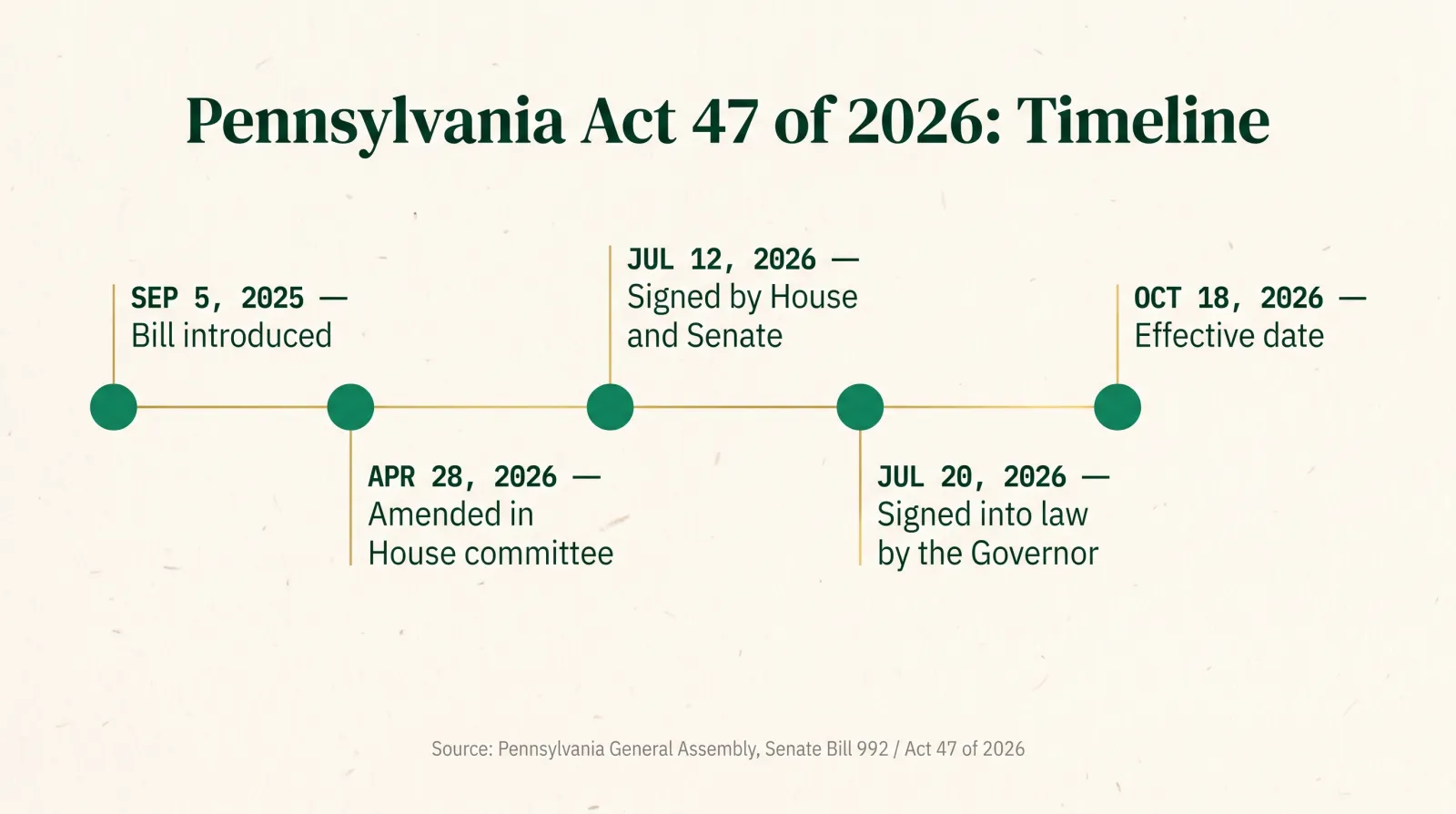
| Date | Milestone |
|---|---|
| September 5, 2025 | Senate Bill 992 introduced in the Pennsylvania Senate |
| April 28, 2026 | Reported from the House Committee on Consumer Protection, Technology and Utilities, as amended |
| July 12, 2026 | Signed in the House and Senate |
| July 20, 2026 | Approved by Governor Josh Shapiro, becoming Act No. 47 of 2026 |
| October 18, 2026 | Effective date, 90 days after the Governor's signature, per Section 5 of the enacted act |
The bill passed with broad, functionally unanimous support in both chambers, which matters for one practical reason: this is not a contested rule likely to get walked back or litigated into limbo the way some federal telemarketing rules have been in the last few years. An agency planning around January 31, 2027 for the still-pending federal TCPA revoke-all provision is watching one clock. This is a separate, state-level clock, already locked in, arriving more than three months earlier.
What it costs to get this wrong
Legal calling window, hours per weekday
Computed directly from the stated hour ranges in each source below. Pennsylvania's new window is roughly a quarter narrower than the federal floor, and drops to zero on Sundays and legal holidays.
Federal window: FTC, Telemarketing Sales Rule compliance guide (8 a.m.-9 p.m.). Pennsylvania windows: enacted text of Act 47 of 2026, Section 3, amending 73 P.S. § 5(a)(1). This is a computed comparison of published legal hours, not a projection of call volume or results.
$1,000
PA civil penalty per violation (up to $3,000 if the person is 60+)
Source: PA Office of Attorney General
$1,500
Federal TCPA statutory damages ceiling per violation
Source: 47 U.S.C. § 227(b)(3)
Oct 18, 2026
Effective date of Pennsylvania's narrower calling window
Source: Act 47 of 2026, Section 5
2,810
TCPA lawsuits filed in federal court, full year 2025
Source: WebRecon, Dec. 2025 year-in-review
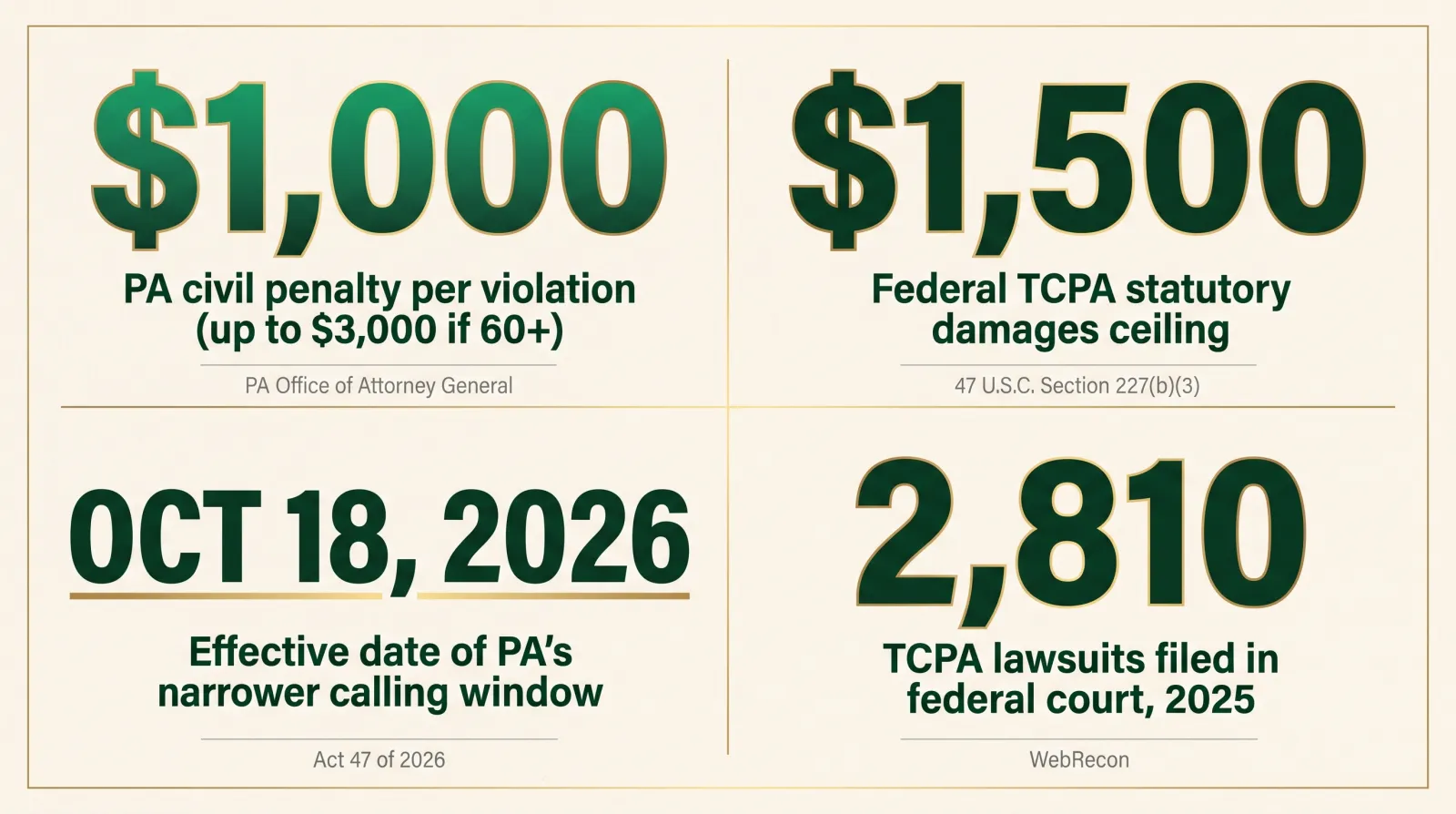
Two separate exposure lines stack here, and they do not cancel each other out. The Pennsylvania Office of Attorney General’s own published guidance states plainly that “a violation of the law carries a civil penalty of up to $1,000, or $3,000 if the person contacted is age 60 or older.” This amendment did not touch that penalty section. Separately, if the call in question was automated or used a prerecorded or artificial voice without valid consent, the federal TCPA’s private right of action under 47 U.S.C. § 227(b)(3) allows a consumer to recover $500 to $1,500 per violation, and TCPA litigation is not a shrinking category: WebRecon’s own year-end tracking counted 2,810 TCPA lawsuits filed in federal court across all of 2025, essentially flat versus 2024 but far from the historical lull some agencies assume the category is in.
Run the arithmetic on a single mistake. An agent working a Pennsylvania Medicare Advantage lead list on a Sunday afternoon, believing the old 8 a.m.-9 p.m. rule still applies after October 18, 2026, places calls that are simultaneously a Pennsylvania civil violation and, if any of those calls used automated dialing without documented consent, a separate TCPA exposure. One afternoon of calling the wrong day, at scale, is not a hypothetical worth ignoring for the cost of updating a dialer’s schedule.
How to get ready before October 18, 2026
None of the following requires buying anything. An agency can run every step below with a CRM it already owns and staff it already employs.
- Reset your calling-hours configuration now, not on October 18. If your dialer, CRM campaign, or manual calling script is set to the old 8 a.m.-9 p.m. window, change it to 9 a.m.-7 p.m. for any Pennsylvania-area codes and ZIP codes, and add a hard Sunday and legal-holiday block. Test it before the effective date so a scheduling error does not surface as a live violation.
- Audit whether your text and ringless voicemail campaigns are on the same schedule as your calls. Because the amended definition folds text messages and ringless voicemail into “telephone solicitation,” any automation that fires SMS drips or voicemail drops on a separate schedule from your live-call campaigns needs to move onto the same 9 a.m.-7 p.m., no-Sunday, no-holiday rule.
- Pull your current consent language and check it against the four required elements. The new state standard requires the agreement to name the phone number, disclose what the person is agreeing to receive, state that consent is not a purchase condition, and carry a signature, electronic signatures included. HighLevel’s own consent checkbox documentation shows the mechanics of capturing and timestamping this kind of consent, though the platform is explicit that enabling a checkbox is a tool for recording consent, not a guarantee of legal compliance on its own.
- Confirm your registration status, and document your reasoning either way. If your agency is relying on the licensed-business exemption in Section 3(b.1)(5), write down why: the specific Pennsylvania insurance license held, and that your calling activity stays within the scope of that licensed business. If you are not confident the exemption applies to your structure, registering with the Office of Attorney General is the safer default.
- Scrub against Pennsylvania’s own do-not-call list, separately from the national registry. Pennsylvania maintains its own do-not-call list through a designated list administrator, distinct from the FTC’s National Do Not Call Registry, and telemarketers are required to obtain and apply updated listings on a quarterly cycle. Calling a number that is clean on the national list does not confirm it is clean on Pennsylvania’s.
- Train whoever answers or places the call on the new opt-out keyword set. The amended act requires recognizing STOP, QUIT, END, REVOKE, OPT OUT, CANCEL, and UNSUBSCRIBE as valid opt-out language for text messages, and requires a live opt-out mechanism within two seconds of a robocall’s opening disclosure. A team that only recognizes “STOP” as valid will miss some of these.
How a lot of PA calling operations run today
- Leads sit in a shared queue and get dialed whenever an agent is free, with no automatic check against the calling-hour window
- Text and voicemail drops run on a separate schedule from live calls, often through a different tool entirely
- A lead that comes in at 6:45 p.m. gets a callback attempt whenever someone notices it, sometimes after 7 p.m.
- Consent records live in scattered notes, if they exist at all
ManualEvery call depends on a person remembering the current rule
A calling setup built for Act 47
- The calling platform is configured with a hard 9 a.m.-7 p.m. window and a full Sunday and holiday block for PA-area numbers
- Calls, texts, and voicemail drops run through the same system on the same schedule, so nothing slips outside the window on a separate track
- A lead that comes in at 6:45 p.m. either gets called before the window closes or waits automatically until 9 a.m. the next legal day
- Every disposition, opt-out, and consent record logs automatically against the lead's file
AutomatedThe window is enforced by the system, not by memory
If you want to build a version of the automated setup above yourself, with your own dialer and a documented consent process, plenty of agencies do exactly that, and it is worth pricing against buying it as a managed service before deciding either way.
Where TheAffordableAI fits
Getting the consent language right and confirming your registration status are decisions a licensed agent, ideally with counsel, has to make. Where a managed AI caller helps is in what happens once those decisions are made: TheAffordableAI’s calling schedule can be configured to the exact legal window for a given state, so a Pennsylvania campaign simply cannot fire a call before 9 a.m., after 7 p.m., or on a Sunday, because the system enforces it rather than relying on a person to remember a date that changed. Every call, text, and disposition logs to the lead’s record automatically and syncs natively with HighLevel, which is the documentation trail a Pennsylvania Attorney General inquiry or a TCPA dispute would ask an agency to produce. The full feature list is on the features page.
State-configurable calling windows
Campaigns can be scheduled to a state's specific legal hours, so a Pennsylvania lead is never dialed outside the 9 a.m.-7 p.m., no-Sunday window once it takes effect.
Native HighLevel CRM sync
Every call, text, and disposition lands in the CRM automatically, building the documentation trail a compliance inquiry would ask for.
Warm transfers and auto-booking
A lead that clears the calling-window and consent checks gets connected to a licensed agent live, or booked against real calendar availability, inside the same call.
Number warmup and spam defense
A narrower legal window means fewer hours to reach the same volume of leads, which makes deliverability, not just legality, matter more.
Hear how a compliant follow-up call actually sounds
There is a live demo call on the homepage. Listen to it, then decide whether your current calling setup would actually stop itself at 7 p.m. on a Pennsylvania lead.
Pricing is published, not quoted privately: a Single Account runs $200 a month plus a $500 one-time setup fee, at $0.20 a minute, down to $0.15 a minute at bulk volume. An Agency plan runs $500 a month plus a $1,000 one-time setup fee, at $0.18 a minute, down to $0.16 a minute at bulk. Both are month to month with no long-term contract, so testing whether a managed caller solves the scheduling problem costs, at most, one month either way. The math above uses TheAffordableAI’s own published rate; run it against your own call volume and average call length on the pricing page.
When this is a scheduling problem, not a calling-platform problem
It would be dishonest to sell a new calling platform as the fix for a compliance gap that is really a documentation and training gap. If your agency runs a small, disciplined Pennsylvania book with a handful of agents who already track calling hours carefully, the honest fix might be nothing more than updating a shared calendar reminder and retraining on the new opt-out keywords, not adopting new software. The place a calling platform earns its cost is volume: an agency dialing hundreds of Pennsylvania leads a week across multiple agents and channels is exactly where a manually enforced calling window starts to fail quietly, one missed cutoff at a time, long before anyone notices the pattern.
Using AI does not transfer liability
Prior express written consent, calling-hour compliance, Pennsylvania and national do-not-call obligations, and honest disclosure of what a call is remain the responsibility of the licensed agent and agency, whether a human or an AI voice places the call. Act 47 of 2026 specifically bars using "any technology or any synthetic or computer-generated messaging to defraud, deceive or mislead" a subscriber, a rule about honesty in how a call presents itself, not a rule against AI calling. Medicare campaigns carry CMS's separate marketing rules on top of everything in this article, covered in the CMS 2027 Medicare marketing rules guide on this site. An automated caller does not carry any of this responsibility away from the agency that owns the campaign.
Pennsylvania’s new telemarketing law is not a distant proposal. It is signed, dated, and counting down to October 18, 2026, with a calling window that is narrower than the federal floor most agencies have been building around for years. The agencies most exposed are the ones running real volume into Pennsylvania across calls, texts, and voicemail drops on schedules that were never built to account for a state-specific window at all. Whether the fix is a calendar update or a new calling platform depends entirely on how much of that volume your agency actually runs, and that is worth answering honestly before October 18, not after.
Frequently asked
What is Pennsylvania's new telemarketing law, and when does it take effect?
It is Act No. 47 of 2026, formerly Senate Bill 992, which amends Pennsylvania's 1996 Telemarketer Registration Act. Governor Josh Shapiro signed it July 20, 2026, and the act text sets its own effective date at 90 days after signing, which lands on October 18, 2026. It narrows the legal calling window, adds a Sunday-wide ban, expressly folds text messages and ringless voicemail into the definition of a regulated telephone solicitation, and writes a state-law prior express written consent standard modeled on the federal TCPA directly into Pennsylvania statute.
What are the new calling hours for telemarketing calls in Pennsylvania?
Starting October 18, 2026, a telephone solicitation to a Pennsylvania residential, business, or wireless subscriber may only be initiated between 9:00 a.m. and 7:00 p.m., and not at all on a Sunday or a legal holiday. That replaces the prior window, which ran from 8:00 a.m. to 9:00 p.m. with no blanket Sunday restriction, per the enacted bill text on file with the Pennsylvania General Assembly. The federal Telemarketing Sales Rule's 8 a.m. to 9 p.m. window, enforced by the FTC, still applies as the national floor, but Pennsylvania's window is now narrower on both ends and adds an entire day the federal rule does not touch.
Does the law cover text messages and ringless voicemail?
Yes, explicitly, for the first time in the state's statute. The amended definition of 'telephone solicitation' in Act 47 of 2026 lists 'a telephone call, voicemail, ringless voicemail or text message,' where the prior definition covered only calls. Practically, that means the calling-hour window, the do-not-call list, and the opt-out keyword requirements (STOP, QUIT, END, REVOKE, OPT OUT, CANCEL, UNSUBSCRIBE) now apply the same way to an SMS drip campaign or a ringless voicemail blast as they do to a live or automated phone call.
Are licensed insurance agents exempt from Pennsylvania's telemarketer registration requirement?
Likely yes, under an exemption that already existed before this amendment and was carried forward unchanged. Section 3(b.1)(5) of the amended act exempts 'a person or business engaged in a business or occupation which is licensed by, certificated by or registered with a Federal or Commonwealth agency while acting within the scope of the business for which licensure ... is required.' A Pennsylvania-licensed insurance producer, selling insurance within the scope of that license, appears to fit that description, which means the agency likely does not have to file the separate telemarketer registration with the Office of Attorney General. This is a reading of the statute, not legal advice, and an agency should confirm its own situation with counsel.
Does the registration exemption also exempt me from the calling-hour and consent rules?
No, and this is the distinction agencies most often miss. The registration exemption in Section 3(b.1) applies only to the registration requirement in Section 3 of the act. The calling-hour restrictions, the consent requirements, the do-not-call list obligations, and the opt-out rules all live in Section 5, which defines 'telemarketer' broadly as any person or business that initiates telephone solicitations to a Pennsylvania subscriber, with no carve-out for licensed businesses. A licensed insurance agency can be exempt from registering as a telemarketer and still be fully bound by every substantive rule in the act.
What happens if my agency violates Pennsylvania's telemarketing law?
Under the Pennsylvania Office of Attorney General's own published guidance, a violation of the Telemarketer Registration Act carries a civil penalty of up to $1,000 per violation, rising to $3,000 if the person contacted is 60 or older, a figure this amendment did not change. That is separate from, and can stack with, TCPA exposure at the federal level, where a private plaintiff can recover $500 to $1,500 per violation under 47 U.S.C. § 227(b)(3). A single non-compliant call placed at 7:15 p.m. to a Pennsylvania Medicare prospect could trigger both.
How is this different from the federal TCPA and FTC Telemarketing Sales Rule?
The federal rules set a floor; Pennsylvania's amended act sets a stricter statewide ceiling on top of it. The FTC's Telemarketing Sales Rule bars calls before 8 a.m. or after 9 p.m., and the TCPA governs consent and automated dialing nationally. Pennsylvania's new window (9 a.m. to 7 p.m., no Sundays, no legal holidays) is narrower than the federal window on both ends and adds restrictions the federal rules do not impose at all. An agency compliant with federal law alone is not automatically compliant with Pennsylvania law once Act 47 takes effect.
Does using an AI voice caller change any of this liability?
No. Consent, calling-hour compliance, do-not-call list scrubbing, and disclosure obligations stay with the licensed agent and agency, whether a human or an AI places the call. Act 47 of 2026 specifically adds a new prohibited act barring 'any technology or any synthetic or computer-generated messaging to defraud, deceive or mislead' a subscriber, which is a rule about honesty in how a call identifies itself, not a rule against using AI to place the call. A well-built AI calling setup can enforce the legal calling window and log consent automatically, but it does not transfer legal responsibility away from the agency that owns the campaign.
Sources
- Pennsylvania General Assembly — Senate Bill 992, Printer's No. 1649, enacted as Act No. 47 of 2026 (signed by the Governor July 20, 2026)
- Pennsylvania General Assembly — Senate Bill 992 Bill History, 2025-2026 Regular Session
- Pennsylvania Office of Attorney General — Telemarketing Frequently Asked Questions
- Federal Trade Commission — Complying with the Telemarketing Sales Rule
- Cornell Law School Legal Information Institute — 47 U.S.C. § 227, Telephone Consumer Protection Act
- WebRecon LLC — December 2025 Stats & Year in Review
- HighLevel Support — Consent Checkbox for Compliance
- Bubeck Law — Pennsylvania Expands Telemarketing Law: New Rules Effective October 18
- TheAffordableAI — Pricing
Put this on your own phone line
See the AI dial, qualify, and warm-transfer a live call in under a minute. No contract, no dev work.
Keep reading

Speed to Lead in 2026: Why the First 60 Seconds Decides Who Writes the Policy
The lead you paid for is not lost to a better agent. It is lost to a faster one. Here is what response time actually does to contact and conversion rates, and how to get to sixty seconds without hiring a dialer team.

TCPA Revoke-All Rule 2026: What the FCC Just Adopted
The FCC adopted a new TCPA revocation order on September 30, 2026, months ahead of the 2027 deadline. Here is what changed for insurance agents.

Florida Insurance Leads: Speed to Lead Under the FTSA
Florida sold more 2026 ACA plans than any state, yet its telephone law adds exposure on top of federal TCPA. How agencies follow up fast and compliant.