Florida Insurance Leads: Speed to Lead Under the FTSA
Florida sold more 2026 ACA plans than any state, yet its telephone law adds exposure on top of federal TCPA. How agencies follow up fast and compliant.
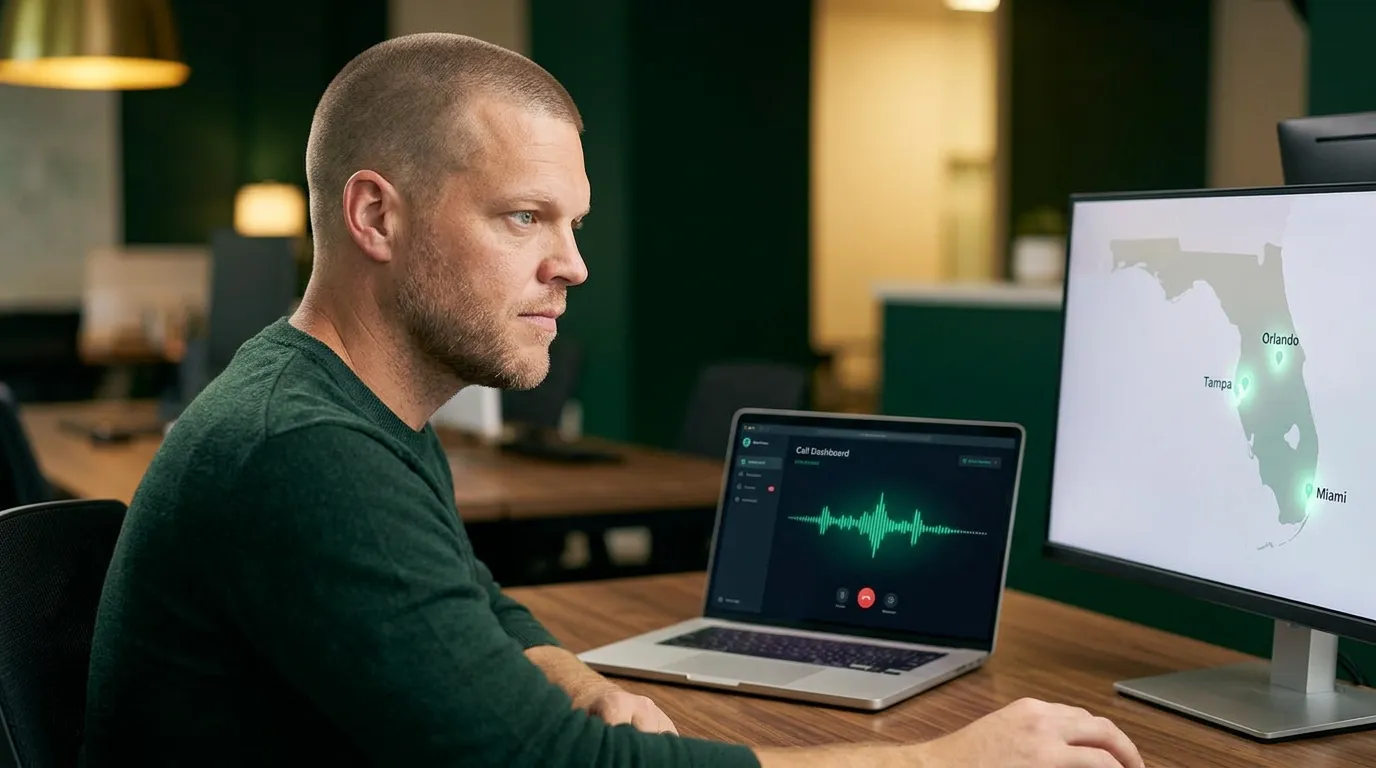
Florida sold more 2026 ACA marketplace plans than any other state in the country: 4,538,772 cumulative plan selections through HealthCare.gov, according to CMS’s own January 28, 2026 enrollment snapshot. It also happens to enforce one of the country’s more aggressive state telemarketing laws, the Florida Telephone Solicitation Act, on top of the federal TCPA every agency already has to follow. Put those two facts next to each other and you get the actual problem this article is about: the state with the most insurance leads in America is also the state where agencies get the most nervous about calling them back fast.
That nervousness is rational. It is also, in a lot of agencies, costing more business than the lawsuits it is trying to avoid. This is what the FTSA actually requires, what it adds on top of federal law, and how to build a follow-up cadence that is both fast and correctly built for Florida specifically, not just copied from a national script and hoped over the state line.
Most of what follows applies whether you buy ACA leads, Medicare Advantage leads, final expense leads, or work an existing book. The lead source changes; the identification line, the consent record, and the calling-hours math do not. If you work leads in more than one state, our companion piece on insurance leads in Texas covers the equivalent picture for that state’s own Mini-TCPA, since the mechanics are similar even though the specific statutes are not.
The short version
- Florida recorded 4,538,772 cumulative 2026 ACA plan selections through HealthCare.gov, the most of any state on that platform, per CMS's January 28, 2026 national snapshot.
- The Florida Telephone Solicitation Act (Fla. Stat. 501.059) requires prior express written consent for automated sales calls and texts, and requires a caller to state their true name and business immediately on every unsolicited call, live or automated.
- FTSA statutory damages match the federal TCPA floor: $500 per violation, up to $1,500 for a willful one. What Florida adds is a second, independent legal track running alongside federal law, not a bigger dollar figure.
- Medicare Advantage competition varies by county: 75 plans in Miami-Dade, 85 in Broward, 91 in Hillsborough (Tampa), each per MedicareAdvantage.com's 2026 county data.
- Enhanced ACA subsidies expired December 31, 2025, and Florida's 2026 enrollment fell about 4% from 2025's record, per HealthInsurance.org's tracking, meaning the leads that do convert now matter more per lead, not less.
How big is Florida’s insurance lead market right now?
Bigger than any other state’s, at least on the ACA side. CMS’s Marketplace 2026 Open Enrollment Period Report: National Snapshot, published January 28, 2026 with data through January 15, 2026, put Florida’s cumulative HealthCare.gov plan selections at 4,538,772, against a national total of 23.0 million consumers signing up for 2026 coverage across every exchange, state-based and federal. No other state on the federal platform came close to Florida’s total.
That volume did not hold flat year over year. HealthInsurance.org’s tracking of Florida’s 2026 marketplace describes a 4% decline from 2025’s record enrollment of roughly 4.7 million, and ties the drop to the enhanced premium tax credits that had capped what many enrollees paid since 2021 expiring on December 31, 2025. The same source reports 16 insurers writing 2026 ACA plans in Florida, a weighted average approved rate increase of 31.5% before subsidies, with individual carrier increases ranging from 23.2% to 48.7%, and an average monthly subsidy of $740 per person among the more than 95% of Florida enrollees who still qualify for assistance. About a third of subsidized enrollees, 34%, pay less than $10 a month after that assistance is applied.
| Metric | Florida | National |
|---|---|---|
| Cumulative 2026 plan selections (HealthCare.gov) | 4,538,772 | 23.0 million (all exchanges) |
| Change from 2025 | -4% | -5% |
| Carriers offering 2026 ACA plans | 16 | Varies by state |
| Weighted average approved rate increase | 31.5% | Varies by state |
| Medicare Advantage share of eligible beneficiaries | 36% of MA enrollees in SNPs | 55% of Medicare in MA |
Sources: CMS Marketplace 2026 Open Enrollment Period Report: National Snapshot (Jan. 28, 2026); HealthInsurance.org Florida ACA Marketplace guide; KFF Medicare Advantage in 2026 (Florida special needs plan share, national MA penetration).
Two things follow from that table. First, Florida is not a market where a slow follow-up quietly costs a little business; it is the single largest concentration of ACA shoppers on the federal exchange, so a one-second delay compounds across more leads than almost anywhere else. Second, KFF’s 2026 Medicare Advantage tracking separately notes that special needs plans, which serve beneficiaries with specific chronic conditions or dual Medicare/Medicaid eligibility, make up 36% of Florida’s Medicare Advantage enrollment, placing it among the states where SNP enrollment runs highest nationally. That is a market with a large share of beneficiaries who need a real conversation to be matched correctly, not a fast generic pitch, which raises the stakes on getting the call itself right.
If you want to see what a full breakdown of national response-time data looks like, and what a sixty-second follow-up standard actually requires operationally, our speed-to-lead guide walks through the mechanics independent of any one state.
What the Florida Telephone Solicitation Act actually requires
The FTSA, codified at Fla. Stat. 501.059, is Florida’s own telemarketing law, and it runs alongside the federal TCPA rather than replacing it. Three provisions matter most for an agency calling Florida leads.
Consent. Under subsection (1)(g)-(h), “prior express written consent” for an automated telephonic sales call must bear the called party’s signature, or an electronic equivalent such as checking a box, must name the specific telephone number being authorized, and must clearly disclose that agreeing to receive automated calls is not a condition of buying anything. That mirrors the federal TCPA’s written-consent standard closely enough that a properly built national consent flow will usually satisfy both, but “usually” is not “automatically,” and the two statutes are legally independent.
Identification. Subsection (2) requires that “any telephone solicitor who makes an unsolicited telephonic sales call to a residential, mobile, or telephonic paging device telephone number shall identify himself or herself by his or her true first and last names and the business on whose behalf he or she is soliciting immediately upon making contact.” That applies to every unsolicited sales call into Florida, human or automated, and it applies before anything else gets said.
Scope. Subsection (1)(j) defines a “telephonic sales call” as “a telephone call, text message, or voicemail transmission” made to solicit a sale, which means an unsolicited marketing text to a Florida cell number carries the same consent obligation as a voice call. Florida also runs its own “no sales solicitation calls” list under subsection (3), administered by the Florida Department of Agriculture and Consumer Services, separate from the federal National Do Not Call Registry.
This is general information, not legal advice
The FTSA interacts with your carrier contracts, your consent-capture vendor's own terms, and Florida case law that moves faster than the statute text itself. Verify your specific call flow against Fla. Stat. 501.059 directly and with your own counsel before you change a script or a consent form.
Defining the terms before you build anything
Every one of these words gets used loosely in agency Slack channels and vendor sales calls, and the looseness is exactly where mistakes get made. Here is what each one means in the statutes themselves.
Prior express written consent is not the same thing as a lead simply filling out a form asking to be contacted. Under both Fla. Stat. 501.059(1)(g)-(h) and the federal TCPA framework at 47 U.S.C. 227, it specifically means a signed or electronically-equivalent record (a checked box counts) that names the exact phone number being authorized, and that clearly states agreeing to receive automated or prerecorded calls is not a condition of buying anything. A lead form that only says “contact me about insurance” without that specific language is consent to be contacted, generically, but it is a weaker record for the automated-calling standard both statutes actually require.
An autodialer or automated telephonic system, as referenced in Fla. Stat. 501.059(8)(a), is a system that selects and dials telephone numbers automatically, or plays a recorded message once a connection is completed. A human agent manually dialing a number from a list, with no automated selection or recorded pitch, sits outside that specific trigger, though the identification and disclosure rules still apply to that call regardless.
A warm transfer is a live handoff: the calling system stays on the line, confirms a real person and a licensed agent are both present, and connects them directly, rather than leaving a voicemail or a callback request. It is the opposite of a cold transfer, where a lead is pushed to a number or queue with no live handoff and often ends up on hold or in voicemail.
Round robin routing distributes incoming qualified leads across a pool of licensed agents in rotation, rather than sending every lead to one fixed extension. It matters in Florida specifically because a single-agent bottleneck during a state producing 4,538,772 plan selections in one enrollment period is a bottleneck at a much larger scale than the same setup in a smaller state.
TPMO stands for Third-Party Marketing Organization, the CMS designation covering entities that market Medicare Advantage and Part D plans on a carrier’s behalf. Any Florida call touching Medicare Advantage or Part D still carries the TPMO disclaimer requirement on top of everything in this article; our CMS 2027 marketing rules guide covers that requirement’s current text in full.
A special needs plan (SNP) is a type of Medicare Advantage plan restricted to beneficiaries with specific chronic conditions, institutional needs, or dual Medicare/Medicaid eligibility. KFF’s 2026 Medicare Advantage tracking notes Florida among the states where SNP enrollment makes up at least a quarter of total MA enrollment, at 36%, which is part of why a generic, fast pitch converts less reliably in Florida than in a market with a smaller SNP-eligible population; more of the beneficiaries on the other end of the call need to be matched to the right plan type, not just any plan.
How the FTSA and the federal TCPA stack on top of each other
Here is the part that gets misunderstood most often: Florida’s private right of action does not carry a bigger dollar figure than federal law. Under Fla. Stat. 501.059(10)(a)-(b), a consumer can recover actual damages or $500, whichever is greater, and a court may increase that award up to three times, or $1,500, for a willful or knowing violation. Under 47 U.S.C. 227(b)(3) and (c)(5), the federal TCPA sets the identical floor: $500 per violation, trebled to $1,500 for willful conduct. Same numbers, both statutes.
What Florida adds is not a higher ceiling. It is a second, independent legal track that runs alongside the federal one, plus two obligations the federal TCPA does not spell out the same way: the immediate self-identification requirement in subsection (2), and its own state-run no-sales-solicitation list separate from the federal registry. A single noncompliant call into Florida can be evaluated under both statutes at once, which is a meaningfully different risk profile than a call that only has to clear one law, even when neither law’s per-violation number changed.
| Requirement | Florida FTSA (Fla. Stat. 501.059) | Federal TCPA (47 U.S.C. 227) |
|---|---|---|
| Base statutory damages | $500 or actual damages, whichever greater | $500 per violation |
| Willful violation multiplier | Up to 3x ($1,500) | Up to 3x ($1,500) |
| Covers text messages | Yes, explicitly, 501.059(1)(j) | Yes, under separate wireless provisions |
| Immediate self-identification required | Yes, true name + business, 501.059(2) | Not specified at the federal statute level |
| State-run do-not-call list | Yes, via Dept. of Agriculture and Consumer Services | National DNC Registry, separate list |
Sources: Florida Statutes 501.059, official Florida Legislature statutes site; 47 U.S.C. 227, Cornell Law School Legal Information Institute.
None of that is a reason to slow down. It is a reason to build the call flow correctly once, so that identification, consent, and disclosure happen in the right order automatically, instead of leaning on hesitation as a substitute for a script that was never actually fixed.
What a cautious, slow follow-up costs in a market this size
Legal caution is a real cost. So is a lead nobody called back. Our companion piece on the true cost of a missed insurance lead works through the commission math CMS itself caps for Medicare Advantage compensation, and none of that math improves because a call felt legally risky and got pushed to tomorrow instead of handled correctly today.
In Florida specifically, the arithmetic is sharper because of scale. A national agency working leads across fifty states absorbs a slow Florida cadence as one input among many. A Florida-focused agency working a state that alone produced 4,538,772 ACA plan selections in a single enrollment period is running that same slow cadence against the largest single-state lead pool in the country. If a compliant, correctly built call can go out the same hour a Florida lead posts instead of two or three days later out of an abundance of caution that the statute never actually required, the difference shows up across a much larger number of leads than it would in a smaller state.
Here is a worked illustration, with numbers you should replace with your own before drawing any conclusion. HealthInsurance.org’s tracking of Florida’s 2026 marketplace puts the average monthly subsidy at $740 per person among the more than 95% of enrollees who still qualify for assistance. Over a full plan year, that is $8,880 in subsidy support riding on a single household completing enrollment correctly and on time. If an agency’s legal caution adds three extra days to every callback purely out of habit, not because the FTSA actually required the delay, and even a modest share of that agency’s Florida leads shop with a faster-moving competitor in those three days, the subsidy dollars at stake per lost household are not small. The three-day number here is illustrative, not a sourced statistic; the point is that the dollar value per household, $740 a month, is real and sourced, and it is the number worth multiplying by your own agency’s actual callback lag and lead volume.
| Input | Value |
|---|---|
| Average monthly subsidy, subsidized Florida enrollees, 2026 | $740 |
| Annualized subsidy value per household | $8,880 |
| Share of Florida enrollees receiving a subsidy, 2026 | >95% |
| Average net premium after subsidy, 2026 | $62/month |
Source: HealthInsurance.org, Florida Health Insurance Marketplace: 2026 ACA Coverage Guide. Annualized figure is arithmetic on the sourced monthly average, not an independently reported statistic.
Caution and speed are not actually in conflict here
The FTSA's requirements, consent, identification, disclosure, opt-out, are all things a call script can satisfy in the first thirty seconds. Once that script exists and is followed every time, there is no remaining reason for the call itself to wait.
Medicare Advantage competition varies sharply by Florida county
Florida’s Medicare Advantage market is not one market; it is dozens of county-level markets with different plan counts, different premiums, and different carrier mixes. MedicareAdvantage.com’s 2026 county data shows real variation even among three of the state’s largest metro counties.
| County | MA plans available | Avg. monthly premium | Avg. out-of-pocket max | Avg. star rating |
|---|---|---|---|---|
| Miami-Dade | 75 | $23.83 | $3,776.00 | 3.99 |
| Broward | 85 | $21.14 | $3,723.53 | 3.95 |
| Hillsborough (Tampa) | 91 | $19.06 | $3,959.89 | 4.02 |
Source: MedicareAdvantage.com 2026 county-level plan data for Miami-Dade, Broward, and Hillsborough counties, Florida.
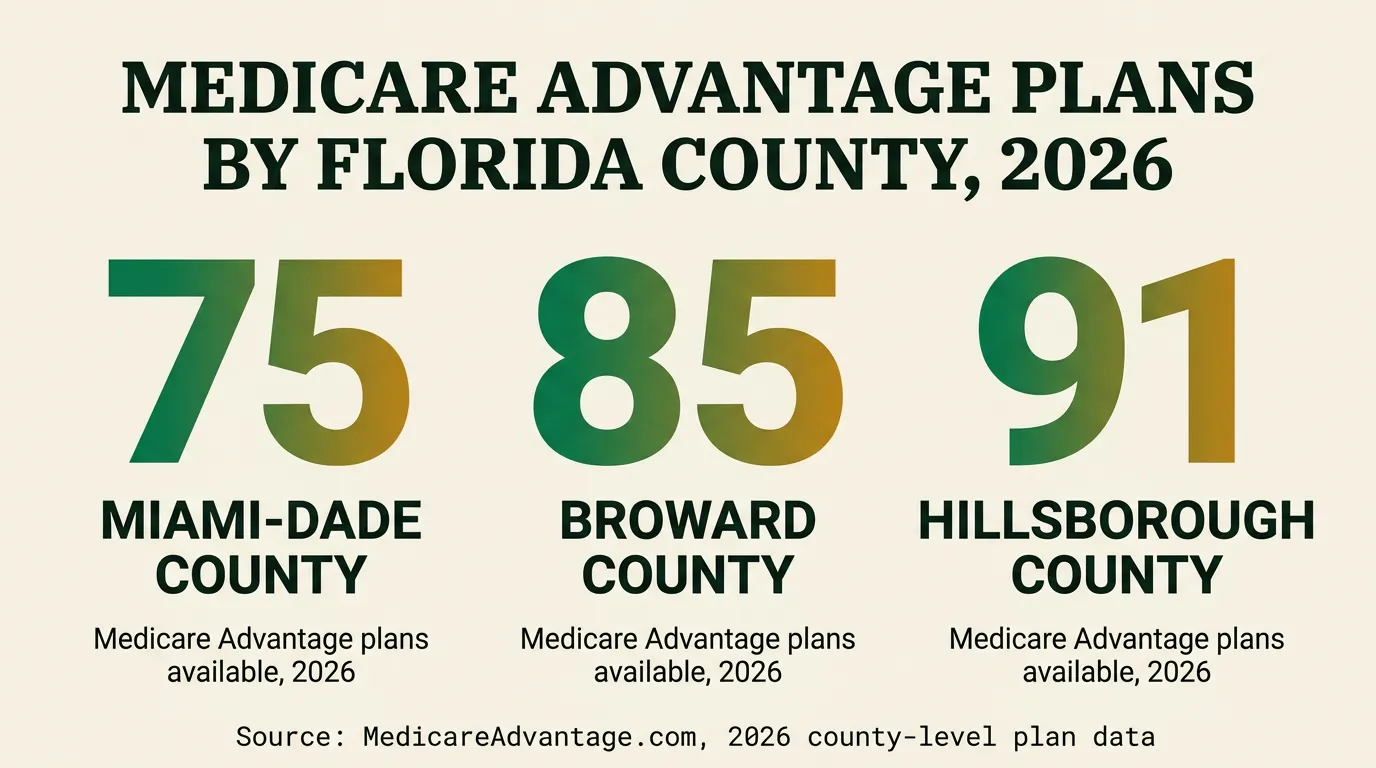
Medicare Advantage plans available by Florida county, 2026
More plans generally means a more competitive, faster-moving conversation with a beneficiary.
Source: MedicareAdvantage.com 2026 county-level Medicare Advantage plan data.
A beneficiary in Hillsborough County is choosing among 91 plans; one in Miami-Dade is choosing among 75. Neither number is small, and in both counties, a beneficiary who calls in or fills out a form is doing so in a market with real, immediate alternatives if nobody calls them back quickly. Star ratings across all three counties cluster tightly, between 3.95 and 4.02, so plan quality alone rarely decides where a beneficiary lands; who reaches them first, with an accurate answer, usually does.
How to build a compliant, same-day Florida call flow yourself
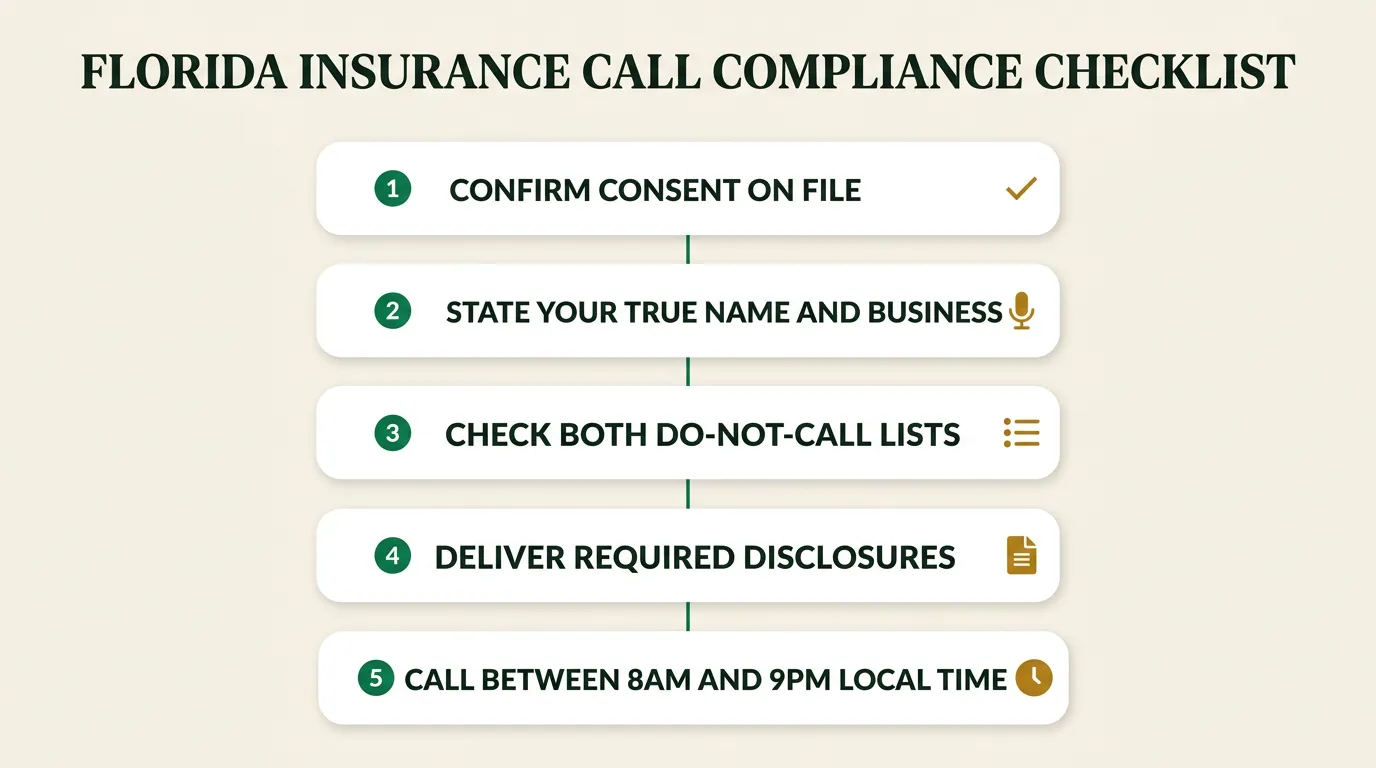
None of this requires new software, and giving away the method is the point: an agent who reads this and thinks “I can build that with the team I already have” is exactly who this is for.
- Fix consent capture first, and check it against the Florida text specifically. Confirm your consent form or checkbox flow independently satisfies Fla. Stat. 501.059(1)(g)-(h): a signature or clear electronic equivalent, the specific number being authorized, and an explicit statement that consent is not a condition of purchase. Do not assume a TCPA-only consent flow automatically covers this; pull the actual form your lead source uses and compare it line by line against the statute text, not against a summary of it.
- Script the identification line first, every time. True first name, true last name, the business being represented, stated immediately on contact, before any qualifying question or pitch, per Fla. Stat. 501.059(2). This is a scripting fix, not a technology fix, and it costs nothing to implement today. Write it into the first line of every script your agents or your AI caller uses for a Florida number, and audit a sample of recorded calls to confirm it is actually being said, not just written down.
- Scrub against both do-not-call lists, not just one. Check the federal National Do Not Call Registry and Florida’s own no-sales-solicitation list, run by the Department of Agriculture and Consumer Services, before an outbound campaign goes out. A list that only checks the federal registry is checking one of the two lists a Florida number can be on.
- Hold the calling-hours window everywhere, not just in Florida. 16 CFR 310.4 sets the federal floor at 8 a.m. to 9 p.m. local time at the called party’s location; build your dialer’s time-zone logic off the lead’s number, not your own office clock. Florida sits entirely in Eastern time except for the ten westernmost Panhandle counties, which run Central, so a single statewide campaign built on one time zone will misfire on part of your own list.
- Make the opt-out actually work, immediately, on every channel. A text “STOP” or a spoken “take me off your list” needs to suppress future contact the same day, not at the end of a batch process, and it needs to suppress every channel, voice and text alike, not just the one it arrived on.
- Sort personal marketing conversations from routine service calls. A beneficiary asking about their existing plan’s ID card is a different call type than one shopping for new coverage; only the latter needs the full FTSA identification and consent sequencing built around it, and forcing the full sequence onto every inbound call adds friction the statute never asked for.
- Time your own Florida lead-to-first-touch lag for two weeks. Most agencies find the real number is driven by habit and caution rather than by anything the statute actually requires, once the script above is built and followed consistently. Track it the same way you would track any other response-time metric, and compare it against the sixty-second standard our speed-to-lead guide walks through.
Compliance that applies to every Florida insurance call, regardless of who or what is speaking
- Prior express written consent is required before an automated or prerecorded call or text reaches a Florida cell number, under both Fla. Stat. 501.059 and 47 U.S.C. 227.
- Immediate self-identification, true name and business, on every unsolicited Florida sales call, per Fla. Stat. 501.059(2).
- Disclosure and opt-outs must be honored immediately, on every channel the lead used to reach you or that you used to reach them.
- Medicare calls carry the TPMO disclaimer and CMS's separate marketing rules on top of everything above; see our [CMS 2027 marketing rules guide](/blog/cms-2027-medicare-marketing-rules/) for the current requirements.
- Using AI does not transfer liability. The licensed agent of record stays responsible for consent, disclosure, and the eventual sale, regardless of what placed or answered the call.
- Never reference cold calling as a substitute for consent; consent is the obligation regardless of how the lead was sourced.
Where an AI voice agent fits, and where a licensed agent still has to
A script that gets followed on every single call, at every hour, during the highest-volume weeks of the year, is a genuinely hard operational problem for a human team to solve through training alone. It is a more tractable one for a system built to sequence the same steps identically every time. The full breakdown of what’s included, warm transfers, number warmup, multi-calendar routing, and HighLevel sync, is on the features page.
Identification stated first, every call
True name and business are delivered immediately on contact, matching Fla. Stat. 501.059(2) by design rather than by whether an agent remembered that day.
Consent and DNC status checked before dialing
Outbound attempts route against your consent records and both do-not-call lists automatically, before the number is ever dialed.
Calling-hours logic keyed to the lead's number
Dial windows respect 16 CFR 310.4's 8 a.m. to 9 p.m. local-time rule based on the lead's area code, not the office where the campaign was built.
Number warmup and spam defense
A high-volume Florida calling campaign is exactly the kind of pattern that gets a caller ID flagged; ongoing warmup keeps outbound numbers landing as calls, not spam.
Warm transfer to a licensed Florida-appointed agent
Once qualified, the lead is transferred live to a licensed agent for the actual plan discussion, application, and sale.
HighLevel sync
Consent status, disposition, and transcript land on the contact record the moment the call ends, so nothing depends on someone remembering to log it.
If you want to hear what a compliant, same-day Florida call flow actually sounds like before you build anything, there’s a demo call on the homepage: theaffordableai.com. Put your own number in and it calls you back in seconds.
You can also build a version of this yourself with a dialer, a documented script, and a VA checking consent records by hand. Plenty of agencies do exactly that, and for a smaller list, it can work fine. It is worth pricing both against your own Florida lead volume before deciding which one actually saves time.
What to build before Florida’s Medicare Advantage volume peaks
Florida’s Medicare Advantage market does not slow down between now and the Annual Election Period; if anything, call volume and lead volume both climb heading into it. Our CMS 2027 marketing rules guide covers the current federal timing and disclosure requirements for that period in detail, and none of it replaces anything in this article. A Florida Medicare Advantage call still needs the FTSA identification line, the consent record, and the calling-hours check on top of the TPMO disclaimer and Scope of Appointment rules that already apply nationally. Building the Florida-specific pieces now, while volume is lower than it will be in October, is meaningfully easier than trying to retrofit a script mid-surge, when the same agents are also handling the highest call count of their year.
The counties in the table above are not the only ones that matter, and a statewide Florida campaign should account for the fact that plan competition, and therefore how fast a beneficiary can find an alternative if nobody calls them back, varies by a wide margin from one county to the next. A script and a consent process built once, correctly, travels across all of them; a lead cadence built around caution instead of a finished script does not scale the same way once volume climbs.
What changes once the script and the speed both match the market
Get the identification line, the consent check, and the calling-hours logic built once and followed every time, and the practical difference in a market Florida’s size is not abstract. A lead who fills out a form during the highest-traffic weeks of the year gets a compliant call the same hour instead of waiting behind a manual review queue. A beneficiary comparing 75 to 91 competing Medicare Advantage plans in their county talks to someone before a competing agent, or a different lead buyer working the same shared list, gets there first. None of that is a claim about close rates or guaranteed outcomes, and it should not be read as one. It is a description of what becomes possible once caution stops standing in for a script that was never actually finished.
See a compliant, same-day Florida call flow on your own number
Put your number in on the homepage and hear the identification line, consent check, and warm transfer sequence on a live call. No contract either way, so the cost of testing it is one month.
The math above uses Single Account pricing as of this writing: $200 a month plus a $500 one-time setup, at $0.20 a minute, stepping down to $0.15 at higher volume. An Agency plan runs $500 a month plus a $1,000 one-time setup at $0.18 a minute, stepping down to $0.16, and adds routing across 20-plus agents with round-robin distribution, useful for a Florida book split across Miami-Dade, Broward, Hillsborough, and everywhere in between. Both plans are month-to-month, with no long-term contract. Florida’s telemarketing law is not going anywhere, and neither is its lead volume. Building a script that satisfies the first without slowing down the second is the actual job.
Frequently asked
What is the Florida Telephone Solicitation Act, and does it apply to insurance sales calls?
Yes. The FTSA, codified at Florida Statutes 501.059, covers any "telephonic sales call," which the statute defines as a telephone call, text message, or voicemail transmission made to solicit a sale of goods or services, and an insurance policy is a service under that definition. It requires prior express written consent before an automated or prerecorded telephonic sales call reaches a Florida residential, mobile, or paging-device number, and it requires the caller to state their true first and last name and the business they represent immediately upon making contact, regardless of consent.
Do I need separate consent for Florida leads if I already have TCPA consent?
Practically, yes, because Florida's consent standard runs alongside the federal one rather than replacing it. Under Fla. Stat. 501.059(1)(g)-(h), prior express written consent must bear the called party's signature or an equivalent electronic action such as checking a box, name the specific telephone number being authorized, and clearly disclose that agreeing to automated calls is not a condition of buying anything. A consent record built to satisfy the federal TCPA at 47 U.S.C. 227 will usually cover most of the same ground, but the safest posture is to confirm your consent capture flow independently meets Florida's own text, since a call can trigger both statutes at once.
What has to happen in the first few seconds of a Florida sales call?
Under Fla. Stat. 501.059(2), a telephone solicitor making an unsolicited telephonic sales call to a Florida number must identify themselves by true first and last name and name the business they are calling on behalf of, immediately upon making contact with the person being called. That requirement applies regardless of whether the call is live, recorded, or AI-generated, and it applies before any pitch, disclosure, or qualifying question.
Does the FTSA cover text messages to Florida leads?
Yes. Fla. Stat. 501.059(1)(j) defines a "telephonic sales call" as a telephone call, text message, or voicemail transmission made to solicit a sale, so an unsolicited marketing text to a Florida cell number needs the same prior express written consent as an automated voice call, and it carries the same statutory exposure if that consent is missing.
How many Medicare Advantage plans are available in Florida for 2026?
It varies sharply by county. MedicareAdvantage.com's 2026 county pages list 75 plans in Miami-Dade County, 85 in Broward County, and 91 in Hillsborough County (Tampa), each with slightly different average premiums and star ratings. Nationally, KFF's 2026 Medicare Advantage tracking puts total enrollment at 35.2 million out of 64.2 million eligible Medicare beneficiaries, or 55%, as of March 2026.
Why did Florida's ACA marketplace enrollment drop for 2026?
The enhanced premium tax credits that had capped what many enrollees paid out of pocket since 2021 expired December 31, 2025, according to HealthInsurance.org's tracking of Florida's marketplace. Florida still recorded 4,538,772 cumulative 2026 plan selections through HealthCare.gov, per CMS's own January 28, 2026 enrollment snapshot, the highest total of any state on that platform, but that is a 4% decline from 2025's record enrollment as smaller subsidies pushed some shoppers to walk away.
Is Florida's telemarketing law tougher than the federal TCPA on paper?
The statutory damages are actually the same floor: $500 per violation under both Fla. Stat. 501.059(10)(a) and 47 U.S.C. 227(b)(3), with courts able to raise that to three times the amount, up to $1,500, for a willful or knowing violation under either law. What Florida adds is a second, independent cause of action layered on top of the federal one, plus its own identification requirement and its own no-sales-solicitation list run by the Florida Department of Agriculture and Consumer Services, so a single noncompliant call chain can be evaluated under two statutes instead of one.
Does using an AI voice agent change any of these compliance requirements for Florida leads?
No. An AI voice agent calling a Florida lead still needs the same prior express written consent, still has to state a true identity and business name immediately per Fla. Stat. 501.059(2), still has to honor the federal calling-hours window of 8 a.m. to 9 p.m. local time under 16 CFR 310.4, and still has to respect any opt-out immediately. Using AI to place or receive the call does not transfer the licensed agent's liability for consent, disclosure, or the eventual sale.
Sources
- Florida Statutes 501.059 — Telephone Solicitation (official Florida Legislature statutes site)
- Cornell Law School Legal Information Institute — 47 U.S.C. 227, Telephone Consumer Protection Act
- Cornell Law School Legal Information Institute — 16 CFR 310.4, Telemarketing Sales Rule calling time restrictions
- CMS — Marketplace 2026 Open Enrollment Period Report: National Snapshot (published January 28, 2026, data through January 15, 2026)
- KFF — Medicare Advantage in 2026: Enrollment Update and Key Trends (published June 5, 2026; updated July 1, 2026 with March 2026 data)
- HealthInsurance.org — Florida Health Insurance Marketplace: 2026 ACA Coverage Guide
- MedicareAdvantage.com — 2026 Medicare Advantage Plans in Miami-Dade County, Florida
- MedicareAdvantage.com — 2026 Medicare Advantage Plans in Broward County, Florida
- MedicareAdvantage.com — 2026 Medicare Advantage Plans in Hillsborough County, Florida
- TheAffordableAI — Pricing
Put this on your own phone line
See the AI dial, qualify, and warm-transfer a live call in under a minute. No contract, no dev work.
Keep reading
Insurance Leads in Texas: How High-Volume Agencies Follow Up
Texas insurance leads move fast in 2026. See how high-volume agencies handle speed to lead, the Mini-TCPA, and follow-up across DFW, Houston, and Austin.

Speed to Lead in 2026: Why the First 60 Seconds Decides Who Writes the Policy
The lead you paid for is not lost to a better agent. It is lost to a faster one. Here is what response time actually does to contact and conversion rates, and how to get to sixty seconds without hiring a dialer team.

Why Your Outbound Number Says 'Spam Likely' — and How to Get It Clean Again
A flagged number quietly destroys a calling operation. Nobody tells you it happened; the pickups just stop. Here is what causes the label, how carriers decide, and the warmup routine that keeps a number healthy.