CMS 2027 Medicare Rules: The 48-Hour Wait Is Gone
CMS eliminated the 48-hour Scope of Appointment wait, changed the TPMO disclaimer timing, and cut call retention to 6 years ahead of AEP 2027.

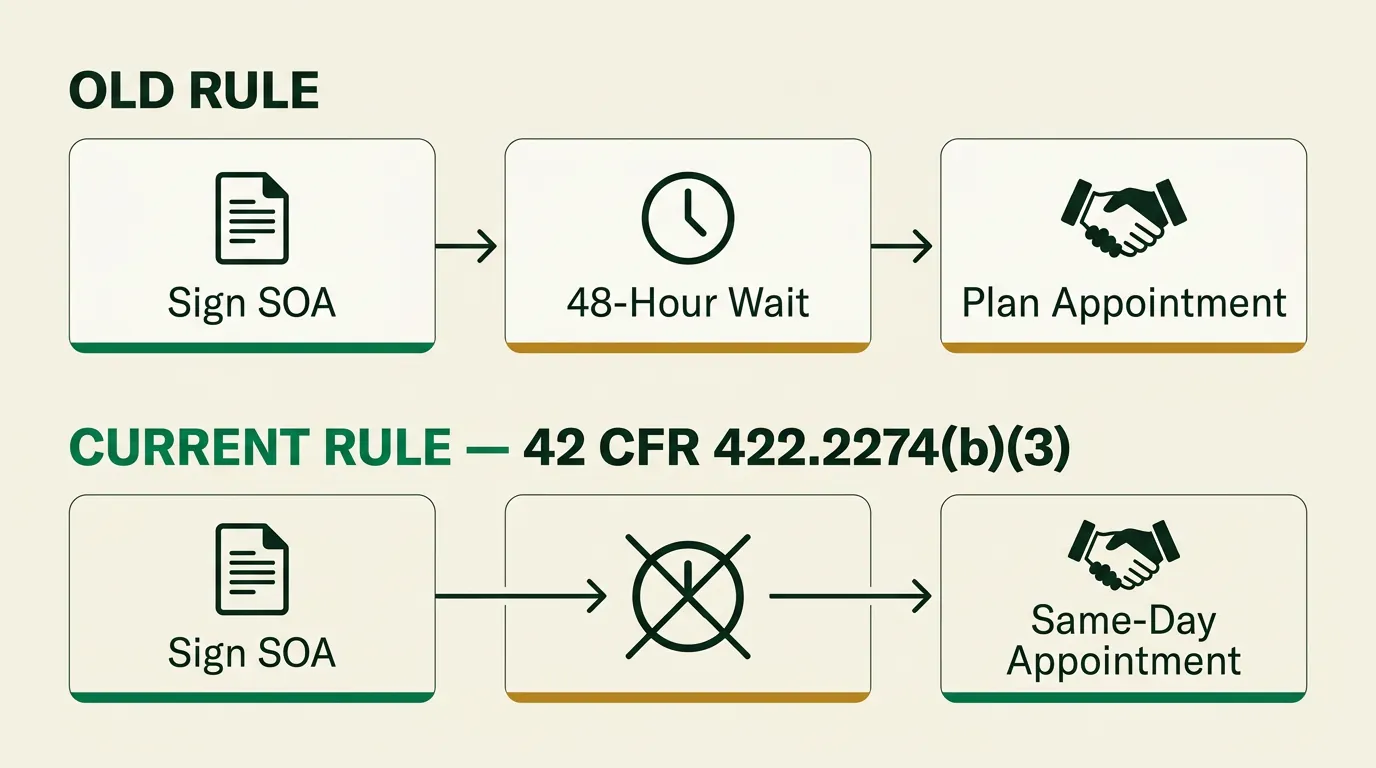
The 48-hour Scope of Appointment wait is gone. Current 42 CFR 422.2274(b)(3) now requires only that the SOA be secured and documented prior to a personal marketing appointment, not a fixed two days ahead of it. Alongside it, the TPMO disclaimer rule moved from a clock to a sequence, and the minimum call-recording retention period dropped from 10 years to 6. All three changes are already reflected in the current regulatory text, and agents will be working under them for the first time this Annual Enrollment Period, which still opens October 15 and runs through December 7, 2026, under the unchanged election-period rule at 42 CFR 422.62(a)(2).
If you sell Medicare Advantage or Part D and you built your entire callback cadence around a mandatory two-day gap, that habit is now optional, not required. What you do with the extra speed is the part CMS did not decide for you.
The short version
- The 48-hour Scope of Appointment waiting period is gone. Current 42 CFR 422.2274(b)(3) requires only that the SOA be secured and documented before the personal marketing appointment — same day is now allowed.
- The TPMO disclaimer no longer lives on a fixed early-call timer. 42 CFR 422.2267(e)(41) requires it verbally, before any benefits are discussed, wherever that falls in the call.
- Minimum call-recording retention for marketing and sales calls dropped from 10 years to 6 years under 42 CFR 422.2274(g)(2)(ii); the first 3 years must be audio, years 4 through 6 can be audio or transcript.
- AEP 2027 still runs October 15 through December 7, 2026, per 42 CFR 422.62(a)(2). The calendar did not move; how fast you're allowed to act inside it did.
- The regulatory excuse for a slow callback just disappeared. Speed to lead was always the differentiator; now there's no compliance floor forcing everyone into the same pace.
What changed in the CMS 2027 Medicare marketing rule
Three provisions moved together in the same rulemaking, and all three now show up in the current text of 42 CFR Part 422, Subpart V, the section governing Medicare Advantage communications and marketing. Here is what each one said before, in practice, and what it requires now.
| Requirement | Prior standard | Current text (42 CFR) |
|---|---|---|
| Scope of Appointment timing | A 48-hour minimum gap between signing the SOA and the personal marketing appointment | Secure and document the SOA prior to the appointment — no minimum gap. 422.2274(b)(3) |
| TPMO disclaimer timing | Widely implemented as a fixed early-call window, commonly described as the first 60 seconds | Verbally conveyed during sales calls prior to the discussion of any benefits. 422.2267(e)(41) |
| Call recording retention | 10 years, per CMS's Agent/Broker Medicare Advantage Marketing Policies FAQ | Minimum 6 years; first 3 years in audio, years 4-6 audio or transcript. 422.2274(g)(2)(ii) |
This is general information, not legal or compliance advice
Marketing rules interact with your carrier contracts, your state's insurance code, and CMS sub-regulatory guidance that changes more often than the CFR itself. Verify current requirements against the CFR sections above, your carrier's compliance department, and legal counsel before you change a script, a cadence, or a retention policy.
The rule reached the Federal Register on April 6, 2026, and CMS’s own fact sheet on the broader Contract Year 2027 final rule package describes the effective date as June 1, 2026, applicable to coverage beginning January 1, 2027. Because CMS treats October 1 as the start of marketing and communications activity for the coming contract year, this is the first Annual Enrollment Period agents and TPMOs will run entirely under the new text — and AEP 2027 opens in about eleven weeks from the publication of this post.
Why CMS moved off a fixed 48-hour clock
The Scope of Appointment exists to document, in writing, which specific products a beneficiary agreed to discuss before an agent walks in with a pitch. That protection did not change. What changed is the assumption baked into the old version: that beneficiaries needed two full days between agreeing to a conversation and having it, as if consent needed time to cool before it could be trusted.
In practice, that assumption produced a strange result. A Medicare beneficiary who called an agency directly, said “I want to talk about a plan today,” and signed an SOA on the spot still had to be told to come back in 48 hours, or the agent had to reschedule for a call two days later, purely to satisfy a clock that had nothing to do with whether the beneficiary understood what they were agreeing to. CMS’s own explanation for cutting call-recording retention from 10 years to 6, as reported by compliance trade publications reviewing the rule, followed a similar logic: a shorter, still-substantial retention window preserves the audit trail regulators actually use without CMS or plans warehousing a decade of audio nobody reviews.
The TPMO disclaimer change follows the same shape. The disclaimer itself, the standardized language telling a beneficiary how many organizations and products a TPMO represents, is unchanged in substance. What moved is when it has to be said. A hard “first 60 seconds” rule works cleanly on a script that opens with the disclaimer and then launches straight into plan talk. It works less cleanly on a real conversation where the beneficiary spends the first two minutes explaining their current coverage, a family situation, or why they’re calling at all, before either party gets anywhere near a benefit. Tying the requirement to a sequence, disclaimer before benefits, rather than a duration, matches the rule to how the calls actually go.
The SOA itself still has substance behind it, and none of that substance moved. Current 42 CFR 422.2264(c)(3)(iii)(A) still bars marketing “beyond the scope agreed upon by the beneficiary, and documented by the plan in a Scope of Appointment,” and 422.2264(c)(3)(i) still requires the SOA be in writing for in-person personal marketing appointments. What an agent can discuss on the call is still limited to whatever products the beneficiary actually agreed to hear about when they signed. Same-day timing did not loosen that boundary; it only removed the arbitrary gap between agreeing to the boundary and operating inside it.
What still requires a Scope of Appointment, and what doesn’t
Not every conversation with a beneficiary is a “personal marketing appointment” in the regulatory sense, and the SOA requirement only attaches to the ones that are. A beneficiary calling in with a service question about a plan they’re already enrolled in, asking for the date or location of an educational event, or checking on the status of an ID card is not the same thing as a beneficiary sitting down to compare plan options with an agent. CMS’s own Agent/Broker Medicare Advantage Marketing Policies FAQ draws this line explicitly when it addresses call-recording scope, distinguishing calls that pertain to sales and enrollment from calls that don’t, such as a beneficiary asking about the time and place of a sales event rather than discussing the event’s content.
That distinction matters operationally because it tells you where the SOA and the disclaimer sequencing apply, and where they don’t. A same-day SOA-to-appointment workflow only needs to trigger the moment a call turns into an actual personal marketing appointment, meaning a one-on-one conversation about specific plan options. Building a workflow that tries to force an SOA onto every inbound call, including routine service questions, adds friction the rule never asked for and slows down the calls that are not the compliance risk in the first place.
The mechanism in one sentence
CMS replaced two duration-based rules, a 48-hour wait and a 60-second disclaimer window, with sequence-based rules: get the SOA before the appointment, and give the disclaimer before benefits, in whatever order the conversation actually takes.
What this means for speed to lead during AEP 2027
Here is the part that matters more than the compliance mechanics: the 48-hour wait was never just a delay. It was a floor that every agent, fast or slow, was forced to stand on. However quickly you called a lead back, the earliest you could legally have a plan conversation was two days after the SOA. That floor is gone. The only limits left on how fast a compliant conversation can happen are your own operational speed and, for outbound calls, the ordinary calling-time restriction the FTC’s Telemarketing Sales Rule has enforced for years: no outbound telephone solicitation before 8 a.m. or after 9 p.m., local time.
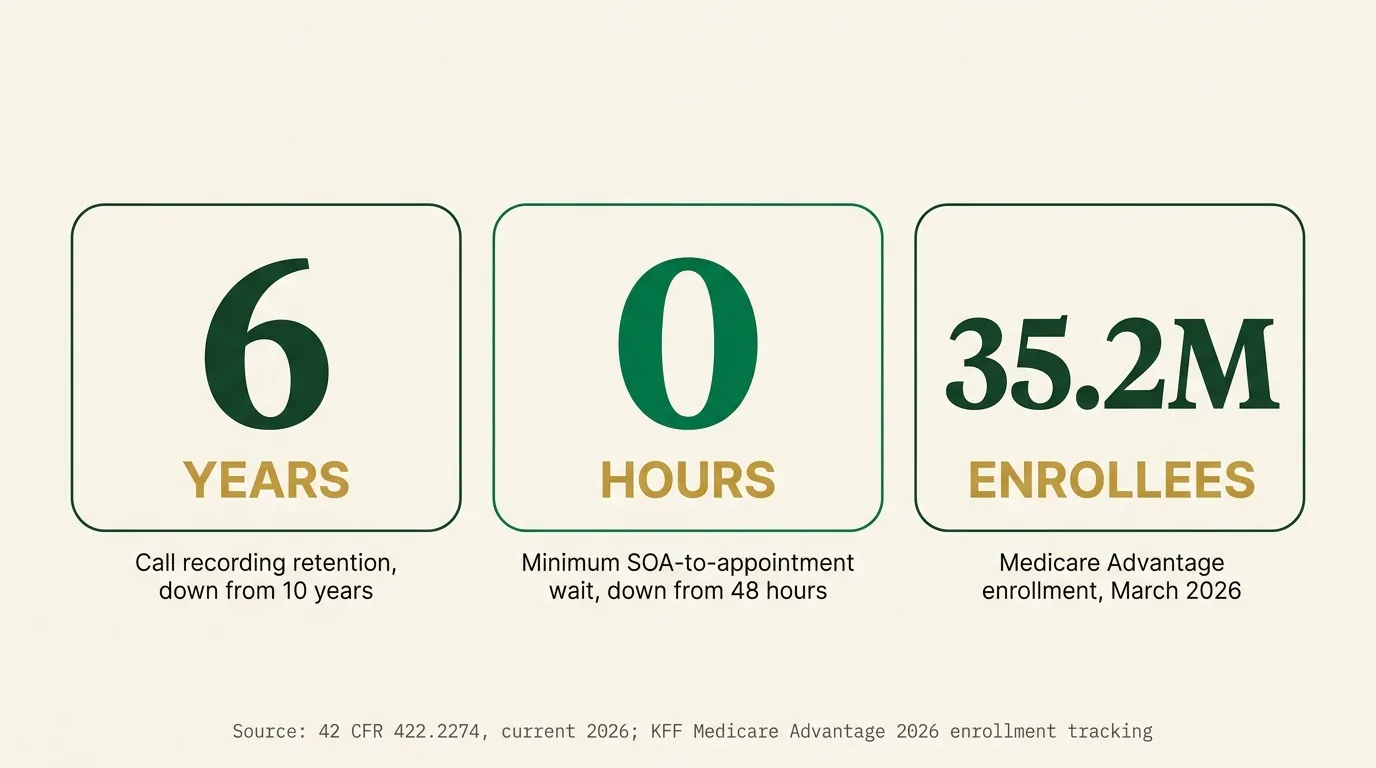
Medicare Advantage is not a small market to be moving fast in. KFF’s tracking of CMS enrollment data puts total MA enrollment at 35.2 million out of 64.2 million Medicare beneficiaries with both Part A and Part B as of March 2026, meaning more than half, 55%, of everyone eligible for Medicare is now enrolled in an MA plan. CMS’s own September 2025 projection for 2026 anticipated a smaller number, 34 million enrollees, or about 48% of the Medicare population, alongside an average monthly MA premium falling to $14.00 from $16.40 the year before. Actual enrollment came in above CMS’s own projection, which is itself worth noting: even the agency writing these rules under-forecasted how many beneficiaries would be shopping this cycle.
0
Hours the SOA must now sit before a personal marketing appointment can happen, per current 42 CFR 422.2274(b)(3)
6
Years minimum a marketing or sales call recording must be retained, down from 10, per 42 CFR 422.2274(g)(2)(ii)
35.2M
Medicare Advantage enrollees as of March 2026, 55% of eligible beneficiaries, per KFF's 2026 enrollment tracking
53
Days from October 15 to December 7, the fixed length of the 2027 Annual Election Period under 42 CFR 422.62(a)(2)
The regulatory floor on speed to lead, before and after
Earliest a personal marketing appointment could legally happen after a beneficiary signed a Scope of Appointment.
Sourced to Cornell Law School's Legal Information Institute text of 42 CFR 422.2274, current through the April 6, 2026 Federal Register amendment. This describes the regulatory floor only, not a recommendation to skip appropriate consumer protection steps in your own process.
None of that is a claim that faster equals more sales; it isn’t, and CMS’s rule change doesn’t say so either. What it does say is that the agent or agency that can move from SOA to a compliant plan conversation the same day now has a real advantage that the old rule specifically prevented anyone from having. If your team’s cadence still assumes a mandatory two-day gap, you’re voluntarily giving up ground the rule no longer requires you to give up.
What it costs to get this wrong
Two different failure modes sit on either side of this change, and both cost real money.
The first is compliance risk, and it did not get smaller just because the wait got shorter. An SOA secured after the plan discussion started, instead of before it, is still a documentation failure under 422.2274(b)(3), same-day timing or not. A disclaimer read after benefits have already come up in conversation is still a violation of 422.2267(e)(41), regardless of how many seconds had elapsed. And a recording deleted at year 5 because someone assumed the old 10-year rule still applied, or deleted at year 6 for enrollment-related records that actually needed to sit on the separate 10-year track, is a retention failure that surfaces at the worst possible time: during a CMS audit or a beneficiary complaint, when the recording that would have settled the question no longer exists.
The second failure mode is the one that predates this rule and that this rule just made more visible: a lead that sits. Our companion piece on the true cost of a missed insurance lead lays out the commission math CMS itself caps for Medicare Advantage compensation, and none of that math improves when a compliant, same-day conversation was available and nobody had it. A beneficiary who signs an SOA on a Tuesday and doesn’t hear from anyone until the following Monday isn’t protected by anything in the current rule; they’re just waiting on your operations, not the law.
Check your own script and cadence against the current text, not the old habit
Pull your SOA-to-appointment scripts and your call-recording retention policy and check them against 42 CFR 422.2274 and 422.2267 directly, not against a training deck written under the old rule. If your compliance documentation still references a 48-hour wait or a 60-second disclaimer window as a hard requirement, it's describing a rule that no longer exists in that form.
How to build a same-day, compliant workflow yourself
None of this requires new software. It requires rebuilding three habits around the current text instead of the old one, and being deliberate about the order operations happen in.
- Rewrite the SOA script to remove the scheduling language. If your current script says some version of “we’ll call you back in two days to go over plans,” change it to capture the SOA verbally or in writing, confirm it covers the specific product types the beneficiary wants to hear about, and then, where the beneficiary is ready and available, move directly into the conversation the same call. The SOA has to be fully documented first; the sequence, not the calendar, is what protects you now.
- Move the TPMO disclaimer trigger from a timer to a checkpoint. Instead of a script cue at 0:60, build the disclaimer into the transition point immediately before any plan name, premium, or benefit is mentioned, however long that takes to reach naturally in the conversation. Train agents to recognize the checkpoint, not to watch a clock.
- Update your retention policy to the correct, shorter window, and don’t touch the enrollment-records track. Six years, first three in audio, for marketing and sales calls. Ten years, unchanged, for enrollment-related records. Those are two different clocks; conflating them in either direction creates a real gap, whether that’s deleting a marketing call recording too early under the old assumption or, less likely but still worth checking, under-retaining an enrollment record because someone assumed the new 6-year number applied everywhere.
- Re-run your agent and broker training against the current text. CMS’s own Agent/Broker Medicare Advantage Marketing Policies FAQ is the reference document; if your internal training materials predate April 2026, they were written under the old standard, and agents trained on them are following instructions that no longer match the rule.
- Sort your inbound call types before you build the workflow. Route routine service and enrollee-status calls one way, and personal marketing appointments another, so the SOA and disclaimer sequencing only fires where it’s actually required, per the distinction CMS itself draws in its marketing FAQ.
- Measure your own SOA-to-conversation lag for the last 90 days, the same way you’d measure lead response time, and see how much of it was policy versus habit. Most agencies find the gap is larger than the rule now requires.
An agent who reads that list and thinks “I can rewrite three scripts, sort my call types, and fix a retention policy” is right, and plenty of shops will do exactly that with existing staff. The harder part, as with most compliance-adjacent process changes, is making sure every agent actually follows the new sequencing on every single call, not just the ones being coached that week, across a full AEP where call volume is highest exactly when shortcuts are most tempting.
Here’s a worked illustration, with hypothetical numbers you should replace with your own before drawing any conclusion. Say an agency runs 150 SOA-eligible conversations a week during AEP, and under the old habit, a third of those beneficiaries waited the better part of the mandatory 48 hours before a callback, simply because that had been the standard operating rhythm for years. If even half of that group, roughly 25 beneficiaries a week, would have been ready to talk the same day the SOA was signed, that’s 25 conversations a week happening on day zero instead of day two, for the roughly seven-and-a-half weeks of AEP. The specific numbers here are illustrative, not a sourced statistic; the point is the four inputs worth pulling from your own CRM: your weekly SOA volume, the share of beneficiaries who were actually ready to talk sooner than your old cadence allowed, your AEP length, and what a same-day conversation is worth to you compared to a two-day-delayed one.
Where an AI voice agent fits, and where a licensed agent still has to
This is the part a person can do consistently only with constant reinforcement, and a system can do the same way every time by design. An AI voice agent handling Medicare inbound or outbound calls can be configured to capture and log the SOA before any plan-specific discussion starts, deliver the exact TPMO disclaimer language at the correct point in the conversation rather than on a clock, and record and route every call into the retention schedule the current rule requires, with disposition and transcript synced to your CRM the moment the call ends.
SOA captured before the pivot
The conversation flow secures and documents the Scope of Appointment before any plan-specific discussion begins, matching 422.2274(b)(3) by design, not by habit.
Disclaimer on sequence, not a stopwatch
The required TPMO language triggers at the actual transition into benefits, whether that's 20 seconds in or four minutes in.
Recording and retention handled once, correctly
Every call is recorded and routed into the current retention schedule automatically, instead of depending on someone remembering the new number is 6, not 10.
Warm transfer to a licensed agent
Once qualified and ready, the beneficiary is transferred live to a licensed agent for the plan discussion and the sale itself.
HighLevel sync
Transcript, SOA status, and disposition land on the contact record the moment the call ends, so nothing depends on manual note-taking.
Same-day follow-up, every time
Outbound callback attempts fire the same day a lead comes in, inside the legal calling-hours window, instead of on whatever schedule someone gets to it.
If you want to hear what that actually sounds like before you decide anything, there’s a demo call on the homepage: theaffordableai.com. Put your own number in and it calls you back in seconds.
What this does not do is give insurance advice, recommend a specific plan, or complete an enrollment. That stays with a licensed agent on every call, at every hour, whether the conversation happens the same day as the SOA or two weeks later. Using AI to handle the mechanical parts of a Medicare call, the disclaimer, the recording, the routing, does not transfer licensing liability away from the agent of record for anything that follows.
The 48-hour wait is gone. The Scope of Appointment, the disclaimer, and the recording requirement are not. Speed changed; the paperwork didn't.
— The distinction this rule change actually makesThe compliance rules that still apply, same-day or not
Moving faster does not lower the bar on anything else already in force.
Non-negotiable, whether the conversation happens same-day or two weeks later
- The Scope of Appointment is still required. Only the mandatory delay before using it is gone; the SOA itself, secured and documented before the appointment, is not optional.
- Prior express consent is still required for automated or prerecorded calls and texts to a cell phone, and that consent belongs to the agent, not a vendor or lead source.
- Disclosure and opt-outs. The caller must disclose it is an AI where required, and honor any opt-out immediately, on every channel.
- Outbound calling hours are unchanged. The FTC's Telemarketing Sales Rule still bars outbound telephone solicitations before 8 a.m. or after 9 p.m., local time at the called party's location.
- The TPMO disclaimer still has to be delivered, verbally, before any benefits are discussed, and in the correct standardized language.
- Recordings still have to be retained, 6 years minimum for marketing and sales calls under the current rule, with the separate 10-year track for enrollment records untouched.
- Using AI does not transfer liability. The licensed agent of record stays responsible for anything that constitutes advice or a sale, regardless of how quickly the conversation happened after the SOA was signed.
What changes once your workflow matches the current rule
Get your scripts, disclaimer sequencing, and retention policy aligned with the current text, and the practical difference shows up in specific places rather than as a vague promise of more business. A beneficiary who signs an SOA on a Tuesday afternoon can have their plan conversation that same afternoon if they’re ready, instead of being told to wait for Thursday. The TPMO disclaimer lands correctly regardless of how the conversation actually unfolds, instead of being rushed into an artificial 60-second window or skipped when the call runs long before benefits come up. Retention sits at the correct 6-year minimum for sales and marketing calls, freeing up the confusion of tracking a 10-year clock that no longer applies to that category, while enrollment records still sit safely on their own separate 10-year schedule.
None of that is a claim about close rates, and it shouldn’t be read as one. It’s a description of what changes mechanically when your process matches the rule CMS actually wrote, instead of the rule that used to exist.
Where to start before October 15
You do not need new software to take the first three steps.
- Pull the current text of 42 CFR 422.2274 and 422.2267 and compare it, line by line, against your SOA script, your disclaimer placement, and your retention policy.
- Fix the retention policy first. It’s the one place where an old habit, over-retaining for 10 years when 6 now applies, is at least safe, while under-retaining below 6 years is not. Get the number right before AEP volume starts.
- Rebuild your SOA-to-appointment script so it captures consent correctly and then lets a ready beneficiary move straight into the conversation, rather than scheduling a callback out of habit.
- Time your own SOA-to-conversation lag for two weeks before AEP opens, and see how much of your current cadence is actual policy versus inherited habit from the old 48-hour rule.
See a compliant, same-day Medicare workflow on your own number
Put your number in on the homepage and hear how the SOA, disclaimer, and warm transfer actually sequence on a live call. No contract either way, so the cost of testing it is one month.
The math above uses Single Account pricing as of this writing, $200 a month plus a $500 one-time setup at $0.20 a minute, stepping down to $0.15 at higher volume. An Agency plan runs $500 a month plus a $1,000 one-time setup at $0.18 a minute, stepping down to $0.16, and adds routing across 20-plus agents with round-robin distribution. Both plans are month-to-month, with no long-term contract. The rule that used to force everyone onto the same 48-hour clock is gone; what you build to use the time it freed up is not something CMS decides for you.
Frequently asked
What actually changed in the CMS 2027 Medicare marketing final rule?
Three things that touch every Medicare Advantage and Part D sales call. First, the Scope of Appointment no longer has to be signed 48 hours before a personal marketing appointment; current 42 CFR 422.2274(b)(3) just requires it be secured and documented prior to the appointment. Second, the TPMO disclaimer no longer has to be delivered within a fixed early window of the call; 42 CFR 422.2267(e)(41) now requires it verbally, prior to discussing any benefits, wherever that falls in the conversation. Third, the minimum retention period for marketing and sales call recordings dropped from 10 years to 6 years under 42 CFR 422.2274(g)(2)(ii), with the first 3 years required in audio format.
Is the 48-hour Scope of Appointment waiting period really gone?
Yes, as a fixed clock. Current 42 CFR 422.2274(b)(3) requires only that the SOA be secured and documented prior to a personal marketing appointment, with no minimum number of hours in between. A beneficiary can sign the SOA and have the plan conversation in the same call or the same visit. The SOA itself is still required; only the mandatory delay between signing it and talking about a plan is gone.
Do I still have to read the TPMO disclaimer within the first 60 seconds of a call?
No, not as a fixed timer. Current 42 CFR 422.2267(e)(41) requires the disclaimer be verbally conveyed during sales calls prior to the discussion of any benefits, rather than tied to a specific number of seconds into the call. Trade compliance publications describe the earlier practice as a first-60-seconds standard; the operative requirement now is sequencing, not a stopwatch. Deliver it, verbatim, before you say anything about what a plan covers or costs.
How long do I have to keep Medicare marketing and sales call recordings now?
A minimum of 6 years under 42 CFR 422.2274(g)(2)(ii), down from the 10-year standard CMS had applied to TPMO sales and marketing calls, as described in CMS's own Agent/Broker Medicare Advantage Marketing Policies FAQ. The first 3 years of that 6-year window must be kept in audio format; years 4 through 6 may be audio or a complete, accurate transcript. Enrollment-related records still sit on a separate 10-year retention track, so do not apply the shorter window to those.
When does the 2027 Annual Enrollment Period start, and did that change?
No. The Annual Election Period is fixed by regulation at 42 CFR 422.62(a)(2): October 15 through December 7 every year since 2011, and that has not moved. What changed is what agents are allowed to do in the days leading up to it and during it, not the calendar itself.
Does removing the 48-hour wait mean I can skip the Scope of Appointment altogether?
No. The SOA requirement itself did not go away. Every personal marketing appointment, whenever and however it starts, still needs a secured and documented Scope of Appointment covering the products to be discussed. What changed is only the timing: it can now be captured the same day, even minutes before the conversation, instead of a mandatory 48 hours in advance.
Does using an AI voice agent for Medicare calls still satisfy these rules?
The mechanics can be built to. The technology can be configured to capture and log an SOA before any plan-specific discussion begins, deliver the TPMO disclaimer verbally before benefits are discussed, and record and retain the call for the required period with disposition data synced to a CRM. None of that removes the requirement for a licensed agent to handle plan recommendations, application review, and the actual sale, and using AI for the mechanical parts of the call does not transfer that liability away from the agent of record.
What is the practical effect of these changes on speed to lead during AEP 2027?
It raises the ceiling on how fast a compliant conversation can happen, and removes the regulatory excuse for not using that speed. When a 48-hour wait was mandatory, a slow follow-up looked almost the same as a fast one from a pure compliance standpoint, because nobody could have that conversation any sooner than two days out regardless. With that floor gone, the agent or agency who can capture an SOA and get to the plan conversation the same day has a real, current-rule advantage over one still following the old cadence out of habit.
Sources
- Cornell Law School Legal Information Institute — 42 CFR 422.2274, Agent, broker, and other third-party requirements (current through 91 FR 17583, Apr. 6, 2026)
- Cornell Law School Legal Information Institute — 42 CFR 422.2267, Required materials and content (current through 91 FR 17583, Apr. 6, 2026)
- Cornell Law School Legal Information Institute — 42 CFR 422.62, Election periods
- Cornell Law School Legal Information Institute — 42 CFR 422.2264, Communication and marketing requirements
- CMS — Agent/Broker Medicare Advantage Marketing Policies FAQ, October 19, 2022
- KFF — Medicare Advantage in 2026: Enrollment Update and Key Trends (published June 5, 2026; updated July 1, 2026 with March 2026 data)
- CMS — Press release, Medicare Advantage and Medicare Prescription Drug Programs Expected to Remain Stable in 2026, September 26, 2025
- FTC — Complying with the Telemarketing Sales Rule
- TheAffordableAI — Pricing
Put this on your own phone line
See the AI dial, qualify, and warm-transfer a live call in under a minute. No contract, no dev work.
Keep reading

Speed to Lead in 2026: Why the First 60 Seconds Decides Who Writes the Policy
The lead you paid for is not lost to a better agent. It is lost to a faster one. Here is what response time actually does to contact and conversion rates, and how to get to sixty seconds without hiring a dialer team.

After-Hours Insurance Leads: The 128-Hour Gap
An agency staffed 9 to 5 on weekdays is unstaffed 128 hours a week. Here is what that costs in after-hours insurance leads, and how to close the gap in 2026.

The True Cost of a Missed Insurance Lead in 2026
A missed insurance lead is not a mystery cost. It is a paid-for lead, a forgone commission CMS puts a real number on, and a seat nobody was watching.