After-Hours Insurance Leads: The 128-Hour Gap
An agency staffed 9 to 5 on weekdays is unstaffed 128 hours a week. Here is what that costs in after-hours insurance leads, and how to close the gap in 2026.

A lead fills out a quote form for a Medicare Advantage plan at 9:14 on a Thursday night. Nobody answers, because the office closed at five. She tries again Saturday at 11 a.m., between errands. Voicemail again. By Monday morning, when your team finally calls her back, she has already talked to two other agents and picked one. You paid for that lead. You just never got the chance to answer it.
That is the after-hours gap, and it is not a small sliver of your business. It is most of the week.
The short version
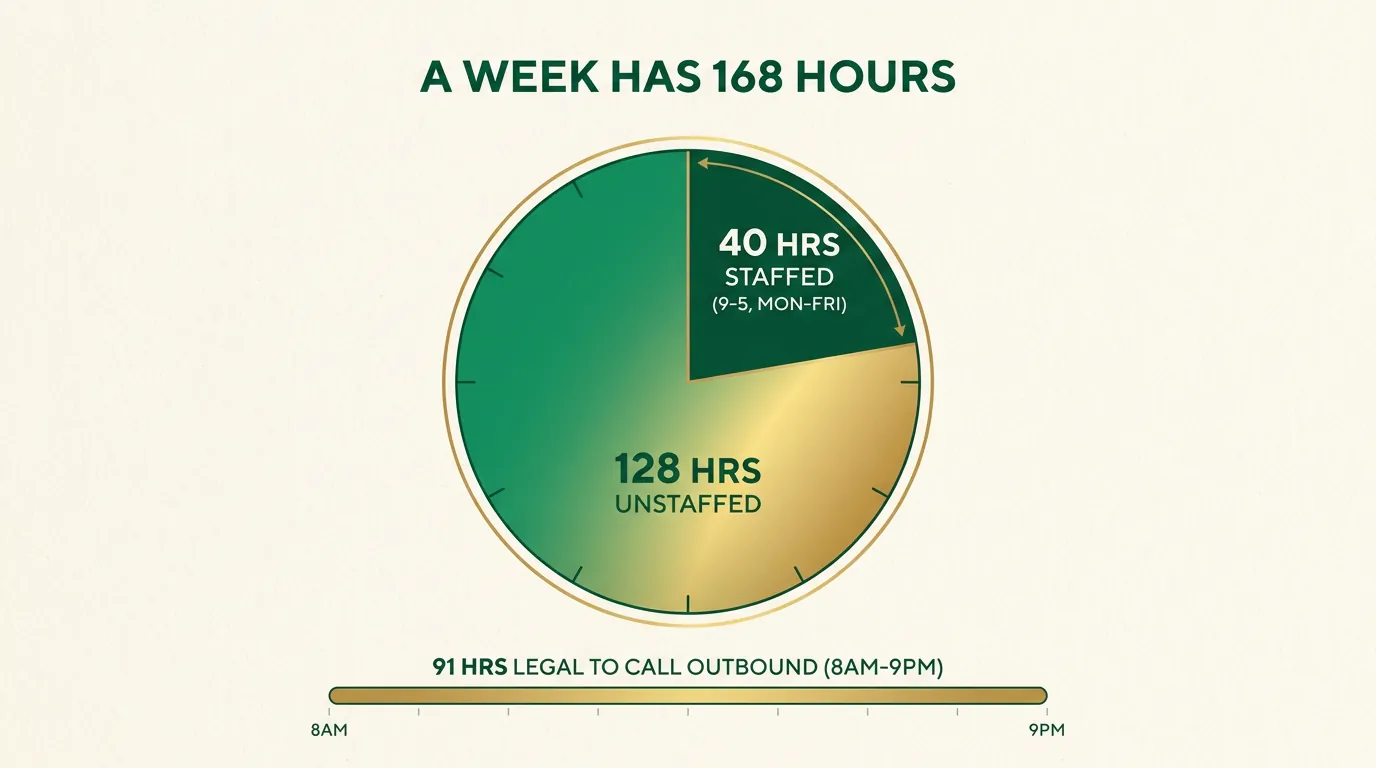
- A week has 168 hours. An agency staffed 9 to 5, Monday through Friday, is staffed for 40 of them — leaving 128 hours a week uncovered.
- Federal rules restrict when you can place an outbound telemarketing call (8 a.m. to 9 p.m. local time), but they do not restrict when a lead can call you, or when you can answer.
- BLS data shows most working adults are on the job during the exact weekday hours most agencies are open, which pushes their own free time — and their calls — into evenings and weekends.
- You can close a meaningful part of this gap yourself with call forwarding, a shared on-call phone, and a disciplined callback window. An AI voice agent closes the rest of it without a night-shift hire.
What “after hours” actually means, and why the definition matters
“After hours” sounds like a small edge case. It is really just the label for every hour your phone is not staffed. Before you can fix that, it helps to define three terms precisely, because two different federal rules govern this territory and they do not say what most agents assume they say.
Telephone Solicitation (TSR). The Federal Trade Commission’s Telemarketing Sales Rule governs commercial telemarketing calls, including a specific restriction on timing. Per the FTC’s own compliance guide, telemarketers “may not call consumers before 8 a.m. or after 9 p.m.” in the consumer’s time zone — codified at 16 CFR 310.4(c).
TCPA calling-hours rule (FCC). The Telephone Consumer Protection Act, administered by the FCC, imposes an equivalent restriction at 47 CFR 64.1200(c)(1): no person or entity may initiate a telephone solicitation to a residential subscriber “before the hour of 8 a.m. or after 9 p.m. (local time at the called party’s location).”
The word that both rules share, and that most agents skip past: outbound. Both restrictions apply to calls a telemarketer places — an outbound telephone solicitation initiated by the seller. Neither rule says anything about a consumer calling a business, or about that business answering the phone when they do. That distinction is the entire mechanism behind after-hours coverage: your outbound dialing has a legal window; your inbound answering does not.
| Rule | Citation | Restricts | Does not restrict |
|---|---|---|---|
| FTC Telemarketing Sales Rule | 16 CFR 310.4(c) | Outbound telemarketing calls before 8 a.m. or after 9 p.m., consumer's local time | Inbound calls the consumer initiates, at any hour |
| FCC TCPA calling-hours rule | 47 CFR 64.1200(c)(1) | Outbound telephone solicitations to residential lines before 8 a.m. or after 9 p.m., called party's local time | A business answering an inbound call, at any hour |
Put plainly: the law tells you when you are allowed to call someone back. It says nothing about when you are allowed to pick up when they call you. That gap between “legal to dial” and “someone is actually there to answer” is where after-hours leads go to die.
This is general information, not legal advice
Calling-hours rules interact with state mini-TCPA statutes, consent records, and your own carrier agreements. Verify current requirements against the FTC and FCC sources above and your compliance counsel before changing your calling practices.
The math nobody runs: 168 hours, 40 staffed, 128 open
Here is the arithmetic, and it does not require a single external citation because it is just the calendar.
A week has 168 hours (24 × 7). An agency open 9 a.m. to 5 p.m., Monday through Friday, is staffed for 8 hours a day, 5 days a week — 40 hours. Subtract that from 168 and you get 128 hours a week where the front desk is unstaffed. That is 76% of the week.
Now layer in the legal outbound-calling window from the section above: 8 a.m. to 9 p.m., every day, is 13 hours a day, or 91 hours a week, during which you are legally allowed to place an outbound call. Compare that to the 40 hours a typical office actually staffs an outbound dialer, and there are 51 hours a week where calling a lead back is completely legal and nobody is doing it — before you even get to the 77 hours a week (168 minus 91) where outbound calling isn’t legal at all but a prospect could still be calling in.
Where the 168 hours in a week actually go
A standard 9-to-5, Monday-through-Friday office, measured against the legal outbound-calling window and the full week.
Hours are calendar arithmetic (24 × 7 = 168; 13 legal outbound hours × 7 days = 91), not a third-party statistic. Your own office hours will differ — the shape of the gap will not.
128
Hours a week a 9-to-5 office is unstaffed, out of 168 total
51
Hours a week outbound calling is legal but a typical office isn't dialing
91
Hours a week outbound calls are legally permitted (8am-9pm, every day)
40
Hours a week a typical 9-to-5, Mon-Fri office is staffed
This is not a marketing exaggeration. It is what happens when you subtract one calendar from another. Every agency’s exact numbers will move depending on their real hours — an agency open until 7 p.m. or working a half-day Saturday closes some of the gap — but the shape of the problem is universal: the legally permitted window for reaching people is bigger than almost anyone’s staffing, and the window for a prospect to reach you is bigger still.
Why the gap lands exactly where your leads are free to call
Here is the part that makes this worse than a simple math exercise: the hours when your office is closed are disproportionately the hours when your prospects are actually available to deal with something like buying insurance.
The U.S. Bureau of Labor Statistics’ American Time Use Survey, in its 2025 annual results, found that 81% of employed people worked on an average weekday, compared with just 30% on an average weekend day. Full-time employees averaged 8.5 hours of work on the weekdays they worked, versus 5.5 hours on the weekend days they worked.
Read that against your own office hours. If your team works 9 to 5, Monday through Friday, you are open during almost exactly the hours when 81% of your prospects are themselves at work, unavailable to take a call about their Medicare Advantage plan or their ACA renewal. Their actual free time — the block where they sit down, open their email, and think about a decision like insurance — clusters into evenings and weekends, which is exactly when 30% of the working population (not 81%) is on the clock and the rest are off. Your closed hours and their open hours overlap almost perfectly.
The mechanism in one sentence
Most of your prospects have jobs that keep them busy during your business hours, and most of your business hours are set up to match a schedule that was never built around when they can actually talk.
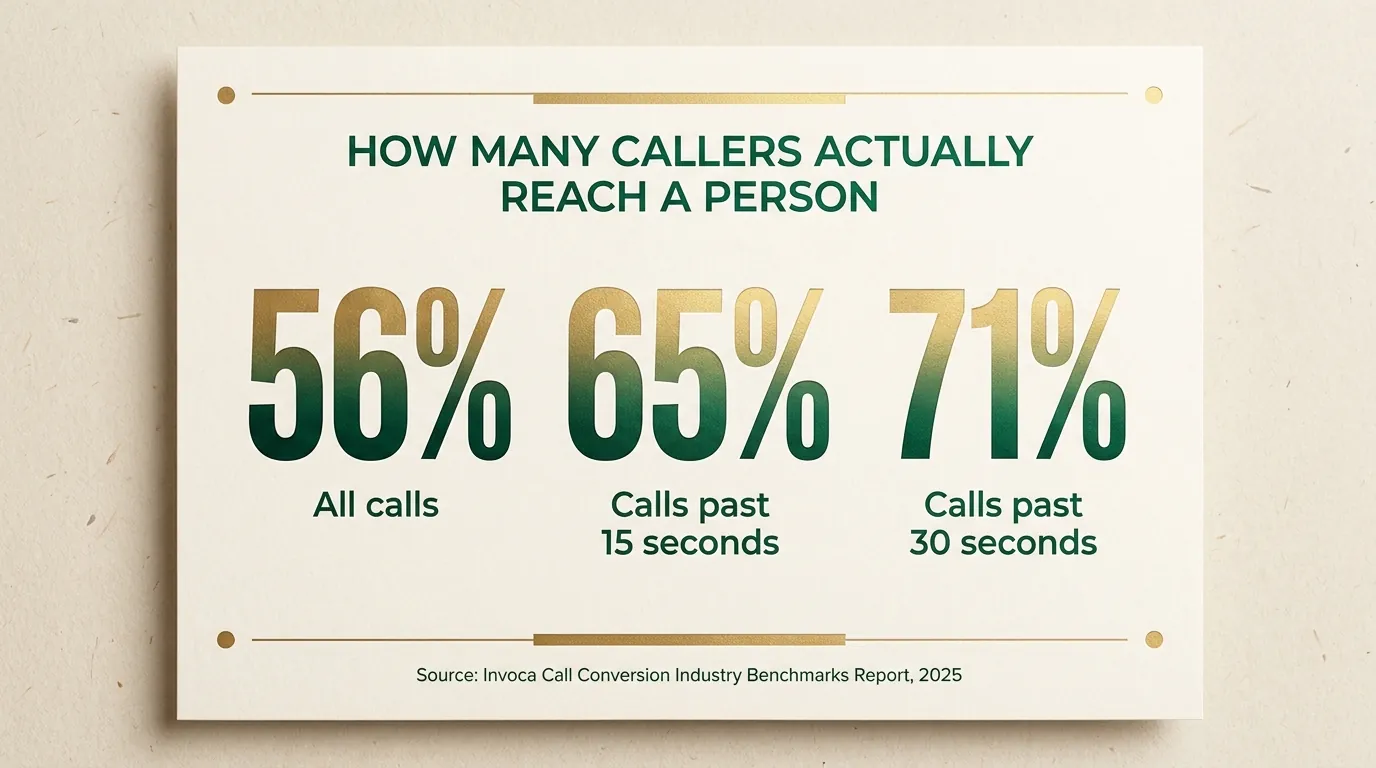
Add the answering data on top. Invoca’s Call Conversion Industry Benchmarks Report, drawing on more than 70 million calls and 600 million conversation minutes tracked across ten industries, found that 56% of callers to businesses reach a live person overall, and that the answer rate climbs to 65% for calls lasting past 15 seconds and 71% for calls past 30 seconds — meaning a call that isn’t picked up quickly is a call that is disproportionately likely to be abandoned before anyone speaks at all. Every ring that goes unanswered because it landed on a Sunday or at 8:45 p.m. is a ring that never gets the chance to cross that threshold.
What the silence actually costs
You already paid for the lead. Whether it came from a shared aggregator, a Facebook campaign, or your own organic form, the acquisition cost is sunk the moment the form posts. An unanswered after-hours call does not refund that spend — it just converts a paid asset into a name in a spreadsheet that somebody else’s agent gets to work first.
The math is not exotic. Take your average cost per lead, and your close rate on a lead you actually reach quickly, and multiply by the share of your leads landing in hours nobody is covering. If a fifth of your inbound volume is arriving nights, weekends, or lunch — a conservative slice given that 76% of the week sits outside a standard 9-to-5 — and those leads convert at a fraction of the rate of the ones you reach immediately, you are not looking at a rounding error. You are looking at a predictable, recurring leak in the same bucket you already spent marketing dollars filling.
Measure your own leak before you estimate anyone else's
Pull lead timestamps and first-contact timestamps for the last 90 days. Bucket by hour of day and day of week. Compare the close rate for leads first touched within an hour against everything else. That gap, multiplied by your own lead volume and average commission, is your real number — not an industry benchmark.
You can build a version of this yourself with a spreadsheet and a Sunday afternoon. Plenty of agency owners do exactly that once, then stop, because measuring the leak is the easy part — closing it every week, forever, is the part that requires either a person on call around the clock or a system that never needs a night off.
Here is a worked example, with hypothetical numbers you should replace with your own before drawing any conclusion. Say an agency runs 200 leads a month and a fifth of them, 40 leads, arrive outside staffed hours. Assume — purely as an illustration, not a sourced figure — that those 40 sit until the next business day and close at half the rate of a lead reached immediately. Even at a modest average commission per policy, halving the close rate on 40 leads a month is not a rounding error once you multiply it out across a year. The point of the exercise is not the specific numbers above; it is the four inputs that matter: leads per month, your own after-hours share, your own measured close-rate gap between fast and slow response, and your own average commission. Pull those four from your CRM and the real number, whatever it turns out to be, is the only one worth acting on.
How to close it yourself, no vendor required
Give this a real try before you decide whether to buy anything. None of the following requires new software you have not already got a version of.
- Forward after-hours calls to a single shared cell phone, rotated weekly among licensed staff who are willing to take an on-call shift. It is unglamorous and it works, provided someone actually answers — the failure mode is the phone going to a person who silences it at 9 p.m. and forgets to hand it off.
- Turn on voicemail transcription and route it to text, so a missed call after hours becomes a message someone can act on at 6 a.m. instead of a blinking light nobody checks until they get to the office. This does not answer the call, but it shortens the gap between “call came in” and “someone knows about it.”
- Set a hard callback rule for the first hour of business: whoever opens the office calls every after-hours voicemail and missed call before touching anything else. The lead who called Sunday and gets a call back at 8:05 Monday is in a completely different position than the one who waits until 2 p.m.
- Add a basic after-hours IVR message that sets a real expectation — “we’re open again at 9 a.m. and we’ll be the first call you get” — rather than a flat “leave a message” that gives no sense of when anyone will respond.
- Track the after-hours bucket separately in your CRM so you can see, in your own numbers, what fraction of your leads are landing there and how they convert compared to business-hours leads. You cannot fix what you have not measured.
An agent who reads that list and thinks “I could do this with a rotating on-call phone and some discipline” is right — you can. The honest tradeoff is that it depends on someone answering every single time, at 11 p.m. on a Tuesday and 10 a.m. on a Saturday, indefinitely, without ever getting tired of it. That is the part that is hard to sustain with people, not because people are bad at it, but because nobody signs up for a job that includes answering the phone at midnight forever.
Where an AI voice agent fits, and where a human still has to
This is the one part of the gap that a person genuinely cannot hold open by themselves without either burning out or costing more than the leads are worth. An AI voice agent answers every inbound call the moment it rings, at any hour, on any day, and it does not need a night-shift rotation or a stipend for holiday coverage to keep doing it.
Answers inbound, any hour
A call that lands at 2 a.m. gets picked up the same as one at 2 p.m. — there is no calling-hours restriction on answering an inbound call.
Outbound respects the legal window
Callback attempts to a new lead are scheduled inside the 8 a.m. to 9 p.m. local-time window every state requires, automatically.
Books against real availability
Multi-calendar intent routing checks who is actually on call before booking or transferring, instead of guessing.
Warm transfer when someone's ready
A qualified, willing prospect gets rung through to a live licensed agent instead of dropped into a queue.
HighLevel sync
Transcript, disposition, and tags land on the contact record the moment the call ends, weekend or weekday.
Number warmup included
Volume from round-the-clock coverage is managed so the number does not get flagged as spam from the added calls.
If you want to hear what this actually sounds like before you decide anything, there is a demo call on the homepage: theaffordableai.com. Put your own number in and it calls you back in seconds.
What an AI voice agent does not do is give insurance advice, recommend a plan, or complete the sale — that stays with a licensed human, every time, on every call, at every hour. The honest use of this technology is narrow and specific: it closes the mechanical gap between “the phone rang” and “a person is qualified and on the calendar.” It does not replace the conversation where a license is required.
See the coverage gap close on your own number
Put your number in on the homepage and the AI calls you back in seconds, any hour you try it. No contract either way, so the cost of testing it is one month.
The math above uses $0.20 a minute because that is what a Single Account costs as of this writing — $200 a month plus a $500 one-time setup, with the per-minute rate stepping down to $0.15 at higher volume. An Agency plan runs $500 a month plus a $1,000 one-time setup at $0.18 a minute, stepping down to $0.16, and adds routing across 20-plus agents with round-robin distribution. Both plans are month-to-month, with no long-term contract. Run the arithmetic with your own call volume and average handle time rather than taking either number on faith.
The compliance side of calling around the clock
Coverage that runs 24/7 does not get a pass on any of the rules that already apply during business hours. If anything, the always-on nature makes the discipline more important, not less.
Non-negotiable, whatever hour the call happens
- Prior express consent is required for automated or prerecorded calls and texts to a cell phone, and that consent belongs to the agent — it does not transfer from a vendor or a lead source.
- Disclosure. The caller must disclose that it is an AI where required, and any opt-out request has to be honored immediately, on every channel.
- Outbound calling hours still apply. Automated callback attempts to a new lead must land inside the 8 a.m. to 9 p.m. local-time window under both the FTC's TSR and the FCC's TCPA rules — around-the-clock inbound answering does not create an exception for outbound dialing.
- Medicare adds rules of its own. CMS's Medicare Communications and Marketing Guidelines require the TPMO disclaimer before plan benefits are discussed and require Third Party Marketing Organizations to record marketing and sales calls in full and retain them for ten years.
- Using AI does not transfer liability. The licensed agent of record stays responsible for anything that constitutes advice or a sale, no matter what hour the call happened or what answered it first.
- Do Not Call obligations, state mini-TCPA statutes, and your own carrier terms still apply — verify current requirements before changing your calling hours or channels.
The rules tell you when you can call someone back. They say nothing about when you're allowed to pick up.
— The distinction every after-hours coverage decision should start fromWhat you actually get once the gap is closed
Close this gap and the change shows up in a few concrete places, not as a vague promise of “more leads.” Every inbound call gets answered, including the ones that used to ring out at 9 p.m. or on a Saturday morning. Outbound callback attempts to new leads happen inside the legal window automatically, instead of depending on whoever remembers to dial first thing Monday. Whoever is on call gets a warm transfer only when a prospect is actually ready, not a stack of cold voicemails to work through. And the record of every call — consent, disclosure, transcript, disposition — lands in your CRM the moment the call ends, so the compliance trail exists whether the call happened at 10 a.m. on a Tuesday or 11 p.m. on a Sunday.
None of that is a claim about close rates or income, and it should not be treated as one. It is a description of what changes mechanically when the hours a phone can be answered stop being limited to the hours a person is willing to sit next to it.
Where to start this week
You do not need to buy anything to take the first two steps.
- Pull 90 days of lead timestamps and bucket them by hour and day. Find your own after-hours share before you estimate anyone else’s.
- Compare the close rate on leads reached within an hour against everything else, split specifically by whether the lead arrived during business hours or not.
- Try the manual fix for two weeks — a rotating on-call phone and a hard Monday-morning callback rule — and see what it actually costs in people’s time and goodwill to sustain.
- If that is not sustainable, price the automated version against what you just measured. You can build a version of this yourself with a dialer and a shared phone. It is worth pricing both before deciding which one you can actually keep running every week for a year.
The lead who called on a Sunday afternoon was never lost to a better agent. She was lost to whoever picked up first. Most weeks, that is 128 hours’ worth of opportunity to be the one who does.
Frequently asked
What counts as 'after hours' for an insurance agency?
Any time outside whenever your office is actually staffed to answer the phone or place an outbound call. For most agencies that is nights, before roughly 8 or 9 in the morning, all day Saturday and Sunday, and lunch. If your office runs a standard 9-to-5, Monday through Friday, that is 40 staffed hours out of the 168 hours in a week, which means 128 hours a week are, by definition, after hours.
Is it legal for my agency to call a lead back at 10 PM or on a Sunday?
For an outbound marketing call or text, no, unless the recipient has given specific consent to be contacted at that time. The FTC's Telemarketing Sales Rule and the FCC's TCPA rules both restrict outbound telephone solicitations to between 8 a.m. and 9 p.m. local time at the called party's location. That window applies to calls you place. It does not restrict a consumer from calling you, or you from picking up, at any hour.
Can an AI voice agent answer inbound calls at 2 AM without breaking TCPA or FTC rules?
Yes. The 8 a.m. to 9 p.m. calling-time restriction in both the FTC's Telemarketing Sales Rule (16 CFR 310.4(c)) and the FCC's TCPA rules (47 CFR 64.1200(c)(1)) governs outbound telephone solicitations initiated by the seller. Answering an inbound call the prospect placed to you is not an outbound solicitation, so there is no calling-hours violation in picking it up at any hour. Prior express consent, clear disclosure, and honoring opt-outs still apply to whatever happens on that call.
Does CMS have separate after-hours rules for Medicare leads?
CMS does not carve out special after-hours calling-time rules beyond the general TCPA and TSR restrictions on outbound calls. What CMS does require, under its Medicare Communications and Marketing Guidelines, is that Third Party Marketing Organizations record marketing and sales calls in their entirety and retain those recordings for ten years, and that the required TPMO disclaimer is delivered before plan benefits are discussed. Those obligations apply whether the call happens at 10 a.m. or 10 p.m.
How do I find out how many of my own leads are actually arriving after hours?
Pull the timestamp on every lead and every inbound call for the last 90 days from your CRM or call tracking platform and bucket them by hour of day and day of week. Most agencies have this data already and have never looked at it this way. The after-hours and weekend buckets are usually larger than owners expect, and they are the buckets with zero coverage.
What is the actual difference between an after-hours answering service and an AI voice agent?
A traditional after-hours answering service is a human working a night shift, usually reading from a script, who takes a message and passes it along the next morning. An AI voice agent answers instantly, can hold a real qualifying conversation, checks a live calendar, books an appointment or executes a warm transfer to whoever is on call, and syncs the transcript and disposition to your CRM the moment the call ends. The message-taking model still leaves the lead cold until business hours; the calendar-aware model can close the loop overnight.
Do I still need a licensed agent if a lead calls in at midnight?
Yes, for anything that constitutes insurance advice, plan recommendation, or the sale itself. An AI voice agent can answer, qualify, disclose what it is, and book the appointment or route a warm transfer to a licensed agent who is on call. Using AI to handle the mechanical part of the call does not transfer liability away from the licensed agent of record for anything that follows.
Will after-hours coverage actually increase how many leads I close, or just how many calls I answer?
It should do both, but they are separate effects worth measuring separately. Answering more calls raises your contact rate, full stop. Whether that turns into more closed business depends on what happens after the call is answered: whether the qualifying questions are right, whether the warm transfer or booked appointment actually reaches the prospect while they are still engaged, and whether the licensed agent who takes it from there follows up. Track contact rate and close rate as two different numbers, not one.
Sources
- FTC — Complying with the Telemarketing Sales Rule (calling-time restriction, 16 CFR 310.4(c))
- Cornell Law School Legal Information Institute — 16 CFR 310.4, Telemarketing Sales Rule abusive practices
- Cornell Law School Legal Information Institute — 47 CFR 64.1200, FCC TCPA rules
- U.S. Bureau of Labor Statistics — American Time Use Survey, 2025 results
- Invoca — Call Conversion Industry Benchmarks Report, 2025
- CMS — Medicare Communications and Marketing Guidelines
- CMS — Agent/Broker Medicare Advantage Marketing Policies FAQ
- TheAffordableAI — Pricing
Put this on your own phone line
See the AI dial, qualify, and warm-transfer a live call in under a minute. No contract, no dev work.
Keep reading

Speed to Lead in 2026: Why the First 60 Seconds Decides Who Writes the Policy
The lead you paid for is not lost to a better agent. It is lost to a faster one. Here is what response time actually does to contact and conversion rates, and how to get to sixty seconds without hiring a dialer team.

The True Cost of a Missed Insurance Lead in 2026
A missed insurance lead is not a mystery cost. It is a paid-for lead, a forgone commission CMS puts a real number on, and a seat nobody was watching.

Warm Transfers vs Voicemail Drops: What Actually Gets an Insurance Prospect on the Phone
Voicemail drops feel productive and cost almost nothing. Warm transfers feel expensive and interrupt your day. Only one of them reliably puts a licensed agent in front of a prospect who is ready to talk.