Surviving Medicare AEP 2026 Without a Seasonal Hire
Medicare AEP runs October 15 to December 7. Real math on staffing that window without hiring and licensing seasonal reps you don't have time for.

Medicare’s Annual Enrollment Period runs October 15 through December 7, 2026, a fixed 54-day window set by CMS, and every Medicare Advantage or Part D lead an agency is going to touch this year has to be reached inside it. That’s the whole problem in one sentence: a full year of Medicare shopping activity gets compressed into 54 days, and most independent agencies staff for an average week, not a peak one.
If you’re reading this in August, the window is still two months out, which is enough time to fix the parts of this that are fixable. If you’re reading it in late September wondering why your phones are already busier, the honest answer is that the fixable part of this problem has a lead time, and some of that lead time has already passed.
The short version
- AEP 2026 runs October 15 to December 7, a fixed 54-day window, per Medicare.gov. It doesn't move for anyone's staffing plan.
- 35.2 million of the 64.2 million people with Medicare Part A and B, 55 percent, were in a Medicare Advantage plan in 2026, up 1.1 million from 2025, per KFF's June 2026 analysis. That's the scale of the book competing for attention in one window.
- A temp hire who's going to sell or market Medicare Advantage or Part D has to be state-licensed, carrier-appointed, and pass annual training and testing at 85 percent or better under 42 CFR 422.2274. That's weeks of lead time, not days.
- Every marketing and sales call touching Medicare Advantage or Part D, AI or human, has to be recorded in full and retained a minimum of six years, the first three in audio, under 42 CFR 422.2274(g).
- A missed AEP lead doesn't roll over to next month. The window closes December 7 and the next shot at that same decision is a year away.
Why AEP breaks a normal staffing model
Every other part of the calendar, an insurance agency’s call volume is roughly a function of how many leads it’s generating that week. AEP breaks that relationship on purpose. CMS sets one enrollment window a year for people to review, switch, or keep their Medicare Advantage and Part D coverage, and it applies to the entire eligible population at once, not on a rolling basis tied to when someone happens to start shopping. Medicare.gov states the rule plainly: during the Open Enrollment Period of October 15 through December 7, a person can join, drop, or switch a Medicare Advantage plan, and any change has to reach the plan by December 7 to take effect January 1.
That single fixed date range is the mechanism. It’s not that Medicare shoppers are 55 percent more active in the fall for some seasonal-behavior reason; it’s that the entire regulatory structure of the program only gives them one chance a year to act, and that chance falls in the same 54 days for every beneficiary in the country, every year. A book of business that took twelve months to build gets almost entirely re-litigated, plan changes, renewals, competitor poaching, all of it, inside a window shorter than two months.
A few terms this article uses
AEP (Annual Enrollment Period) is the October 15–December 7 window for Medicare Advantage and Part D changes, distinct from the ACA's separate open enrollment window and from Medicare's spring Open Enrollment Period for Medicare Advantage-only switches. AHIP + FWA certification is the annual Medicare-plus-fraud-waste-and-abuse training most carriers require before an agent can sell their products; it's a carrier requirement built to satisfy the federal training rule below, not a CMS product itself. Carrier appointment is the formal authorization from an insurance carrier that lets a licensed agent legally sell that carrier's specific plans.
Multi-state books add another layer to that mechanism. An agent licensed and appointed in one state isn’t automatically cleared to work Medicare Advantage or Part D leads in a neighboring state; each state’s department of insurance has its own resident and non-resident licensing rules, and a producer picking up license reciprocity in a new state for the first time still has to complete that state’s process before touching a lead there. An agency that generates leads across several states during AEP, which is common for anyone running national digital ads, has to make sure its actual licensed footprint matches where its leads are landing, not just where its office is.
We’re deliberately not putting a call-volume multiplier in front of you here. Search around and you’ll find call center vendors citing “8 to 10 times normal volume” or “a 300 to 400 percent surge,” and those numbers get repeated constantly in AEP planning content. When you trace them back, they come from vendor blog posts describing their own operational experience, not from a published survey or a named methodology. That’s a hard no under any real sourcing standard, so we’re leaving it out rather than repeating an unverifiable number just because it’s the number everyone else uses. What’s verifiable instead is the size of the population making a decision in that window: 35.2 million people in a Medicare Advantage plan as of 2026, per KFF, all of them deciding inside the same 54 days as everyone shopping for the first time. Whatever the real multiplier turns out to be for your specific book, the mechanism producing it, one fixed window for the whole country, is not in dispute.
What it actually costs to be short-staffed in October
The direct cost of being under capacity during AEP isn’t abstract. It’s every call that rings past the point where a prospect stays on the line, every voicemail that doesn’t get a callback before the prospect calls the next name on their list, and every warm lead who reaches your after-hours message on a Saturday in November and doesn’t try again Monday. None of that is unique to AEP; it’s the same math that governs any missed call. What’s unique to AEP is that there’s no slow season on the other side of it to make up the difference. A lead lost in March can be recovered in April. A Medicare Advantage decision missed in the last week of AEP is gone until next October.
| Step | Typical lead time | Source of the requirement |
|---|---|---|
| Pre-licensing education | 20–40 hours of coursework | State insurance department pre-licensing requirements (varies by state) |
| State licensing exam and processing | Days to a few weeks, state-dependent | State department of insurance |
| Carrier appointment | Varies by carrier, typically requires an active license first | Individual carrier contracting requirements |
| Annual Medicare plan and FWA training and testing | Required annually, must score 85% or higher | 42 CFR § 422.2274, agent/broker training and testing |
| Call recording and retention infrastructure in place | Must be ready before the first marketing call | 42 CFR § 422.2274(g), 6-year minimum retention |
Pre-licensing hour ranges and exam turnaround vary by state; figures shown are typical ranges, not a guarantee for any specific state. Federal training, testing, and retention requirements per 42 CFR 422.2274, fetched August 2026.
None of those five rows is optional if the new seat is going to touch Medicare Advantage or Part D sales or marketing. A temp staffing agency can hand you a warm body in a week. It cannot hand you a state license, a carrier appointment, and a passed certification exam in a week, because none of those are the staffing agency’s to grant. That’s the part of “just hire seasonal help” that quietly falls apart every year around the third week of September, when agencies realize the person they just hired can’t legally get on the phone with a Medicare prospect yet.
There’s a wage data point worth having for context, even though it doesn’t map cleanly onto a seasonal hire. The Bureau of Labor Statistics puts the median annual wage for insurance sales agents at $60,370 as of May 2024, roughly $29.02 an hour, across 568,800 jobs nationally, with 4 percent projected employment growth from 2024 to 2034 and about 47,000 openings projected per year over that decade. That’s a base wage figure, not a fully loaded cost, and it’s a year-round median, not a seasonal or AEP-specific rate; treat it as a directional floor for what a licensed agent’s time is worth, not a temp-staffing quote. Whatever the actual number an agency pays for AEP coverage, licensed labor at that skill level isn’t cheap, and it isn’t instantly available on short notice either.
Medicare Advantage's share of Medicare enrollment, 2007 vs. 2026
The population making an AEP decision has grown for two straight decades; it isn't a static number to plan capacity around.
Source: KFF, Medicare Advantage in 2026: Enrollment Update and Key Trends, published June 5, 2026, updated July 1, 2026. 2026 figure is 35.2 million of 64.2 million people with Medicare Parts A and B; 2007 figure is share of beneficiaries only, shown for trend context, not a directly comparable raw count.
A worked example: what 54 days of overflow actually costs
Numbers make this concrete faster than percentages do, so here’s the arithmetic, using only figures already cited above. The Bureau of Labor Statistics puts the median annual wage for an insurance sales agent at $60,370 as of May 2024. Prorate that base wage, not fully loaded, no benefits or payroll tax included, across the 54 days of AEP: $60,370 ÷ 365 × 54 ≈ $8,931. That’s roughly what 54 days of one median-wage licensed producer’s time is worth, on paper, before you’ve even solved the licensing and certification lead time described above.
Now compare that same $8,931 against a Single Account managed AI caller at $0.20 per minute, no bulk discount applied: $8,931 ÷ $0.20 ≈ 44,655 minutes, or about 744 hours of phone-answering capacity across the same 54-day window. That’s not an apples-to-apples trade. The AI caller can’t give licensed Medicare advice or close a sale; the human can. What the math actually shows is the shape of the problem: a licensed seat is expensive and slow to add on short notice, while call-answering capacity for the qualification, scheduling, and after-hours layer is comparatively cheap and doesn’t carry a multi-week licensing timeline. The realistic AEP plan for most agencies isn’t “replace the licensed seat,” it’s “stop losing calls to the licensing bottleneck while the licensed seats you do have spend their hours on the conversations that actually require a license.”
Run the same math against your own book. Take your realistic AEP call volume, average minutes per call, and multiply by $0.20 (or $0.18 on Agency), then compare that to what an additional licensed hire, plus the weeks of lead time in the table above, would actually cost you to stand up before October 15. The two numbers usually aren’t solving the same problem, which is exactly why most agencies end up using both: licensed staff for the calls that need a license, and answering capacity for everything ahead of that conversation.
How to actually prepare for it, no part held back
This is the method in full. None of it requires software; it requires starting early enough that the lead times in the table above don’t run past October 15.
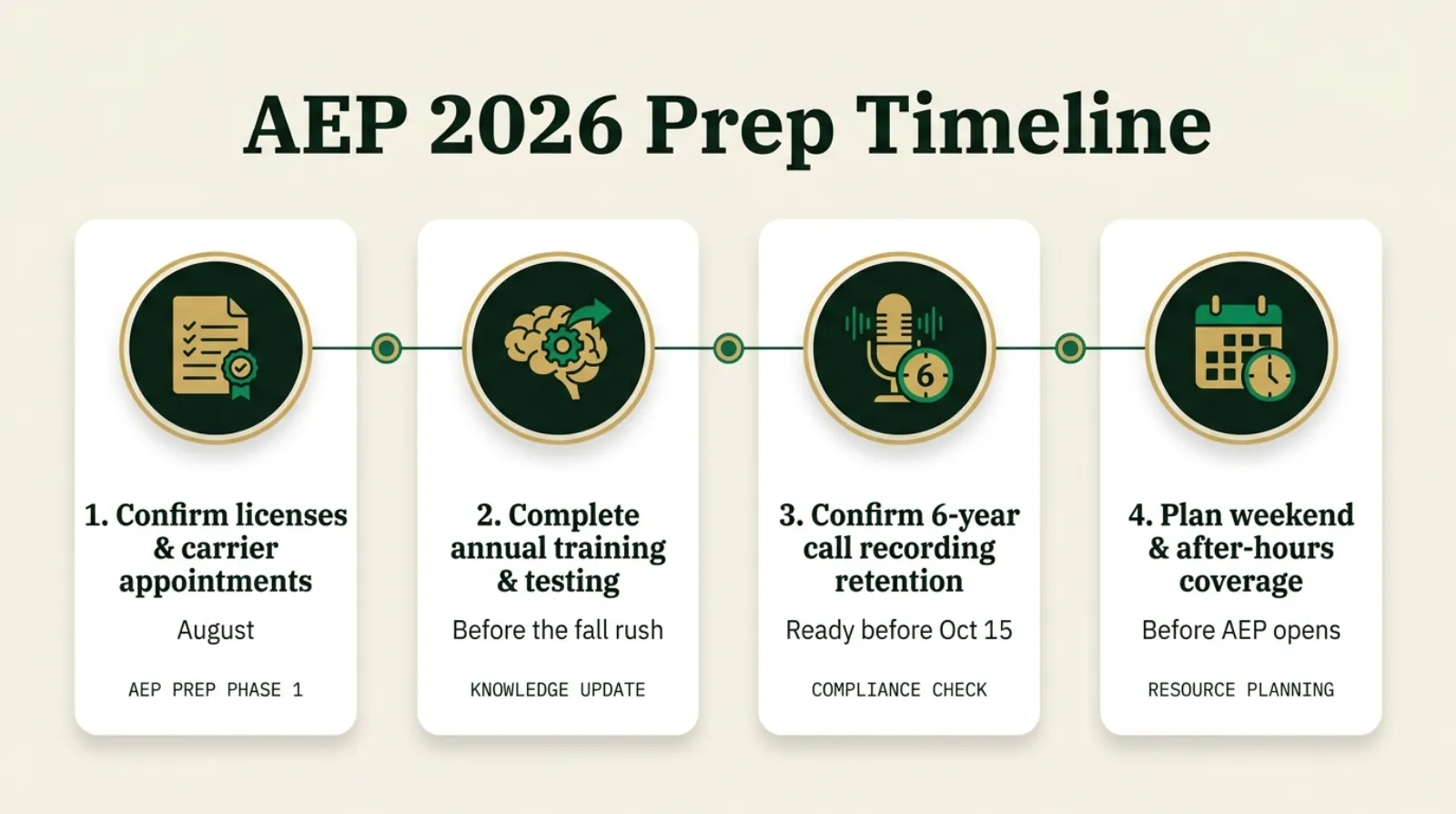
1. Audit who on your team is actually eligible to work AEP calls. Pull every producer’s license status and carrier appointments now, not in September. A lapsed appointment or an incomplete annual certification is the single most common reason a seat that looks staffed on paper can’t actually take a Medicare Advantage call in October.
2. Get the annual training and testing done early. Carriers typically open the new plan year’s certification and appointment renewal process well before October 15. Waiting until the last few weeks means competing with every other agent in the country trying to finish the same testing at the same time, and 42 CFR 422.2274 requires an 85 percent or higher score, which is not the kind of thing you want to rush.
3. Confirm your call recording and retention setup can actually hold six years of audio. This has to be working before the first marketing call of the season, not retrofitted after a compliance question comes up in November. If you’re not sure your current CRM or dialer configuration meets the 6-year, 3-years-in-audio requirement under 42 CFR 422.2274(g), that’s worth confirming with whoever runs your call infrastructure before October, not during it.
4. Model your realistic call volume against your realistic seat count. Look at how many active and prospective Medicare Advantage or Part D contacts are in your pipeline right now, and be honest about how many of them are going to call, text, or need an outbound call in a 54-day window. Compare that to how many licensed, appointed, certified people you actually have available to answer, including realistic hours, not theoretical full-time availability.
5. Plan for after-hours and weekend coverage specifically. AEP doesn’t observe business hours any more than it observes a normal calendar. A beneficiary comparing plans on a Saturday afternoon or a Tuesday evening after work is a normal AEP lead, not an edge case, and a gap in weekend or evening coverage during this specific window costs more than the same gap costs in April.
6. Decide now, not in October, how overflow gets handled. Whether that’s temp staff you started licensing in July, a call center partner, or a managed AI caller carrying the qualification and scheduling layer, the decision needs lead time baked in. The worst version of this plan is the one built the week volume actually spikes.
What most agencies walk into AEP with
- The same headcount that handles a normal March or June
- Certifications and appointments finished right up against the deadline
- No specific plan for weekend or after-hours volume
- An overflow plan decided reactively once the phones are already full
ReactiveCapacity decisions made after the surge is already visible
What a prepared agency does instead
- Licensing and carrier appointments confirmed in August, not September
- Annual training and testing completed early, ahead of the certification rush
- Weekend and evening coverage planned as a specific line item, not an afterthought
- Overflow capacity, whatever form it takes, decided and built before October 15
PlannedCapacity decisions made with the lead time they actually require
Where an AI caller fits in this, and where it doesn’t
TheAffordableAI is a managed AI caller, and the honest place it fits into an AEP plan is the volume and coverage layer, not the licensed-advice layer. It can answer inbound calls and place outbound calls around the clock, including the weekend and evening hours that AEP doesn’t skip, qualify who’s calling and why, and hand a real conversation to a licensed person through a warm transfer that checks availability before the handoff happens. Every call syncs to HighLevel automatically, so a lead who calls in at 9pm on a Sunday during AEP doesn’t sit unlogged until Monday morning. Calls run at $0.20 per minute on a Single Account or $0.18 per minute on Agency, both with lower bulk rates available, and there’s no contract locking an agency into that capacity past the season it’s actually needed for.
What it doesn’t do is replace the licensing, the carrier appointment, or the annual certification a human being still needs to give plan-specific advice or close a Medicare Advantage sale. Those obligations, and the compliance responsibility that comes with them, stay with the licensed agent regardless of what technology answered the phone first. If a call reaches a point where it needs a licensed voice, that’s exactly what the warm transfer is built to do, hand it to one, not simulate one.
Coverage that doesn't stop at 5pm or on weekends
AEP calls don't wait for business hours; the answering capacity shouldn't either.
Warm transfers to your licensed people
The AI qualifies and routes; a licensed, appointed producer handles the actual plan conversation.
Capacity you can turn on for one season
No contract means you can scale for the 54-day window without committing past it.
Native HighLevel sync
Every call and disposition lands in the CRM automatically, so an AEP lead doesn't get lost in the volume.
If you want to hear what one of these calls actually sounds like before deciding anything, there’s a demo call on the homepage. https://theaffordableai.com/ And since the math changes with call volume and season length, it’s worth running your own numbers against the current per-minute rates on the pricing page rather than taking anyone’s word for what a season like this costs. Full plan detail is on the features page.
The compliance line that doesn’t move for AEP
Medicare marketing carries its own rules on top of general telemarketing law, and AEP doesn’t relax any of them; if anything, it’s the season regulators pay closest attention to. Every marketing and sales call has to be recorded in its entirety and retained a minimum of six years, the first three in audio format, under 42 CFR 422.2274(g). Agents and brokers have to pass annual training and testing on Medicare rules and the specific plans they’re selling, at 85 percent or higher, before they can be appointed to sell for that plan year. Prior express consent, clear disclosure, and a working opt-out still apply to every call and text, automated or not, and the caller has to honor an opt-out immediately rather than working through the rest of a planned sequence first. None of that shifts because the caller is AI instead of human, and using an AI caller does not transfer liability away from the licensed agent responsible for the call.
The volume itself doesn’t create new legal exposure by itself, but it multiplies the consequence of any gap in the process. A consent or disclosure mistake that would touch a few dozen calls in a normal month touches a much larger number of calls when the whole season’s activity is compressed into 54 days. That’s a reason to have the consent, disclosure, and retention pieces solid before AEP starts, not a reason to slow the calling down once it’s underway.
This isn't a substitute for your own compliance review
This article describes the general federal training, testing, and recording requirements under 42 CFR 422.2274 as a planning reference. It isn't legal advice, and it doesn't cover every carrier-specific or state-specific rule that may apply to your book. Confirm your specific obligations with your compliance officer or counsel before AEP begins.
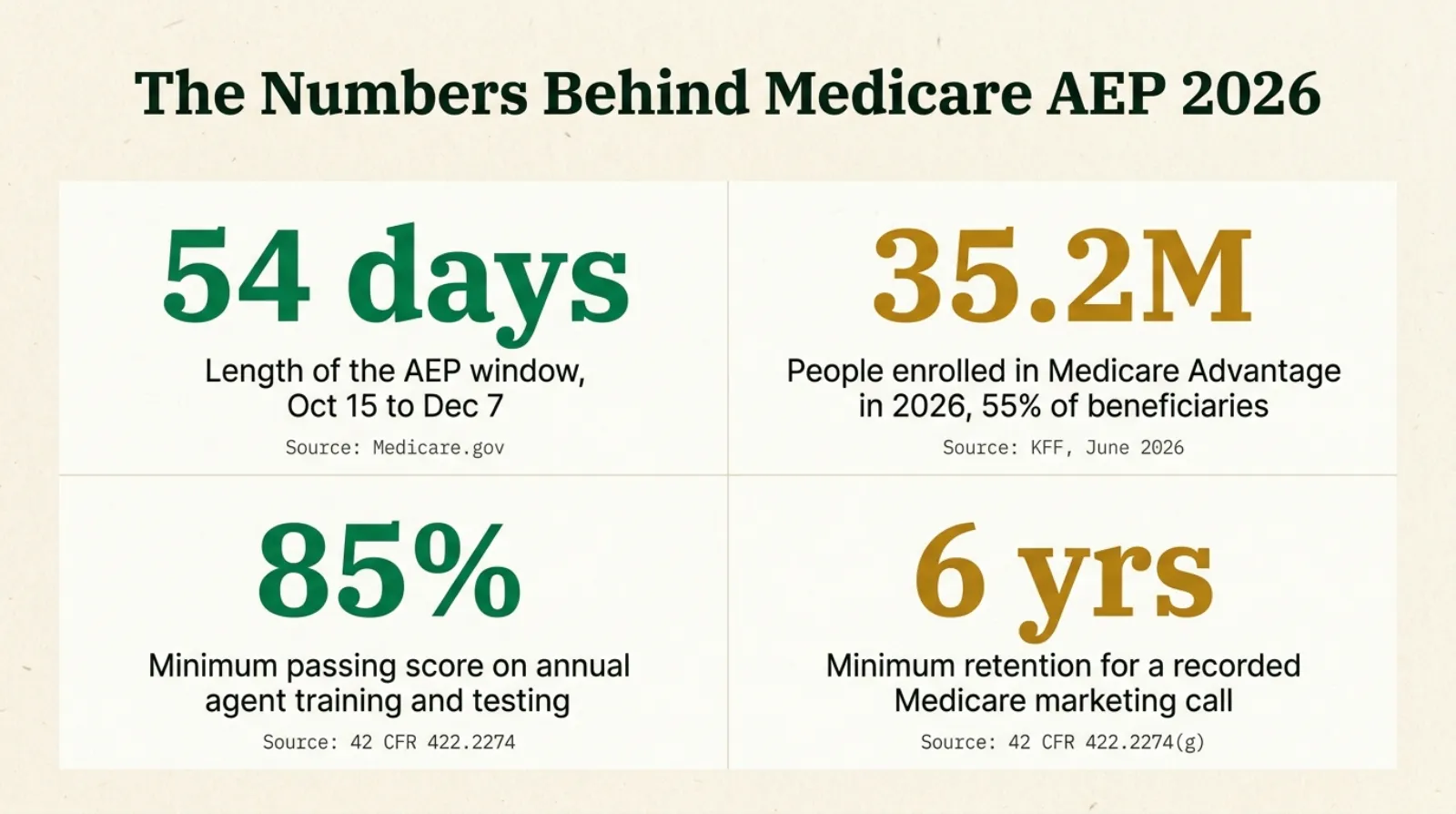
54 days
Length of the fixed AEP window, October 15–December 7
Source: Medicare.gov, 2026
35.2M
People enrolled in Medicare Advantage in 2026, 55% of eligible beneficiaries
Source: KFF, June 2026
85%
Minimum passing score required on annual agent/broker training and testing
Source: 42 CFR § 422.2274
6 yrs
Minimum retention for a recorded Medicare marketing call
Source: 42 CFR § 422.2274(g)
Where this isn’t the right fix
Not every AEP capacity problem is a phone-coverage problem, and it’s worth saying where the approach in this article doesn’t help. If the actual bottleneck is licensing, not call volume, no caller, human or AI, fixes that; you need licensed producers, and that has the lead time described above, full stop. If your AEP lead flow is thin to begin with, more answering capacity on a small number of calls won’t move revenue much; the fix there is lead generation, not call coverage. And if your team is already comfortably staffed for the volume you actually expect, adding a calling layer on top of that is spending money to solve a problem you don’t have. Diagnose which constraint is actually binding before building around it.
AEP doesn't add more hours to the day. It adds more calls to the same 54 days everyone else has too.
— The constraint this whole article is aboutThe audit to run before October 15
Walk through this in order, and do it in August or early September while there’s still runway: is every producer who might touch a Medicare call currently licensed, appointed, and certified for this plan year; has the annual training and testing under 42 CFR 422.2274 actually been completed, not just scheduled; is your call recording and six-year retention setup confirmed working before the first marketing call goes out; does your after-hours and weekend coverage plan exist as a specific decision rather than a gap nobody’s addressed; and if volume outpaces your licensed headcount, what’s the overflow plan, and is it built now or is it going to get built in a panic in November. Most agencies that run through this list in August find at least one row that’s further behind than they assumed. Better to find that in August than during the second week of AEP.
Run your own AEP capacity check this week
Count your licensed, appointed, certified seats against your realistic AEP call volume, including evenings and weekends. If the gap is a coverage gap rather than a licensing gap, there's a demo call on the homepage that shows how the phone-coverage piece actually works.
Frequently asked
When is the Medicare Annual Enrollment Period in 2026?
October 15 through December 7, 2026, per Medicare.gov. Any plan change made in that window takes effect January 1, 2027. It's a fixed 54-day calendar window, the same dates every year, and it does not move for any individual agency's staffing readiness.
How much does Medicare Advantage call volume actually increase during AEP?
We're not going to hand you a precise multiplier here, because the widely circulated figures (call centers claiming 8 to 10 times normal volume, or a flat 300 to 400 percent surge) trace back to vendor blog posts that describe their own operational experience rather than a published, methodologically sourced industry figure. What is verifiable: 35.2 million of the 64.2 million people with Medicare Part A and B, 55 percent, were enrolled in a Medicare Advantage plan in 2026, per KFF's June 2026 enrollment analysis, up 1.1 million from 2025. Every one of those 35.2 million, plus everyone eligible and shopping for the first time, has exactly one 54-day window a year to act. That's a demand curve concentrated into a fixed window regardless of the exact multiplier, and it's why AEP call volume feels disproportionate to the rest of the year even without a single sourced percentage attached to it.
Can I just hire temporary staff for AEP?
You can, but the lead time is longer than most agencies plan for. A temp hire who's going to sell or market Medicare Advantage or Part D plans has to be licensed in your state, appointed with the carriers you represent, and has to pass each carrier's required annual training and testing under 42 CFR 422.2274, which requires an 85 percent or higher score on all forms of testing. Pre-licensing education alone commonly runs 20 to 40 hours before the state exam. None of that happens the week before October 15 if you start looking for seasonal help in September.
Does using an AI caller for AEP calls change the compliance requirements?
No. Every marketing and sales call touching Medicare Advantage or Part D, human or AI, has to be recorded in its entirety and retained for a minimum of six years, with the first three years specifically in audio format, under 42 CFR 422.2274(g). The AI does not replace a licensed agent's compliance obligations or absorb liability; the licensed agent stays responsible for what's said and how the lead was contacted, regardless of what technology placed the call.
What does a Medicare Advantage plan's own staffing look like during AEP, and does that affect my agency?
It affects you indirectly. When carrier and national call center lines get overwhelmed during the surge, more of the burden of a fast, informed first response shifts to the independent agent, because a beneficiary who can't get through to a 1-800 number or a national call center will call the agent whose name and number they already have. An agency that can't answer that call promptly during AEP is competing against the same crunch on both ends: understaffed on their own side, and unable to lean on an overwhelmed carrier line to pick up the slack.
What happens if I miss a lead during AEP?
The window closes December 7 and doesn't reopen for that plan year. A lead who can't reach you during AEP either picks another agent who did answer, defaults into their current plan by inaction, or gets auto-enrolled into whatever their carrier assigns, none of which puts a commission in your book. Unlike a lead lost in March, there's no quiet stretch of the calendar to catch up on it; the next Medicare Advantage or Part D enrollment opportunity for most of that book is a full year away.
Is it too late to prepare for AEP 2026 if I'm reading this in August?
No, August is close to on schedule. Carriers typically open their annual certification and appointment renewal windows for agents over the summer, well ahead of October 15, and pre-licensing plus state exam turnaround for anyone not already licensed commonly takes several weeks. Starting in August still leaves runway to get licensing, carrier appointments, and call capacity in place. Starting in late September does not.
Should I outsource AEP calls to an offshore or nearshore call center instead?
That's a real option some agencies use, and it's worth pricing against any alternative, including a managed AI caller. The tradeoffs are different: a human call center, onshore or nearshore, still needs licensed and carrier-certified staff for anything that touches plan-specific advice, while an AI caller handles the volume, qualification, and warm-transfer layer and still routes the licensed conversation to a person. Which one fits depends on how much of your AEP call volume is pure qualification and scheduling versus calls that need a licensed voice from the first sentence.
Sources
- Medicare.gov — Joining a plan: Open Enrollment Period dates and rules (Centers for Medicare & Medicaid Services)
- KFF — Medicare Advantage in 2026: Enrollment Update and Key Trends (published June 5, 2026, updated July 1, 2026)
- U.S. Bureau of Labor Statistics — Occupational Outlook Handbook, Insurance Sales Agents (2024 data, 2024-2034 projections)
- Cornell Law School Legal Information Institute — 42 CFR § 422.2274, Medicare Advantage marketing, call recording, and agent/broker training and testing
- TheAffordableAI — Pricing (fetched August 2026)
Put this on your own phone line
See the AI dial, qualify, and warm-transfer a live call in under a minute. No contract, no dev work.
Keep reading

CMS 2027 Medicare Rules: The 48-Hour Wait Is Gone
CMS eliminated the 48-hour Scope of Appointment wait, changed the TPMO disclaimer timing, and cut call retention to 6 years ahead of AEP 2027.

Insurance Agency Staffing Shortage 2026: The Real Numbers
Insurance agencies can't hire fast enough in 2026. Real BLS, SHRM, and NFIB data on hiring delays, and how to cover lead follow-up while a seat sits open.

Cost Per Call: Live Agent vs AI Voice Agent in 2026
AI voice agents run about $0.07 to $0.50 a minute in 2026, versus $0.75 to $1.40 for a US live agent. Here is the real cost-per-call math, by volume.