Insurance Agency Staffing Shortage 2026: The Real Numbers
Insurance agencies can't hire fast enough in 2026. Real BLS, SHRM, and NFIB data on hiring delays, and how to cover lead follow-up while a seat sits open.

You post the job, you interview who applies, and the seat still sits open for weeks while leads keep coming in. That’s not a staffing failure specific to your agency. SHRM’s 2026 Recruiting Benchmarking Report, built from data across more than 4,600 organizations, puts the median time to fill a nonexecutive role at 39 calendar days industry-wide. In January 2026, NFIB found 31 percent of small business owners had a job opening they simply could not fill, well above the survey’s 24 percent historical average. For an agency that lives on speed to lead, 39 days of an empty chair isn’t an HR inconvenience. It’s five and a half weeks of leads getting whatever attention the remaining staff can spare.
This isn’t a post about how bad the labor market is in the abstract. It’s about what the actual, sourced numbers say about hiring an inside sales agent or CSR for an insurance agency right now, what an open seat really costs while it sits open, what you can do about it with zero new spending, and where a managed AI caller does and doesn’t fit into that gap.
The short version
- SHRM's 2026 Recruiting Benchmarking Report puts the median time to fill a nonexecutive role at 39 calendar days, based on data from over 4,600 organizations.
- NFIB's January 2026 jobs report found 31 percent of small business owners had at least one job opening they couldn't fill, above the survey's 24 percent historical average, even as finance-sector complaints about applicant quality fell to the lowest of any industry NFIB tracks.
- BLS counts 568,800 insurance sales agent jobs nationally in 2024, growing just 4 percent through 2034, with about 47,000 openings a year, most from replacement rather than growth.
- The insurance and finance sector's quits rate ran 0.9 percent in June 2026, well below the 2.0 percent nonfarm rate, per BLS's JOLTS report, meaning the people already in seats aren't the ones leaving fastest.
- A licensed producer's median $60,370 salary works out to roughly $232 a workday. Every day a seat sits open is a day that budgeted cost buys zero answered calls.
What “hard to hire” actually looks like in an agency right now
Ask five agency owners why a CSR seat has been open for six weeks and you’ll get five different guesses: nobody wants to work anymore, the pay isn’t competitive, the applicants are unqualified. The actual national data points somewhere more specific.
NFIB surveys a random sample of its member firms every month and asks a direct question: do you have a job opening you couldn’t fill in the current period? In January 2026, a seasonally adjusted 31 percent said yes, down 2 points from December but still well above the survey’s own historical average of 24 percent. Twenty-five percent had unfilled openings specifically for skilled workers. Separately, 44 percent of all owners, which NFIB notes was 88 percent of the owners who were actively hiring or trying to hire that month, reported few or no qualified applicants for the roles they were trying to fill.
Here’s the detail that complicates the easy story. NFIB also breaks out which industries cite labor quality, meaning the caliber of applicants, as their single most important problem. In January 2026, finance, the closest broad sector NFIB tracks to insurance, reported just 2 percent citing labor quality as their top problem, down from 6 percent a year earlier and the lowest of every industry in NFIB’s table. Construction sat at 30 percent. Manufacturing at 24 percent. Finance was the outlier at the bottom.
| Measure | Reading | Comparison |
|---|---|---|
| All firms, couldn't fill an opening (Jan 2026) | 31% | Historical average: 24% |
| All firms, few or no qualified applicants (Jan 2026) | 44% | 88% of firms actively hiring that month |
| Finance, labor quality as top problem (Jan 2026) | 2% | Down from 6% in Jan 2025; lowest of any industry tracked |
| Construction, labor quality as top problem (Jan 2026) | 30% | Highest of any industry tracked |
Put those two facts together and a clearer picture emerges. The people who do apply to work at an agency or a finance-adjacent business aren’t the problem, by NFIB’s own numbers. The problem is that there simply aren’t enough of them relative to the number of open seats, industry-wide, and insurance specifically draws from a narrow, slow-growing pool.
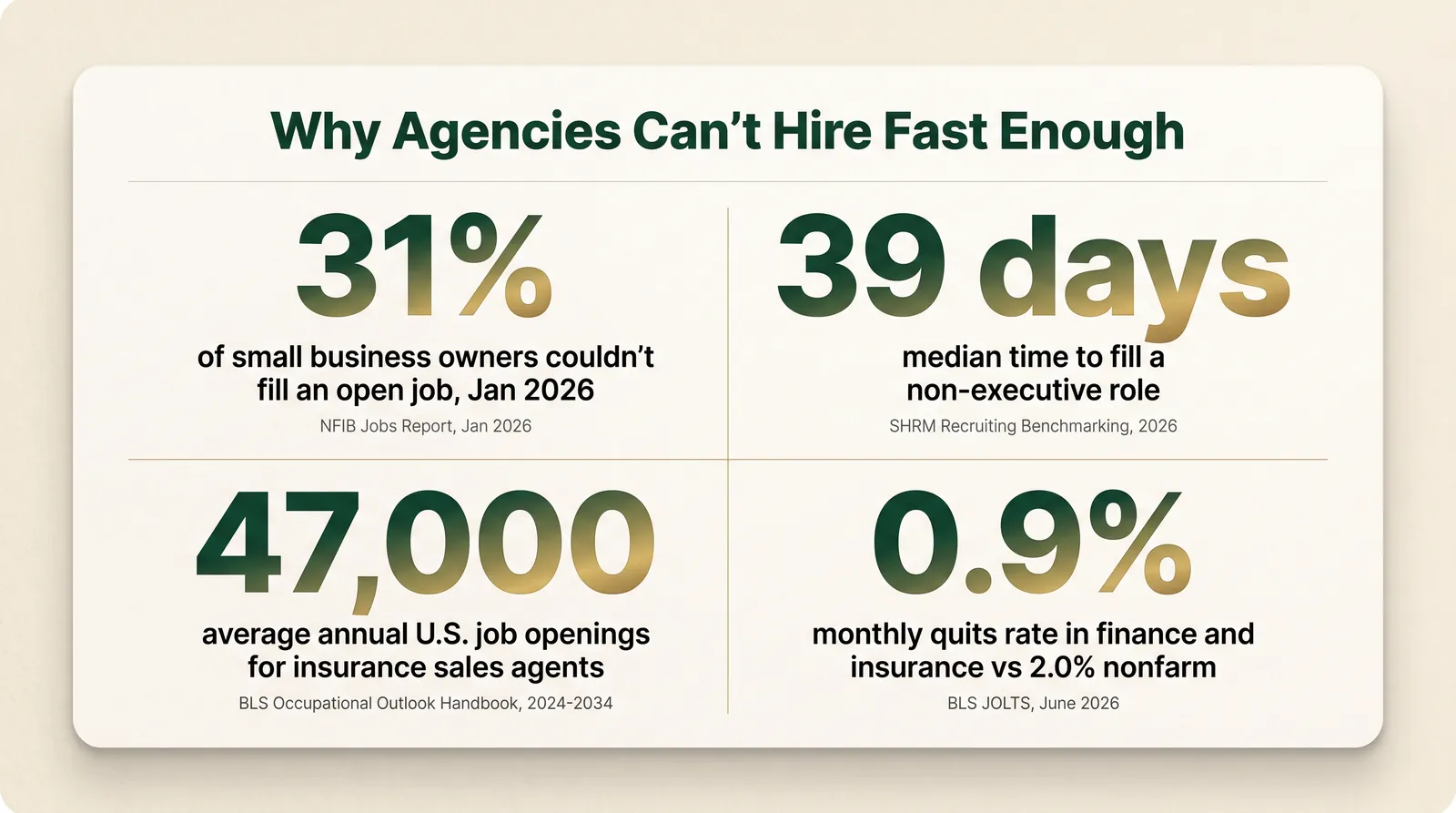
31%
Small business owners with an unfilled opening, January 2026
Source: NFIB Jobs Report, Jan 2026
39 days
Median time to fill a nonexecutive role, across 4,600+ orgs
Source: SHRM Benchmarking, 2026
47,000
Average annual U.S. job openings for insurance sales agents
Source: BLS OOH, 2024-2034
0.9%
Monthly quits rate in finance and insurance vs. 2.0% nonfarm
Source: BLS JOLTS, June 2026
Why an insurance seat takes longer to fill than most
Insurance hiring runs into friction that a generic retail or admin hire doesn’t. A few terms are worth defining plainly, because they’re the actual reasons a posting sits open.
Producer license. Anyone selling or soliciting insurance, meaning quoting, binding, or advising on coverage, generally needs a state-issued producer license, which requires pre-licensing education, a state exam, and a background check. A CSR or inside sales agent who’s only qualifying leads and setting appointments doesn’t necessarily need one, but the moment their job description drifts into discussing coverage specifics, it does. That ambiguity alone slows down what an agency is willing to hire for.
Appointment. Once licensed, a producer usually needs to be individually appointed by each carrier they’ll write business for before they can actually sell that carrier’s products. A newly licensed hire can be fully hired, trained, and eager, and still not be productive on your book of carriers for days or weeks while appointments process.
Errors and omissions (E&O) insurance. Most agencies require anyone touching client advice to be covered under the agency’s E&O policy, which is a straightforward addition for an existing employee but one more box to check before a new hire is actually doing licensed work.
A thin labor pool competing against everyone else. BLS counted 568,800 insurance sales agent jobs nationally as of 2024, projected to grow just 4 percent, about 21,100 net new jobs, through 2034. Compare that to customer service representatives broadly, a much larger occupation at 2,814,000 jobs in 2024, which BLS actually projects to shrink 5 percent over the same period, losing about 153,700 positions, even while still generating roughly 341,700 openings a year purely from replacement demand. An agency hiring for a CSR-style role is drawing from a much bigger applicant pool than one hiring a licensed producer, but it’s also competing against every other employer who wants the same generalist skill set: phone comfort, basic computer literacy, reliability. Neither pool is deep when you need someone this month.
Small-agency HR capacity. SHRM’s 39-day median comes from organizations of every size, many of which have a dedicated recruiter running a structured pipeline. An agency owner who’s also writing policies, handling renewals, and running the office doesn’t have that bandwidth. The median is a floor for a shop with real recruiting infrastructure, not a ceiling for one without it.
A CSR role and a licensed producer role are different hiring problems
If the open seat is pure phone triage, no advice, no binding, you're drawing from the much larger customer-service labor pool. If it involves any coverage discussion, you're drawing from the smaller licensed pool and adding the appointment and E&O steps on top. Get clear on which one you're actually hiring for before you write the job post, because the two have genuinely different timelines.
What an open seat actually costs while it sits empty
The honest version of this section is short, because most of the numbers people cite here, close rate lost, revenue lost, don’t have a clean public source. What does have a clean source is the wage itself.
BLS’s May 2024 data puts the median annual wage for an insurance sales agent at $60,370. Divide that by a standard 260-workday year and you get roughly $232 a workday. That’s simple arithmetic on a public figure, not a claimed savings number, but it’s a useful anchor: for every one of the roughly 39 median days a seat sits open, per SHRM’s 2026 benchmark, that budgeted $232 a day produces zero answered calls, zero booked appointments, zero warm transfers, because there’s no one in the chair.
| Role | Median annual wage | Approx. cost per workday |
|---|---|---|
| Insurance sales agent | $60,370 | ~$232/day |
| Customer service representative | $42,830 | ~$165/day |
Neither of those numbers tells you how many leads went unanswered or how much commission walked. That depends entirely on your own call volume, your own average premium, and your own close rate, none of which we’d invent a number for on your behalf. What the wage math does show plainly is that the budgeted cost of the role doesn’t pause just because the chair is empty, and the leads arriving during those 39 days aren’t pausing either.
How to cover the gap without waiting on a hire
None of what follows requires new software or a new vendor. It’s what a disciplined agency does with the staff already on the payroll while a seat is open.
- Segment the call queue by urgency, not by whoever’s turn it is. A round robin built for full staffing breaks down the moment one seat is empty. Rank incoming leads by how time-sensitive they are, an ACA shopper mid-comparison-shop outranks a routine renewal check-in, and route the top tier to whoever’s actually available right now, not next in a rotation built for a fuller team.
- Write a specific, time-boxed overtime or comp-time policy for the gap. An open-ended “can you cover more” ask burns out the staff you have left. A defined policy, this many extra hours a week, this rate, until the seat is filled, gets more genuine buy-in and is easier to sustain for weeks rather than days.
- Call a staffing agency for temporary phone coverage. A temp doesn’t need a producer license to do pure qualification and triage: confirming contact details, basic eligibility, and interest level, before a warm handoff to a licensed agent for anything involving actual coverage advice. This is exactly the kind of role BLS’s much larger, faster-to-fill customer service representative pool supports.
- Push new leads to text-first triage before anyone picks up the phone. A short text exchange confirming interest and basic details means the phone call that does happen is with someone who’s already engaged, which makes the reduced staff’s time go further.
- Extend coverage hours with staggered shifts instead of adding headcount. If your team is normally 9-to-5, having one existing staffer start two hours later and end two hours later a few days a week covers more of the after-hours window when leads are actually arriving, without waiting on a new hire at all.
- Log every call and disposition even during the scramble. A compressed, understaffed stretch is exactly when documentation habits slip, and exactly when you can least afford a consent or disclosure gap if any of the coverage involves automated outreach.
An agency with a few hundred leads a month and a team willing to grind through a temporary crunch can run all six of those and get through a 39-day gap without spending anything new. That’s a completely reasonable path, and plenty of agencies take it.
Share of small business owners reporting an unfilled job opening
NFIB's seasonally adjusted reading, historical average vs. the most recent month available.
Source: NFIB Jobs Report, January 2026 (survey conducted through January 30, 2026). Bars scaled relative to a 50% axis maximum for readability.
Where a managed AI caller fits, if you decide you need more than staff reshuffling
If the six steps above aren’t enough, because your lead volume is high, your team is already stretched thin, or the gap has dragged past 39 days with no candidates in the pipeline, that’s the point where added capacity stops being optional. TheAffordableAI is one option for the volume side specifically: it dials outbound the moment a lead comes in, answers every inbound call around the clock, qualifies against your criteria, books against real calendar availability, and warm-transfers anyone ready for a real conversation straight to a licensed agent while they’re still on the line. Full detail on what’s included is on the features page.
It does not replace the hire. It’s not licensed, it doesn’t give coverage advice, and it doesn’t build the client relationship that keeps a book renewing year over year. What it does is make sure the phone gets answered and the easy qualification work gets done while that seat is open, so your existing staff spends their time on the conversations that actually need a license and a name they recognize.
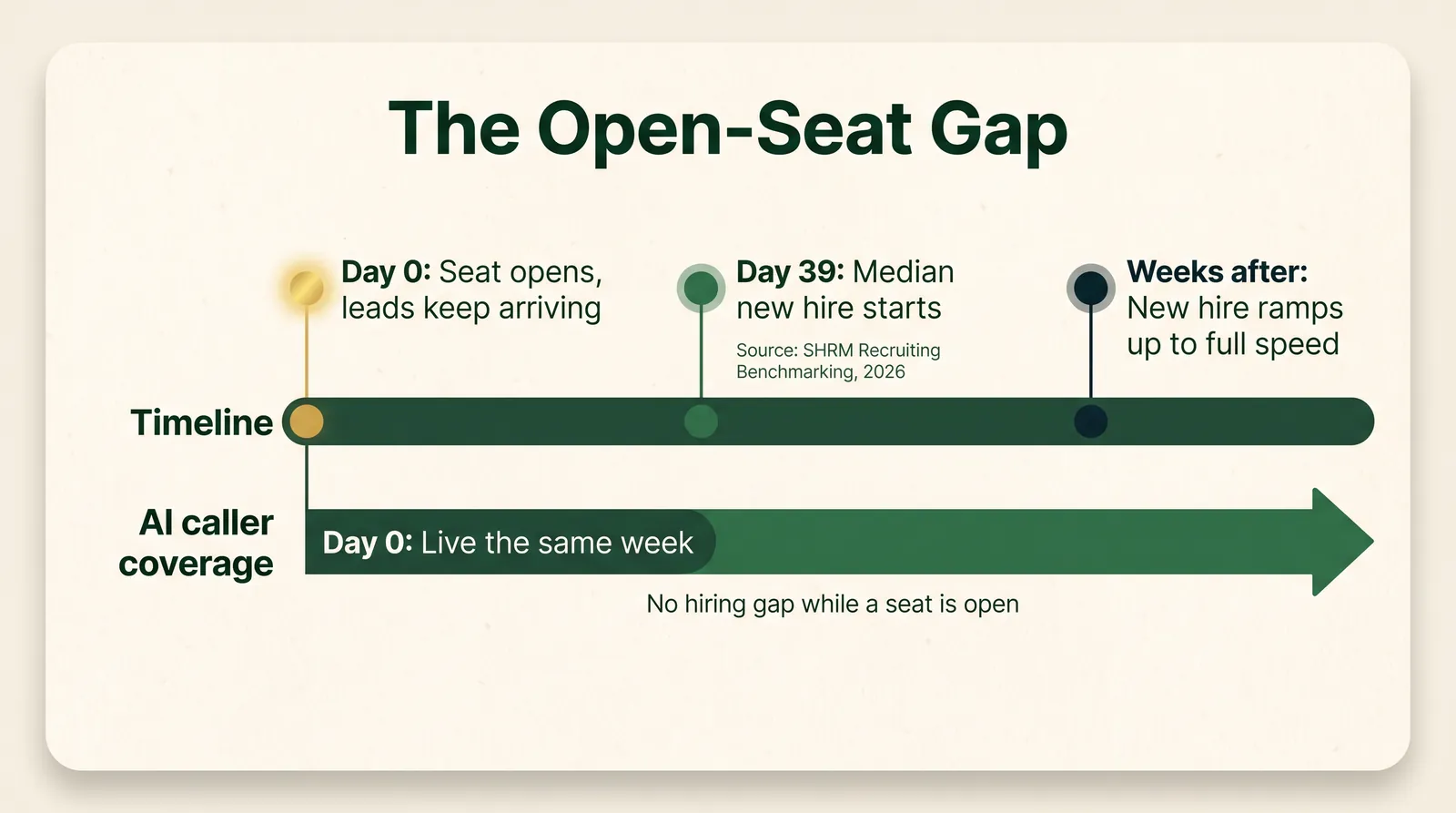
Coverage that starts this week, not in 39 days
No posting, no interview loop, no appointment-processing wait. It's live on your number in about the time it takes to onboard.
Warm transfers to whoever's licensed and available
A qualified lead gets handed to a real agent live, not parked in a callback queue that a short-staffed team can't clear.
Works alongside a hiring push, not instead of one
Keep recruiting for the seat. The caller covers the gap so the 39-day median doesn't mean 39 days of unanswered leads.
Native HighLevel CRM sync
Every call, disposition, and transcript lands in your CRM automatically, whether or not the seat next to it is filled yet.
Run the arithmetic with your own numbers
The $232-a-day figure above uses the BLS median wage. Your actual role, your actual gap, and your actual lead volume will be different. There's a demo call on the homepage if you want to hear what the coverage actually sounds like before deciding anything.
Pricing is published, not quoted privately. A Single Account runs $200 a month plus a $500 one-time setup fee, at $0.20 a minute down to $0.15 at bulk volume. An Agency plan, built for routing across 20 or more agents, runs $500 a month plus a $1,000 one-time setup fee, at $0.18 a minute down to $0.16 at bulk. Both are month to month with no long-term contract, so the cost of testing this against a specific hiring gap is capped at one month’s subscription either way. You can also build a version of this yourself with a dialer and a temp hire; plenty of agencies do, and it’s worth pricing both approaches side by side before deciding.
Before and after: the same open CSR seat
Waiting it out
- Remaining staff absorbs the extra call volume on top of their existing workload
- Leads that arrive after hours or during a busy stretch go to voicemail
- Round robin still routes leads evenly, even though one seat isn't there to take its share
- By the time a hire starts, weeks of leads have already gone cold
ReactiveStaff absorbs the gap however they can
Coverage while the seat is open
- Every inbound call answered, every outbound lead dialed, regardless of headcount that day
- Qualified leads warm-transferred to whichever licensed agent is available
- Existing staff focused on renewals and complex conversations, not first-touch dialing
- Hiring continues on its own timeline, without the gap costing lead volume in the meantime
CoveredThe gap doesn't cost you the leads that arrive during it
The hiring market isn't uniquely broken for insurance. It's just narrow, and narrow means slow. The agencies that don't lose ground during the wait are the ones that plan for the 39 days, not the ones surprised by them.
— The planning problem this article is built aroundWhen hiring, not an AI caller, is still the right call
It would be dishonest to end this pretending every staffing gap should be solved with a caller. If your open seat is genuinely about relationship management, an experienced CSR who knows forty client households by name and handles renewal conversations with judgment a script can’t replicate, the fix is hiring, mentoring, or cross-training an existing employee into that role, not adding call volume. If your lead flow is low enough that your remaining team can genuinely keep pace using the six steps above, you don’t need anything new; spending money to solve a problem you can already handle with a policy change is just spending money. And if the actual bottleneck is that leads are qualified and booked but producers don’t have time to close what’s already on their calendar, more first-touch calling makes that backlog worse, not better.
AI calling earns its place specifically in the volume-and-speed gap: the window between a lead arriving and a human being available to have that first conversation. It’s the wrong tool for judgment-heavy relationship work, and it’s the wrong tool if your actual constraint is closing capacity rather than contact capacity. Knowing which problem you actually have is the first step, before pricing out anything.
The compliance layer, whether staffed or short-staffed
A staffing gap creates real pressure to move fast, and that’s exactly when compliance habits slip. Automated, autodialed, or AI-generated-voice calls to a wireless number still require prior express consent under the Telephone Consumer Protection Act, 47 U.S.C. § 227, regardless of whether the agency is fully staffed or running on a skeleton crew. That consent requirement doesn’t have a carve-out for being short-handed, and it applies the same way whether the automated call comes from a rented dialer, a temp staffing service running scripts, or a managed AI caller.
Using AI does not transfer liability
Adding an AI caller to cover a hiring gap is an operational decision. It is not a transfer of licensing responsibility. Consent, disclosure, and a working opt-out remain the licensed agent's and agency's obligation no matter who or what is making the call, and none of that responsibility moves to a vendor because the vendor's tool made the calls faster.
Under the TCPA’s private right of action, a consumer who receives a violating call can recover actual damages or $500 per violation, whichever is greater, with courts able to raise that to $1,500 per violation for willful or knowing violations. A short-staffed season with rushed onboarding of new tools or temp staff is exactly the season where getting consent and disclosure right, every single time, matters more than usual, not less.
The honest test before you spend anything
Before pricing out a staffing agency, an AI caller, or anything else, run one piece of arithmetic with your own numbers instead of the illustrative ones above. Take your average daily inbound and outbound lead volume, and be honest about whether your remaining staff, using the six free steps above, can actually keep pace with it for the weeks a real hire is likely to take. SHRM’s 39-day median is a reasonable planning assumption for a nonexecutive role industry-wide; a small agency without dedicated recruiting infrastructure should plan for that as a floor, not a guarantee. If your team can hold the line with segmentation, a defined overtime policy, and text-first triage, you don’t need anything new. If the math says otherwise, that’s the actual gap to solve, not a hypothetical one, and it’s worth solving before the 39 days turn into 60.
Frequently asked
Why is it so hard for insurance agencies to hire right now in 2026?
It's not that applicants are bad, it's that filling any nonexecutive role takes time and the insurance sales labor pool is small and barely growing. SHRM's 2026 Recruiting Benchmarking Report, drawn from more than 4,600 organizations, puts the median time to fill a nonexecutive position at 39 calendar days industry-wide. Meanwhile the Bureau of Labor Statistics counted just 568,800 insurance sales agent jobs nationally in 2024, projected to grow only 4 percent through 2034, about 47,000 openings a year, most of them replacing agents who leave rather than net-new seats. A small agency competing for a narrow pool of licensed or license-track candidates feels that scarcity directly, even in months when NFIB's small-business surveys show hiring conditions easing overall.
How long does it actually take to fill an inside sales or CSR seat?
There's no insurance-specific figure with a public methodology, but the closest solid benchmark is SHRM's 2026 Recruiting Benchmarking Report: a median of 39 calendar days to fill a nonexecutive role, based on survey data from over 4,600 organizations across industries. That's the posting-to-start-date window, and it doesn't include the weeks a new hire needs afterward to learn your CRM, your carriers, and your scripts before they're a full contributor. A small agency without a dedicated recruiter often runs slower than that median, not faster.
What does an unfilled seat actually cost an agency?
The clearest sourced piece is the wage itself. BLS's May 2024 data puts the median insurance sales agent salary at $60,370 a year, which works out to about $232 a workday over a 260-workday year. Every one of the roughly 39 median days that seat sits open is a workday where that budgeted cost produces zero answered calls, because there's no one in the chair yet. That's not a promised savings number, it's the arithmetic on a public wage figure applied to a public time-to-fill figure, and it's worth running with your own numbers rather than ours.
Is the hiring market actually worse for insurance specifically, or is this just small business in general?
Both things are true at once, and they cut in different directions. NFIB's January 2026 jobs report found finance, the closest broad sector to insurance in NFIB's industry breakdown, reported the lowest rate of any sector citing labor quality as their single most important problem, just 2 percent, down from 6 percent a year earlier. That says the applicants coming through aren't the bottleneck. The bottleneck is supply: BLS counts only 568,800 insurance sales agent jobs nationally, a small, slow-growing occupation, competing for candidates against every other employer running the general 31 percent can't-fill rate NFIB reported for small business overall in January 2026, well above NFIB's 24 percent historical average.
What can an agency do while a seat sits open, before spending money on anything new?
Segment the call queue by urgency and route it to whoever's covering, not just whoever's next in a round robin. Set a written overtime or comp-time policy for the specific gap, rather than an open-ended ask. Call a staffing agency for temporary phone coverage, since a temp doesn't need a producer license to qualify and triage before a warm handoff to a licensed agent. Push new leads to text-first triage so a person only picks up the phone once there's a real, qualified conversation to have. None of that costs anything beyond staff time, and it's worth trying before adding a new tool.
Does an AI caller replace the need to hire a licensed producer?
No, and it isn't licensed to sell or advise on coverage. What it replaces is the volume-of-contact problem: dialing a list, qualifying basic details, booking a slot on a real calendar, and warm-transferring anyone ready to talk to a licensed human. The advice, the underwriting judgment, and the actual sale still require a licensed agent. Think of it as covering the gap in phone coverage while you hire, or permanently taking the repetitive first-touch dialing off a producer's plate, not as a stand-in for the license itself.
Is it legal to have an AI caller handle lead follow-up while an agency is short-staffed?
The staffing shortage doesn't change the legal requirements. Automated, autodialed, or AI-voice calls to a wireless number still need prior express consent under the Telephone Consumer Protection Act, 47 U.S.C. § 227, with clear disclosure and a working opt-out honored immediately. Being short-handed is a business problem, not a legal exemption, and using an AI caller doesn't shift consent or disclosure responsibility away from the licensed agent or agency.
When does hiring, not an AI caller, remain the right call?
When the bottleneck is judgment, not volume. A client with a complicated claims dispute, a nuanced coverage comparison, or a relationship built over years needs a licensed human who knows the account, not a caller optimized for first-touch qualification. If your problem is that three good producers are drowning in complex renewals and can't get to easy ones, hiring or redistributing work solves that better than adding call volume. AI calling earns its keep on the repetitive, high-volume, time-sensitive first-touch work, not on the conversations that are the actual reason a client stays.
Sources
- NFIB — Jobs Report, January 2026 (surveyed through January 30, 2026)
- SHRM — 2026 Recruiting Benchmarking Report
- U.S. Bureau of Labor Statistics — Occupational Outlook Handbook: Insurance Sales Agents (data as of May 2024, projections 2024-2034)
- U.S. Bureau of Labor Statistics — Occupational Outlook Handbook: Customer Service Representatives (data as of 2024, projections 2024-2034)
- U.S. Bureau of Labor Statistics — Job Openings and Labor Turnover Survey, Table 4: Quits levels and rates by industry (June 2026 data, released August 4, 2026)
- Cornell Law School Legal Information Institute — 47 U.S.C. § 227, Telephone Consumer Protection Act
- TheAffordableAI — Pricing
Put this on your own phone line
See the AI dial, qualify, and warm-transfer a live call in under a minute. No contract, no dev work.
Keep reading

The True Cost of a Missed Insurance Lead in 2026
A missed insurance lead is not a mystery cost. It is a paid-for lead, a forgone commission CMS puts a real number on, and a seat nobody was watching.

Cost Per Call: Live Agent vs AI Voice Agent in 2026
AI voice agents run about $0.07 to $0.50 a minute in 2026, versus $0.75 to $1.40 for a US live agent. Here is the real cost-per-call math, by volume.

Speed to Lead in 2026: Why the First 60 Seconds Decides Who Writes the Policy
The lead you paid for is not lost to a better agent. It is lost to a faster one. Here is what response time actually does to contact and conversion rates, and how to get to sixty seconds without hiring a dialer team.