ACA Insurers Exit for 2027: What Agents Do Now
Nine insurers are leaving the ACA marketplace for 2027, and Cigna alone affects up to 369,000 members. Here is how agencies handle the call surge.

Nine insurers have told regulators they are leaving the ACA marketplace for 2027, and the biggest of them, Cigna, is pulling out of all 11 states where it sells individual plans. Open enrollment for 2027 coverage runs November 1, 2026 through January 15, 2027, and anyone whose carrier just left gets dropped into an automatic reassignment to a different plan on January 1 unless they pick one themselves by December 15. That is a lot of people who did not ask to shop for insurance this fall, calling in confused, annoyed, and on a deadline, all inside the same eleven-week window your existing renewal book already has to get through. If your agency staffs for a normal open enrollment and this year is not a normal open enrollment, the gap shows up as a hold queue, not a line item.
The short version
- Nine carriers have told regulators they're exiting ACA marketplaces for 2027, per KFF's tracker as of September 15, 2026. Cigna alone is leaving all 11 states where it currently sells, affecting roughly 350,000 to 369,000 members depending on whose count you use.
- Open enrollment for 2027 coverage runs November 1, 2026 through January 15, 2027 on HealthCare.gov, after a federal court vacated the shorter December 15 end date CMS had planned. December 15 is still the deadline to start coverage January 1.
- A displaced member who does nothing gets auto-reassigned to a comparable plan from a different insurer. That protects their coverage, not their subsidy accuracy or their premium, which is why the smart move is still an active call, not a passive one.
- 2027 marketplace premiums are proposed to rise a median of 15 percent across 276 insurers, the second straight year of double-digit increases, so even clients whose carrier didn't leave have a real reason to pick up the phone.
- This is a volume-timing problem, not a volume problem. The same number of calls your agency would make in a normal year is now compressed against a hard deadline and stacked on top of a surge of people who were never your clients until their carrier quit on them.
Which insurers are actually leaving the ACA marketplace for 2027?
Nine carriers, according to the one organization tracking it in public: the Kaiser Family Foundation’s running tally of 2027 marketplace participation, last updated September 15, 2026. Cigna is the name doing the most damage to any single agency’s book, because it isn’t trimming a county here or there, it’s leaving every state where it currently sells on- and off-exchange individual coverage: Arizona, Colorado, Florida, Georgia, Illinois, Indiana, Mississippi, North Carolina, Tennessee, Texas, and Virginia.
The exact number of people affected depends on which disclosure you read. Cigna’s own first-quarter 2026 earnings call, held April 30, 2026, put its on-exchange enrollment at “over 350,000” individuals, a figure KFF cites directly from that call. STAT News, reporting on the same announcement, put the displaced-member count at 369,000. Neither number is wrong so much as they’re measuring slightly different things, likely total ACA individual-market enrollment versus on-exchange only, and KFF’s own write-up doesn’t reconcile the gap. The honest way to use this is to say “roughly 350,000 to 369,000 Cigna members” rather than pretend the number is precise to the person, and to flag that KFF is currently the only publicly tracked source for the full list of nine, so until a second tracker publishes an independent count, treat that figure as the best available floor rather than a verified ceiling.
Cigna’s own explanation for leaving, given by COO Brian Evanko on that April earnings call, was blunt: the company “did not see a way to meaningfully grow” its ACA individual business, and exiting frees up focus for its Evernorth specialty pharmacy and employer-plan lines. That is a company choosing to stop competing, not a company going out of business, which matters for how you talk to a displaced client: their old carrier didn’t fail them, it just decided the individual market wasn’t worth the math anymore.
This already happened once, at bigger scale
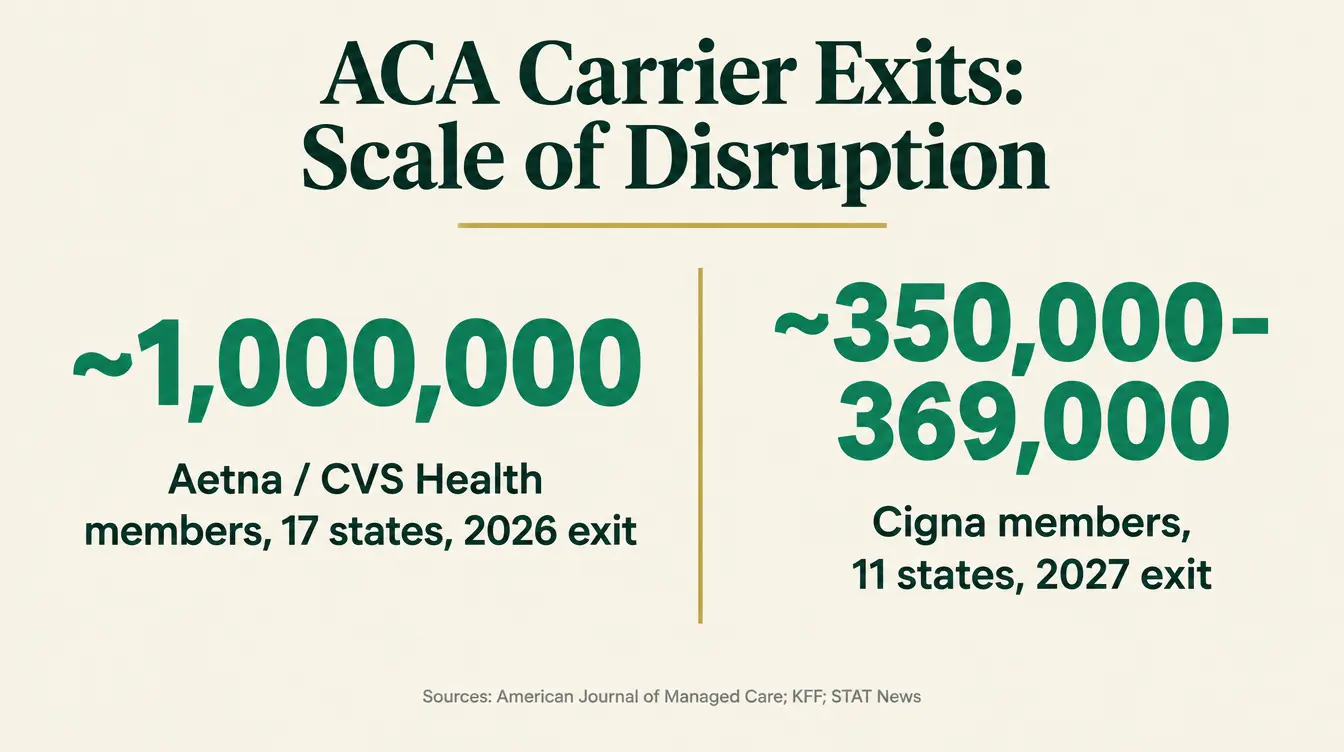
CVS Health announced in its first-quarter 2025 earnings release that Aetna would exit the ACA individual exchange business entirely for 2026, after reserving $448 million for anticipated 2025 losses in that line. Trade coverage, including the American Journal of Managed Care, put the displaced count at roughly 1 million members across 17 states. If your agency felt a 2026 renewal season that ran hotter than normal, Aetna's exit is very likely part of why, and it's the closest precedent for what a Cigna-sized exit does to call volume the following year.
| Exit event | Members affected | States | Effective plan year |
|---|---|---|---|
| Aetna / CVS Health | ~1,000,000 | 17 | 2026 |
| Cigna | ~350,000–369,000 | 11 | 2027 |
Sources: American Journal of Managed Care, "Aetna Members With ACA Plans Will Need New Coverage in 2026" (published May 1, 2025), corroborated by CVS Health's Q1 2025 earnings release confirming the exit decision and a $448 million reserve; KFF, "Tracking Insurer Participation Changes in the ACA Marketplaces in 2027" (as of September 15, 2026); STAT News, "Cigna to exit ACA individual market in 2027" (published April 30, 2026).
Why are insurers leaving the ACA marketplace right now?
Because the individual market got less profitable at the same time it got more uncertain, and nine companies independently did the math and walked. The mechanism has two separate parts worth untangling, because they push in the same direction but for different reasons.
The first part is the risk pool. The enhanced premium tax credits that subsidized ACA coverage since the American Rescue Plan Act expired December 31, 2025, after Congress didn’t extend them. KFF’s own calculator shows what that did to the people who stayed enrolled: the average subsidized enrollee’s premium payment, after tax credits, rose 114 percent, from $888 a year to $1,904 a year, covering the 2026 plan year. When a subsidy cliff like that hits, the people most likely to drop coverage entirely are healthier enrollees who can do the math and decide it’s not worth it anymore, while sicker enrollees who need the coverage stay. That shifts the remaining risk pool toward higher costs per remaining member, which is exactly the dynamic that makes an insurer’s actuaries recommend exiting rather than repricing.
The second part is the price increase that’s still coming on top of that. KFF’s analysis of rate filings from 276 insurers across all 50 states and DC, published August 3, 2026, found a median proposed premium increase of 15 percent for 2027, the second consecutive year of double-digit increases. KFF’s stated drivers, pulled from detailed filings in 16 states and DC, are “higher costs for health services, general economic inflation, and labor shortages,” plus the same morbidity shift from the subsidy cliff showing up in 2027 pricing. Put the two together: insurers are pricing in a sicker, smaller pool, and some of them are deciding that even a 15 percent increase doesn’t make the math work, so they’re leaving instead of repricing into it.
That second number matters for your call list even if a client’s carrier didn’t exit. A household staying with the same insurer at 15 percent more money has a real reason to call and ask what else is out there, and marketplace enrollment data backs up that people are already walking from coverage over cost: KFF reported that 2026 open enrollment sign-ups fell to about 23.1 million, down more than 1 million from the prior year and the first enrollment decline since 2020. That decline happened before this round of exits. The 2027 window is stacking a fresh wave of involuntary shoppers on top of a market that was already shrinking from voluntary drop-off.
Put a real household in front of that 114 percent figure and it stops being an abstraction. KFF’s own numbers give a subsidized enrollee’s average net premium payment going from $888 a year in 2025 to $1,904 a year in 2026, which is $1,016 more a year, or about $85 more a month, for coverage that didn’t change. A client on a tight monthly budget who opens that bill in November isn’t calling to chat about options next spring; she’s calling now, this week, because the number on the page is $85 bigger than the one she budgeted for. That’s the conversation your phone lines need to be ready for on top of the displaced-carrier calls, not instead of them, and it’s why a 15 percent median rate filing and a 114 percent subsidized-payment jump are two different numbers describing two different groups of callers who show up in the same eleven weeks.
Two separate caller types, one window
Displaced clients (carrier exited, deadline is auto-reassignment) and price-shocked clients (carrier stayed, premium jumped) are different conversations with different urgency curves, but they land in the same six to eleven weeks. A triage list that only flags the first group misses the second group entirely, and the second group is larger.
The subsidy question is still unresolved as this goes live
Whether Congress extends any version of the enhanced premium tax credits remains an open legislative question. Don't build a client-facing script that assumes an outcome either way. Confirm the current status before you quote a subsidy number on a call, and point clients to their own Marketplace account for the figure that will actually apply to them.
What happens if a displaced member does nothing by December 15?
They don’t lose coverage, but they lose control over what it costs and whether it fits. CMS’s standard rule, confirmed in the same framework covering this transition, lets a marketplace auto-reassign an enrollee whose plan is discontinued into a comparable plan, often from a different insurer, so coverage continues without a gap starting January 1. That’s a real consumer protection, and it’s worth saying plainly on a call, because a panicked client’s first fear is usually “will I have insurance on January 1,” and the honest answer is almost always yes, automatically, whether they call you or not.
What auto-reassignment doesn’t do is verify their subsidy is still calculated correctly, confirm the new plan’s network includes their doctors, or guarantee the new premium is competitive. A household that got assigned into a replacement plan without updating their income or household size on file keeps whatever advance premium tax credit was last on record, which may be stale if anything changed in the past year. That’s the actual case for the call: not “your coverage is at risk,” which isn’t true for most displaced members, but “the plan you’re about to get stuck with by default might not be the best one available, and nobody checks that for you automatically.”
The deadline math is specific and worth stating exactly, because agents have been burned by assuming last year’s calendar still applies. Open enrollment for 2027 coverage runs November 1, 2026 through January 15, 2027 on HealthCare.gov. That’s not what CMS originally planned: the agency’s 2025 Marketplace Integrity and Affordability Final Rule set the Federally Facilitated Marketplace’s open enrollment at November 1 through December 15 for plan year 2027 onward, a 45-day window, down from the 76 days enrollees had for 2026. A federal court in Maryland vacated that shortened end date in June 2026, in litigation reported as City of Columbus v. Kennedy, and CMS’s own enrollment platform now reflects the restored January 15 end date, with the case under appeal and oral arguments held in late October 2026. December 15 remains the deadline for coverage to start January 1; enroll between December 16 and January 15 and coverage starts February 1 instead. If you or your agency published anything assuming the 45-day window, that information is now out of date and worth correcting, because the actual working window this season is back to 76 days, not 45.
One more edge case worth knowing before you build a calendar around any of this: the federal dates above only govern the Federally Facilitated Marketplace used by most states. CMS’s own final rule gives state-based marketplaces room to set their own schedule, with three limits: the window has to start no later than November 1, end no later than December 31, and run no longer than 9 calendar weeks. A state-based exchange can legally choose, say, a November 1 to December 31 window, or something shorter that still clears 9 weeks, and several have historically set deadlines later than the federal calendar. If you write business in a state-based marketplace state, Washington, California, New York, and a dozen or so others each run their own platform, confirm that state’s specific 2027 dates on its own exchange site rather than assuming the HealthCare.gov calendar applies. The displaced-carrier mechanics are the same everywhere; the clock isn’t.
Coverage continuing automatically is not the same as the best plan continuing automatically.
What a missed call actually costs during this window
The honest cost argument here isn’t a fabricated close-rate or an invented dollar figure per lead, it’s arithmetic about volume and time. Your agency has a fixed renewal book, plus whatever new and displaced shoppers come in through Nov 1 to Jan 15. Every one of those contacts competes for the same calendar days as your existing clients who are up for renewal on their own schedule. A displaced Cigna client isn’t a bonus lead sitting in a drawer; she’s a call that has to happen in the same eleven weeks you were already planning to use for your current book, and she arrives with more urgency and less patience than a routine renewal because she didn’t choose to be shopping.
Phone capacity is the actual constraint, and it’s measurable in a way a close-rate guess isn’t. One licensed agent working an 8-hour day, at a realistic 6 minutes of average talk time per contact including hold and callback attempts, can physically complete somewhere around 50 to 60 live conversations in a day if nothing else interrupts them, which nothing in an insurance office ever does. Scale that against a book where even a few hundred clients got displaced on top of normal renewal volume, and the math stops being about skill and starts being about hours in the day. An agency that tries to absorb a Cigna-sized exit with the same staffing it used last year is choosing, whether on purpose or not, to let some percentage of that volume go to voicemail, a competitor, or the default auto-reassignment.
What a renewal-season call pass costs per minute, by method
Per-minute cost only; does not include setup fees or management time
Sources: TheAffordableAI Pricing (verified October 1, 2026); live-agent range as published in TheAffordableAI's "Cost Per Call: Live Agent vs AI Voice Agent" analysis, theaffordableai.com/blog/cost-per-call-ai-vs-human-2026/, itself sourced to published call-center labor benchmarks. Your own agent cost may differ; run the math with your actual fully loaded hourly rate.
A four-minute outbound call to flag a Cigna exit and offer to walk a client through their reassignment options costs about $0.80 at the Single Account’s $0.20-a-minute rate, or $0.64 at the Agency plan’s $0.16-a-minute bulk rate. Five hundred of those calls run $400 or $320 depending on plan. That’s not a claim about what any of those calls close into; it’s what it costs to make sure the call happens at all, which is the actual bottleneck during a compressed, deadline-driven window.
How to triage the surge without a bigger headcount
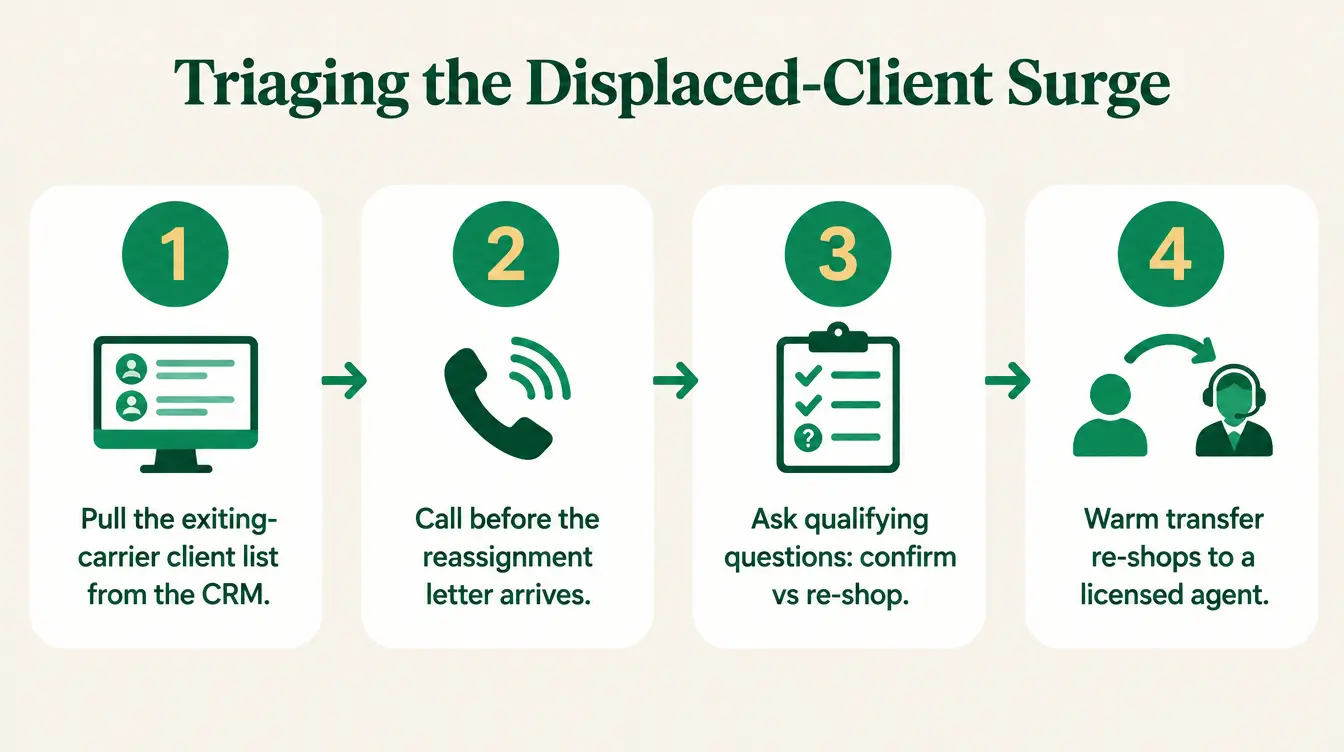
Start with who’s actually displaced, not with your whole book. Pull every client currently enrolled with an exiting carrier first; if you don’t have that cut in your CRM already, that’s the first thing to build, because it’s the segment with the real deadline and the real urgency, not a general “everyone’s renewal is due” list. For most agencies that’s Cigna if you wrote business in any of its 11 exit states, plus whatever smaller regional carriers KFF’s tracker lists as exiting in your specific states, which you should check directly since KFF’s public write-up doesn’t name all nine publicly.
Everyone calls in at once
- Displaced clients learn about the exit from a marketplace letter, not from you, and call in already frustrated
- Front desk fields the same "am I losing my insurance" question dozens of times a day with no script
- New shoppers and existing renewals compete for the same hold queue with no triage between them
- Calls that don't get answered inside a day or two go to a competitor or default to auto-reassignment
You call them first
- Displaced clients get a short, scripted outbound call before the letter anxiety sets in, with identification and disclosure already built into the opener
- Qualifying questions sort who needs a full re-shop versus who's fine with a comparable auto-assigned plan
- Urgent and routine volume route separately, so a 15-minute re-shop conversation doesn't block a 2-minute confirmation call
- Warm transfers hand a licensed agent a caller who already knows why they're on the phone
The script itself only needs a few qualifying questions, asked in order: confirm they know their current plan is ending, ask whether their household or income changed this year (which determines whether the auto-reassigned subsidy will still be accurate), ask whether they want to keep the same type of plan (HMO versus PPO, same deductible range) or are open to shopping broadly, and flag anyone who mentions a specific ongoing prescription or provider relationship for a licensed agent to handle directly rather than letting a qualifying script get into coverage specifics. That last point matters: a qualifying call should route a health-specific question to a human, not attempt to answer it.
Sequence the outreach instead of blasting the whole list at once. Call the clients with the nearest effective deadline first, which in practice means anyone on an exiting carrier whose household or income changed this year, since their auto-reassigned subsidy is the most likely to be wrong. Behind them, call displaced clients whose situation is stable and who mostly need a five-minute confirmation that the comparable plan they’ll be defaulted into is fine. Behind that, work the price-shock segment, clients whose carrier stayed but whose premium jumped, since they have the full window through mid-January rather than the December 15 deadline for a January 1 start. Three lists, three scripts, one calendar, worked in that order, is a better plan than one long list worked in whatever order the CRM happens to sort it.
Outbound to your own existing clients about their own coverage is a different compliance posture than cold marketing, but it isn’t consent-free. If the outreach uses an autodialer, an artificial voice, or an AI-placed call to a wireless number, the Telephone Consumer Protection Act’s prior express consent requirement still applies, existing-client relationship or not; a live, manually dialed call from a human agent is a different legal footing than an automated one. Either way, the call needs a clear identification of who’s calling and why, a real callback number, and an honored opt-out. None of that changes because the client has a direct business reason to hear from you.
If you want to hear what an AI-run version of this qualifying flow actually sounds like before committing to anything, there’s a demo call on the homepage: https://theaffordableai.com/.
Where TheAffordableAI fits in a window like this
This is exactly the kind of volume-against-a-deadline problem a managed AI caller is built for, and it’s worth being specific about what that means rather than vague. TheAffordableAI runs outbound calling that can dial your exiting-carrier segment the moment you’ve built the list, not whenever a human gets to it, at $0.20 a minute on a Single Account or $0.18 a minute on an Agency plan, dropping to $0.16 at bulk volume. It also answers everything coming in: the clients calling about their own marketplace letter, the new shoppers finding you through a renewal-season ad, after hours and on weekends, when a lot of this panic-driven calling actually happens because people open their mail at night.
The part that matters most for a surge like this one is the handoff. The AI asks the qualifying questions above, routes urgent re-shops separately from simple confirmations, and warm-transfers a ready caller to a licensed agent with the context already captured, through HighLevel CRM sync if that’s your stack, so the agent’s first sentence picks up where the AI left off instead of re-asking everything. If you’re spreading this across more than one producer, round-robin routing and availability toggles mean a single agent in a single exit state doesn’t end up carrying the whole surge alone while someone else in the office has open calendar slots.
None of this is a promise about how many of those calls turn into written policies; that depends on your product fit and your follow-through, not the dialer. What it changes is whether the call happens inside the window at all. Every plan is month to month, no contract, so the cost of trying this against one eleven-week window is capped at a month’s subscription plus whatever minutes you actually use. The math above used $0.20 a minute because that’s what a Single Account costs; run it against your own book size at https://theaffordableai.com/pricing before you decide anything.
What you get, concretely
A list of exactly who’s affected, instead of guessing from a general renewal calendar. A call that goes out before the marketplace’s own reassignment letter lands, so you’re the first explanation a displaced client hears instead of the last one they try after getting frustrated with a help line. Qualifying answers captured and waiting for the licensed agent the moment a transfer happens, instead of a bare name and number. Coverage during the hours this kind of anxious, deadline-driven calling actually spikes, not just your posted office hours. And a record, through disposition tracking and CRM sync, of who was contacted, when, and what they said, which matters if anyone ever asks how your agency handled this specific disruption.
When a manual push is genuinely enough
If your book has a dozen or two affected clients, a list, a free afternoon, and your own phone will get through it, and paying for a managed AI caller to handle a stack of calls you could finish yourself by Thursday doesn’t make sense. The economics here only start to matter once the list gets long enough, or compressed enough against the December 15 and January 15 deadlines, that a single person or a small team physically cannot get through it with the hours available. Know which situation you’re actually in before you spend anything. If you’re not sure, you can build a version of this yourself with a dialer and a spreadsheet and see where the ceiling actually is; plenty of agencies do exactly that first.
The compliance layer for this specific outreach
A few things stay true no matter who or what is making these calls. Prior express consent for an automated or AI-placed call to a wireless number is still required under the TCPA, and an existing client relationship doesn’t substitute for it; if your consent records for a given lead source or client list are unclear, resolve that before dialing, not during the call. CMS’s rules for Marketplace agents and brokers also tightened this year: the same 2025 final rule that reset the open enrollment calendar adopted a “preponderance of the evidence” standard for terminating an agent, broker, or web-broker’s Marketplace agreement over noncompliance, which raises the bar HHS uses but doesn’t lower anyone’s obligation to disclose accurately and avoid misrepresenting a client’s options. And using an AI voice to make or answer these calls does not transfer a licensed agent’s responsibility for consent, disclosure, or the advice ultimately given; the agent and agency stay accountable, the same way they would if a human made every call by hand.
TheAffordableAI is a technology provider, not an insurance agency or a government entity, and is not affiliated with HealthCare.gov, CMS, or any state marketplace. This article isn’t insurance or legal advice, and current rules, deadlines, and the pending Columbus v. Kennedy appeal can change the specifics described here; confirm the live HealthCare.gov calendar and your own state’s exchange rules before you build a script or a call calendar around any date in this piece.
See the qualifying call before you build your own
Hear an AI caller ask the displaced-client questions above and warm-transfer a ready caller to a licensed agent, in under a minute, no setup required to listen.
Frequently asked
Which insurers are leaving the ACA marketplace for 2027?
Nine carriers have told regulators they're exiting ACA marketplaces for plan year 2027, according to KFF's running tracker, last updated September 15, 2026. Cigna is the largest single exit: it's leaving all 11 states where it currently sells individual coverage on- and off-exchange (Arizona, Colorado, Florida, Georgia, Illinois, Indiana, Mississippi, North Carolina, Tennessee, Texas, and Virginia), affecting roughly 350,000 to 369,000 members depending on whether you use Cigna's own Q1 2026 enrollment disclosure or STAT News's reporting on the same announcement. KFF's public write-up doesn't name all nine carriers or every affected state, so if you write business outside Cigna's footprint, check KFF's tracker directly for carriers exiting your specific states rather than assuming only Cigna matters to your book.
Did the 2027 open enrollment dates actually change, or is it still a 45-day window?
It changed back. CMS's 2025 Marketplace Integrity and Affordability Final Rule originally set the Federally Facilitated Marketplace's open enrollment at November 1 through December 15 for plan year 2027, a 45-day window cut down from the 76 days enrollees had for 2026. A federal court in Maryland vacated that shortened end date in June 2026, in litigation reported as City of Columbus v. Kennedy, and the case is now on appeal, with oral arguments held in late October 2026. HealthCare.gov's current, live enrollment calendar reflects the restored window: November 1, 2026 through January 15, 2027. December 15 is still the deadline to enroll for coverage starting January 1; anyone who enrolls between December 16 and January 15 gets a February 1 start instead. If anything you've published or scripted assumes the 45-day version, it's out of date.
What happens if a displaced client doesn't pick a new plan by December 15?
They don't lose coverage. Marketplace rules allow an enrollee whose plan is discontinued to be automatically reassigned into a comparable plan, often from a different insurer, so coverage continues without a gap starting January 1 whether they act or not. What auto-reassignment doesn't do is confirm the new plan's network still includes their doctors, verify their subsidy amount is current if their income or household changed this year, or guarantee the replacement premium is competitive. That's the real reason for the call: not that their coverage is at risk, which it generally isn't, but that the default option nobody actively chose for them might not be the best one available.
Why are 2027 premiums going up even for clients whose carrier didn't exit?
Two separate pressures are stacking. First, the enhanced premium tax credits that subsidized ACA coverage expired December 31, 2025, which KFF's calculator shows raised the average subsidized enrollee's net premium payment 114 percent, from $888 a year in 2025 to $1,904 in 2026. Second, KFF's analysis of 2027 rate filings from 276 insurers across every state and DC found a median proposed increase of 15 percent, the second straight year of double-digit hikes, driven by rising health care costs, inflation, labor shortages, and a sicker risk pool left behind as healthier, subsidy-sensitive enrollees drop out. A household whose carrier stayed can still be opening a bill that's meaningfully bigger than last year's, which is its own reason to call and re-shop.
Do I need special consent to call my own existing clients about their carrier leaving the marketplace?
Yes, if the call uses an autodialer, an artificial voice, or an AI-placed call to a wireless number. The Telephone Consumer Protection Act's prior express consent requirement doesn't carve out an exception for an existing client relationship when the call is automated; a live, manually dialed call from a human agent sits on different legal footing than an automated campaign, but either way the call needs a clear identification of who's calling and why, a working callback number, and an honored opt-out. If your consent record for a given client or lead source is unclear, resolve that before you dial, not during the call.
Does using an AI voice agent change who's liable if a call goes wrong?
No. Using an AI to place or answer a call doesn't transfer a licensed agent's or agency's responsibility for consent, disclosure, or the advice ultimately given to the client. CMS's agent and broker rules, including the 2025 final rule's new preponderance-of-the-evidence standard for terminating a Marketplace agreement over noncompliance, apply to the entity responsible for the call, human-staffed or automated. The agent and agency stay accountable the same way they would if every call were dialed by hand.
What would it actually cost to call every displaced client with an AI caller?
Using TheAffordableAI's published rates, verified October 1, 2026, a four-minute call runs about $0.80 at the Single Account's $0.20-a-minute rate or $0.64 at the Agency plan's bulk $0.16-a-minute rate. Five hundred calls run $400 or $320 depending on plan, on top of the $200 or $500 monthly fee and a one-time setup charge of $500 or $1,000. Both plans are month to month with no long-term contract, so testing this against one open enrollment window costs one month's subscription plus whatever minutes you use, not a multi-year commitment. Run the math against your own book size at theaffordableai.com/pricing before deciding, since the live page is the source of truth.
Is a managed AI caller even necessary if only a handful of my clients got displaced?
Probably not. If your affected list is a dozen or two clients, a spreadsheet, and a free afternoon will get you through it, and paying for a managed caller to handle a stack of calls you could finish yourself by Thursday doesn't make sense. The economics start to matter once the combined list of displaced clients and price-shocked renewals gets long enough, or compressed enough against the December 15 and January 15 deadlines, that one person or a small team genuinely can't get through it with the hours available. Know which situation you're in before you spend anything.
Sources
- KFF — Tracking Insurer Participation Changes in the ACA Marketplaces in 2027 (as of September 15, 2026)
- STAT News — Cigna to exit ACA individual market in 2027, affecting 369,000 people (published April 30, 2026)
- KFF — How Much and Why ACA Marketplace Premiums Are Going Up in 2027 (published July 8, 2026, updated August 3, 2026)
- KFF — ACA Marketplace Premium Payments Would More Than Double on Average Next Year If Enhanced Premium Tax Credits Expire (published September 30, 2025)
- KFF — ACA Marketplace Enrollment Is Down in 2026, But All of the Data Isn't In Yet (published February 5, 2026)
- CMS — 2025 Marketplace Integrity and Affordability Final Rule, Fact Sheet (published June 20, 2025)
- HealthCare.gov — Dates & deadlines for 2027 Marketplace coverage (live calendar, confirmed October 1, 2026)
- Medical Daily — Obamacare enrollment opens November 1 and runs through January 15 after a court blocked the shorter window
- American Journal of Managed Care — Aetna Members With ACA Plans Will Need New Coverage in 2026; CVS to Exit ACA Marketplace (published May 1, 2025)
- CVS Health — First Quarter 2025 Earnings Release (published April 30, 2025)
- Cornell Law School Legal Information Institute — 47 U.S.C. § 227, Telephone Consumer Protection Act
- TheAffordableAI — Pricing (verified October 1, 2026)
- TheAffordableAI — Cost Per Call: Live Agent vs AI Voice Agent in 2026
Put this on your own phone line
See the AI dial, qualify, and warm-transfer a live call in under a minute. No contract, no dev work.
Keep reading

ACA Open Enrollment 2027: 31 Fewer Days to Save Your Book
CMS cut the ACA open enrollment window from 76 days to 45 starting with plan year 2027. Here's what that compression means for your renewal calls.

Speed to Lead in 2026: Why the First 60 Seconds Decides Who Writes the Policy
The lead you paid for is not lost to a better agent. It is lost to a faster one. Here is what response time actually does to contact and conversion rates, and how to get to sixty seconds without hiring a dialer team.

After-Hours Insurance Leads: The 128-Hour Gap
An agency staffed 9 to 5 on weekdays is unstaffed 128 hours a week. Here is what that costs in after-hours insurance leads, and how to close the gap in 2026.