ACA Open Enrollment 2027: 31 Fewer Days to Save Your Book
CMS cut the ACA open enrollment window from 76 days to 45 starting with plan year 2027. Here's what that compression means for your renewal calls.

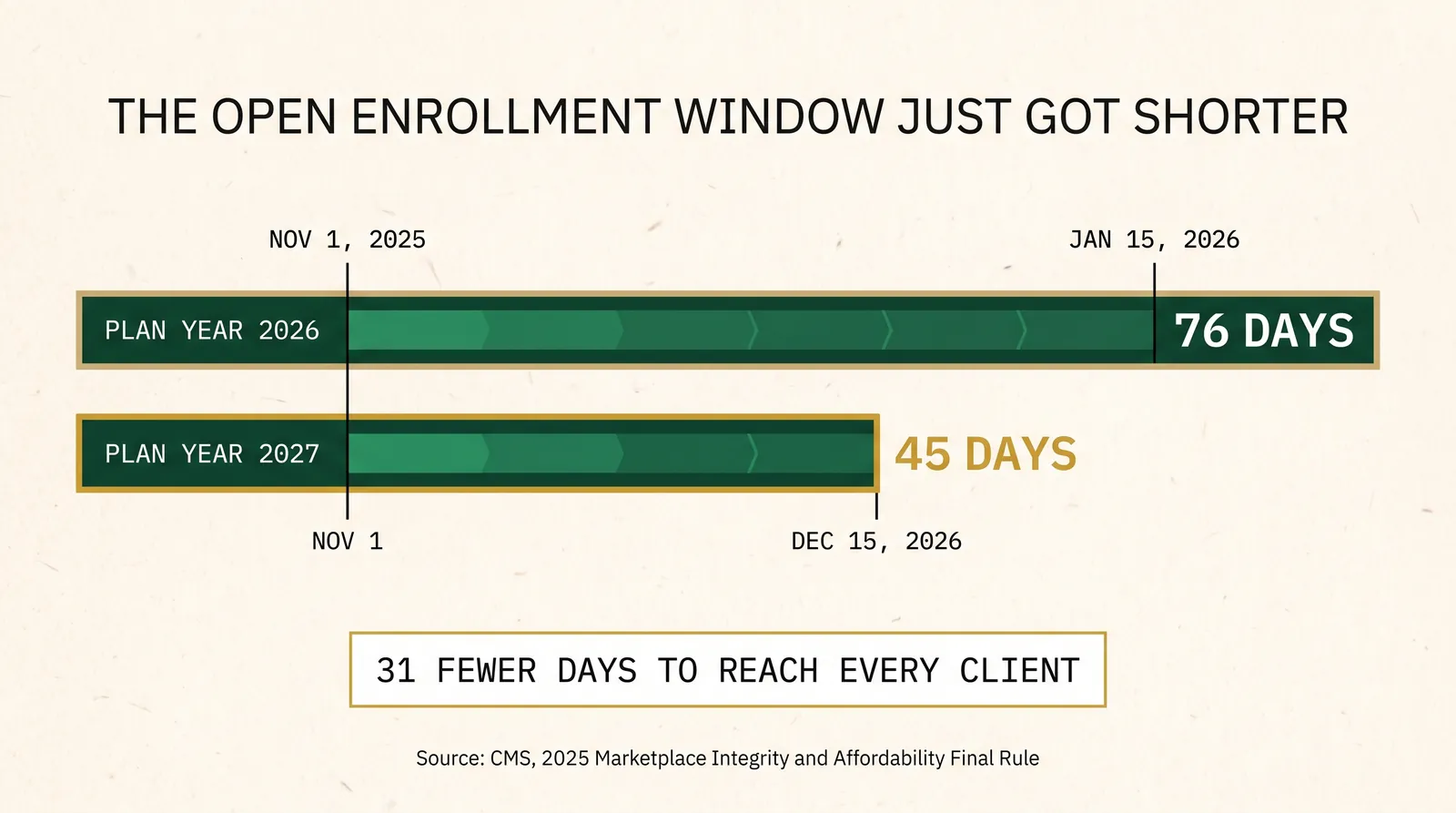
Open enrollment for 2027 ACA coverage runs November 1 through December 15, 2026, for the Federally Facilitated Marketplace most states use. That’s 45 days. The window that just closed for 2026 coverage ran November 1, 2025, through January 15, 2026, a 76-day stretch. Same job, same size book in a lot of agencies, 31 fewer days to do it, under a rule CMS finalized in June 2025 and applied starting with plan year 2027. Layer that onto a client base that’s been absorbing the biggest premium jump the ACA marketplace has seen since it launched, and the phones are going to ring harder in a shorter window than they have in any prior enrollment season.
This isn’t a rule you can get ahead of by working smarter within the old calendar. The calendar itself changed. What follows is what actually changed, what it costs when a compressed window meets a client base in sticker shock, how to work through it with a plain call plan, and where an AI caller fits if your book is bigger than your staff can cover in 45 days by hand.
The short version
- Starting with plan year 2027, CMS caps every ACA exchange's open enrollment period at nine weeks, no later than November 1 to no later than December 31. The Federally Facilitated Marketplace specifically runs November 1 through December 15, 2026, a 45-day window.
- The 2026 coverage year window ran 76 days, November 1, 2025 through January 15, 2026. The 2027 window is 31 days shorter, a 41 percent reduction in calendar time.
- Enhanced premium tax credits expired January 1, 2026. The House passed a three-year extension 230-196 on January 8, 2026; the Senate has not passed a companion bill as of the most recent public tracking.
- KFF's May 2026 data shows subsidized enrollees' average monthly premium payment rose 58 percent, deductibles rose 37 percent, and effectuated enrollment could fall by roughly 4.8 million people.
- A compressed window plus a client base absorbing a real premium increase means more inbound and outbound call volume packed into less time, which is a capacity problem before it's anything else.
What actually changed for 2027 open enrollment
CMS’s Marketplace Integrity and Affordability Final Rule, published as a fact sheet on June 20, 2025, standardizes the annual open enrollment period across every ACA exchange in the country, federal and state-run alike. Under the rule, every exchange’s OEP must start no later than November 1, end no later than December 31, and run no longer than nine calendar weeks. For exchanges on the federal platform, healthcare.gov in most states, the rule sets the window explicitly: November 1 through December 15, beginning with the open enrollment period for plan year 2027. All enrollments made during that window take effect January 1, with no more staggered February 1 start date for late sign-ups the way earlier cycles allowed.
That’s a real change from how the window has worked in past years. The 2026 coverage year’s open enrollment period ran November 1, 2025 through January 15, 2026 on the federal exchange, a 76-day window, and healthinsurance.org’s own tracking of state deadlines shows just how much variation existed on top of that: enrollment ended in December 2025 in Idaho, ran until January 31, 2026 in several states, and extended into early February 2026 in Washington D.C. Starting with 2027 coverage, that flexibility to run long is gone. No exchange, state or federal, can push its deadline past December 31.
| Coverage year | Start | End | Length |
|---|---|---|---|
| Plan year 2026 | November 1, 2025 | January 15, 2026 | 76 days |
| Plan year 2027 | November 1, 2026 | December 15, 2026 | 45 days |
| Difference | — | — | 31 fewer days (-41%) |
State-based exchanges retain some flexibility under the rule, they can choose their own start and end dates, but the same ceiling applies: no start later than November 1, no end later than December 31, nine weeks maximum. A handful of state exchanges have historically opened earlier than the federal date in past years. If you’re licensed in a state-run exchange, confirm that state’s specific 2027 calendar once it’s published, typically in late summer or early fall, rather than assuming the federal November 1 to December 15 dates apply to your state.
Why CMS shortened the window
The open enrollment compression wasn’t the headline provision of CMS’s rule, it’s one piece of a broader package the agency describes as closing enrollment loopholes and reducing improper enrollments. The same rule eliminates the monthly Special Enrollment Period for people at or below 150 percent of the federal poverty level, requires income verification for a larger share of SEP enrollments, and reduces the advance premium tax credit to $5 a month for anyone auto-re-enrolled into a fully subsidized plan without confirming their eligibility. CMS’s own projection attached to the rule estimates roughly a 5 percent average premium reduction and up to $12 billion in 2026 taxpayer savings from the package as a whole, though most of the temporary program-integrity provisions are set to sunset at the end of the 2026 plan year. The open enrollment standardization is not temporary in the same way; it’s the new baseline starting with plan year 2027.
The practical effect for an agent is the same regardless of the policy reasoning: a fixed universe of prospects and renewing clients now has to move through a shorter calendar window, with no more quiet stretch into mid-January to mop up stragglers.
The subsidy fight nobody has resolved
The enhanced premium tax credits, first introduced under the American Rescue Plan Act in 2021 and extended through 2025 by the Inflation Reduction Act, expired on December 31, 2025. They removed the 400 percent of federal poverty level income cap on subsidy eligibility and lowered the percentage of income enrollees had to pay toward the benchmark plan. With that expiration, subsidy eligibility and contribution levels reverted to the ACA’s original, pre-2021 structure, and, for the first time since 2021, some middle-income households lost subsidy eligibility entirely.
Congress has not settled what happens next. On January 8, 2026, the House passed H.R. 1834, a bill that included a three-year extension of the enhanced credits, by a recorded vote of 230 to 196, with 17 Republicans crossing over to join every voting Democrat, according to the Office of the Clerk of the U.S. House of Representatives. The bill moved to the Senate, where it has not received a floor vote as of the most recent public tracking. A bipartisan group led by Senators Bernie Moreno and Susan Collins had been negotiating a narrower, two-year compromise, the reported CARE Act framework, with income caps and minimum premium contributions attached, but coverage from mid-January 2026 described those talks as stalled over an unrelated policy rider.
Build your script around current law, not a prediction
As of this writing, the enhanced premium tax credits remain expired. Congress could still act before or during the 2027 open enrollment period, and if it does, subsidy amounts and eligibility could change again on short notice. Check the current status before you finalize a renewal script or a client-facing explanation of what they'll pay. Don't promise a client a subsidy outcome that depends on a bill that hasn't passed.
What a compressed renewal season actually costs
The premium side of this is already showing up in the numbers. KFF’s May 2026 analysis of the 2026 open enrollment period found that the average monthly premium payment for subsidized marketplace enrollees, net of tax credits, rose 58 percent, from $113 to $178 a month. Average deductibles rose 37 percent, an increase of $1,027, to $3,786, which KFF describes as the steepest deductible increase the marketplace has seen since it launched. Plan selections shifted hard toward cheaper coverage: bronze plan selections rose from 30 percent to 40 percent of enrollees, while silver selections, the tier most subsidy calculations are based on, fell from 57 percent to a record-low 43 percent.
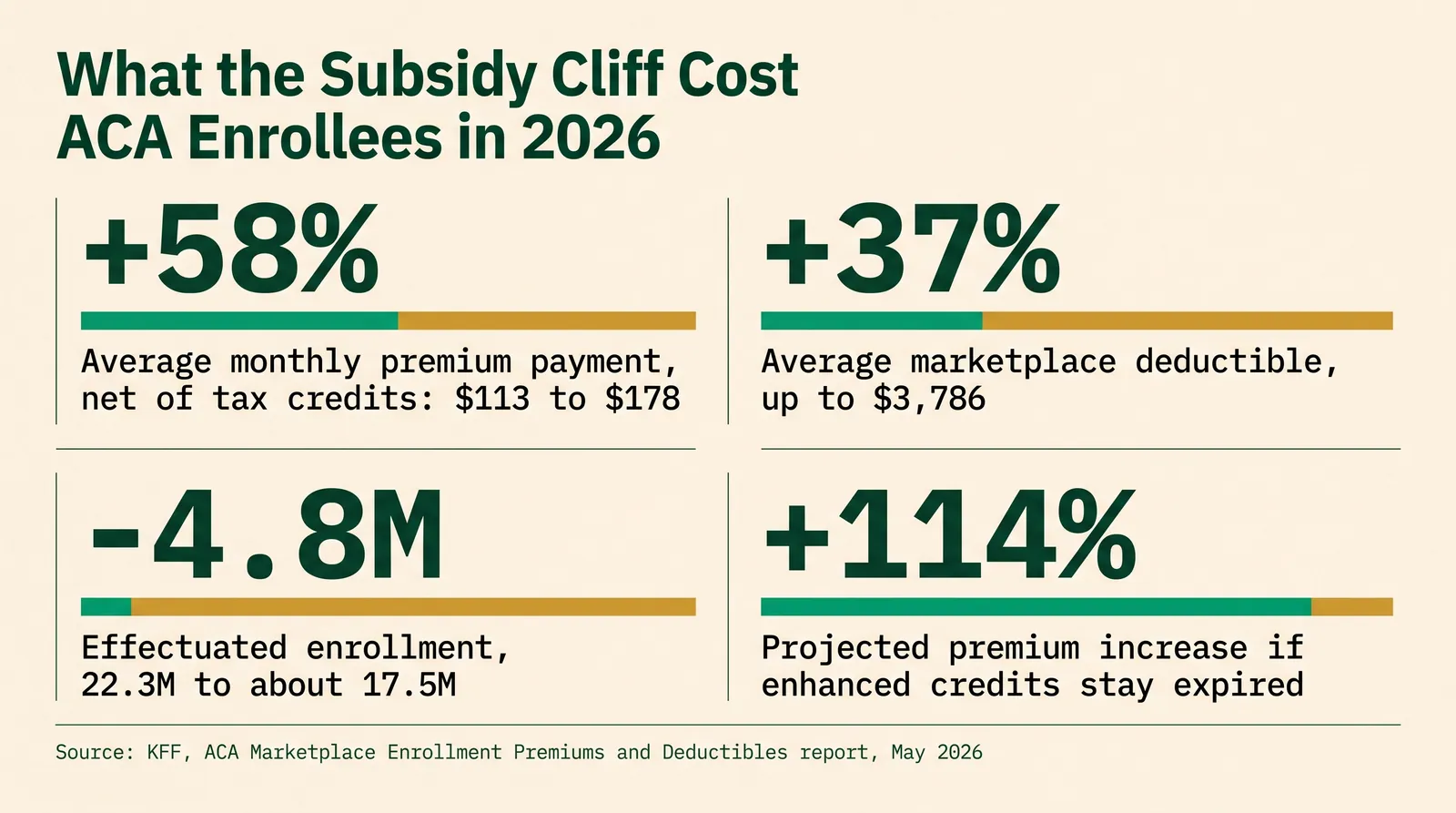
+58%
Rise in average monthly premium payment, net of tax credits ($113 to $178)
Source: KFF, May 2026
+37%
Rise in average marketplace deductible, up to $3,786
Source: KFF, May 2026
-4.8M
Possible drop in effectuated enrollment, 22.3M to about 17.5M
Source: KFF, May 2026
45 days
Length of the plan year 2027 federal open enrollment period
Source: CMS, June 2025
That’s the demand side. Every one of those numbers describes a client who is more likely to call your office confused, more likely to actively re-shop instead of letting a renewal happen passively, and more likely to need a real conversation about what changed and why, not a two-minute confirmation call. People at 400 to 500 percent of the federal poverty level, who lost subsidy eligibility entirely when the enhanced credits expired, accounted for 27 percent of coverage losses in KFF’s data despite being just 3 percent of 2025 enrollees; sign-ups in that income band fell 44 percent, more than 321,000 people. That’s not a group that renews quietly. That’s a group deciding whether to keep coverage at all, in the same 45 days everyone else is trying to reach you too.
Stack that demand against 31 fewer days to meet it, and the arithmetic of “get to everyone before the window closes” gets meaningfully harder than it was for 2026, even if your book hasn’t grown at all.
How to work a 45-day window without dropping clients
None of this requires new software. It requires a plan built around the actual number of working days you have, not the number you assumed you had based on last year.
- Segment your book by urgency before November 1, not during it. Pull every client due for a renewal decision and split them into at least three groups: clients in the 400-500 percent FPL band or otherwise likely to have lost subsidy eligibility, clients whose current plan is being discontinued or substantially changed, and everyone else who’s a reasonably straightforward passive renewal. The first two groups need a real conversation. The third can often be handled with a shorter check-in call or a text-and-confirm flow.
- Count your actual working days, not the calendar days. Forty-five calendar days from November 1 to December 15, 2026 includes about 13 weekend days and the Thanksgiving holiday, leaving roughly 30 working days to make contact. If your book has 640 clients due for renewal, that’s about 21 individual client contacts a day, every working day, for six weeks, on top of whatever new business comes in over the same stretch. If half your outbound dials connect on a given day, the actual dial volume needed is roughly double that.
- Front-load the high-urgency segment into the first two weeks. A client who lost their subsidy or is losing their plan needs time to actually decide and enroll, not just receive a call on December 14. Work backward from December 15 and put your hardest conversations earliest in the window, not latest.
- Build one script for premium-increase questions and use it consistently. Every agent on your team is going to field some version of “why did my price go up” this fall. Have a plain, accurate answer ready: the enhanced tax credits that lowered premiums since 2021 expired January 1, 2026, and Congress has not passed a replacement as of the date you’re speaking with the client. Don’t guess at what Congress might do. State what’s true today.
- Confirm who’s actually being auto-re-enrolled, and whether that’s the right outcome for them. CMS’s rule specifically targets people who get passively re-enrolled without confirming eligibility, cutting their advance premium tax credit to a nominal $5 a month if they don’t take action. A client who assumes “no news is good news” and does nothing could end up paying full, unsubsidized price starting January 1 without realizing it. That’s worth a proactive call, not a passive mailer.
- Log every call and every consent, especially for anything automated. A compressed timeline creates pressure to move fast and skip documentation. That’s exactly the wrong moment to skip it, both because a fast season means more calls, and because more calls means more chances to get consent or disclosure wrong.
You can run all six steps with a spreadsheet, a segmented call list, and a team willing to grind through the hours. Plenty of agencies will do exactly that, and for a book under a couple hundred renewals, a disciplined manual push through 30 working days is entirely realistic.
| Book size | Single Account, $0.20/min | Agency bulk, $0.16/min |
|---|---|---|
| 500 clients, 4 min avg. call | $400 | $320 |
| 1,000 clients, 4 min avg. call | $800 | $640 |
| 2,500 clients, 4 min avg. call | $2,000 | $1,600 |
Contacts needed per working day, by renewal book size
Illustrative arithmetic based on the 45-day plan year 2027 window CMS announced (Nov 1 to Dec 15, 2026), assuming roughly 30 working days once weekends and Thanksgiving are excluded. Not a contact-rate or answer-rate estimate.
Working-day estimate derived from CMS's plan year 2027 open enrollment dates (Nov 1 to Dec 15, 2026). Per-client contact counts are simple division, not a claimed answer rate or conversion rate.
Who to call first when you can’t call everyone at once
Not every renewal deserves the same urgency, and pretending otherwise is how a compressed window turns into a scramble in the final week.
Passive, straightforward renewals
- Same household, same income bracket, subsidy largely unchanged
- Current plan continuing into 2027 without major benefit changes
- Client has a history of responding quickly to a single outreach
- A confirmation call or a text-and-confirm flow is usually enough
Laterin the 30-day working window
Clients who need a real conversation
- Household in the 400-500% FPL band, where subsidy loss hit hardest in 2026
- Current plan discontinued or materially changed for 2027
- Household or income changed since last enrollment
- Client was auto-re-enrolled without confirming eligibility last cycle
Firstinto the working window, with time to actually decide
The compliance layer for renewal calls
A shorter window creates real pressure to move fast, and moving fast is exactly when compliance gets skipped. It shouldn’t be. Automated, autodialed, or prerecorded calls, including AI-generated voice calls, to a wireless number still require prior express consent under the Telephone Consumer Protection Act, and that requirement doesn’t carve out an exception just because the person is already your client. A manually dialed call from a licensed human agent to their own book carries a different legal posture, but it still needs a clear disclosure and a working opt-out honored immediately.
Using AI does not transfer liability
A faster way to reach a full renewal book in a shorter window is a real operational advantage. It is not a transfer of licensing responsibility. Consent, disclosure, and a working opt-out are the licensed agent's and agency's obligation, whether a human or an AI voice makes the call, and none of that responsibility moves to a vendor because the vendor made the calls faster.
Under the TCPA’s private right of action, 47 U.S.C. § 227(b)(3), a consumer who receives a violating call can recover actual damages or $500 per violation, whichever is greater, with courts able to raise that to $1,500 per violation for willful or knowing violations. A compressed season with a higher volume of automated outreach is a season where getting consent and disclosure right, every time, matters more than it did when you had 76 days to be careful.
Where TheAffordableAI fits
Building the segmented list, deciding who goes first, and writing the premium-increase script are process work no vendor does for you, including us. Where a managed AI caller helps is on the volume side of the problem: once your renewal list is segmented and your script is set, TheAffordableAI can work through hundreds or thousands of client contacts across the full 45-day window without adding seasonal headcount, log every call and disposition against your CRM automatically, and warm-transfer anyone with a real question straight to a licensed agent while they’re still on the line. The full breakdown of what’s included is on the features page.
Outbound at volume, on a fixed calendar
Work a segmented renewal list across all 45 days without needing to staff up for six weeks and then let people go in mid-December.
Warm transfers to a licensed agent
A client with a real premium or eligibility question gets connected live, not parked in a callback queue three days before the deadline.
Number warmup and spam defense
A six-week volume surge is exactly the kind of pattern that gets a business number flagged. Warmup runs as a standing routine, not a one-time fix.
Native HighLevel CRM sync
Every call, disposition, and transcript lands in the CRM automatically, which is the documentation trail a consent question would ask for later.
Hear how a renewal call actually sounds
There's a live demo call on the homepage. Listen to it, then decide whether your renewal book is a fit for AI-assisted outbound during a 45-day window.
Pricing is published, not quoted privately. A Single Account runs $200 a month plus a $500 one-time setup fee, at $0.20 a minute, down to $0.15 a minute at bulk volume. An Agency plan runs $500 a month plus a $1,000 one-time setup fee, at $0.18 a minute, down to $0.16 a minute at bulk. Both are month to month with no long-term contract, so testing this against your own renewal book costs, at most, one month either way.
Before and after: the same 640-client renewal book
Working the old calendar out of habit
- Outreach paced assuming a mid-January cushion that no longer exists for 2027
- Highest-urgency clients, subsidy-cliff households, contacted whenever staff gets to them
- Seasonal temp hires trained and ramped for a six-week push, then let go
- Call volume peaks in the final week before December 15, when it's too late to fix a missed contact
ReactivePace set by the old 76-day window
The same book, paced against the actual calendar
- List segmented by urgency before November 1, with subsidy-cliff households called first
- Outbound volume spread evenly across all 30 working days, not backloaded into week six
- Capacity added for the six-week window without a seasonal hiring and layoff cycle
- Every call logged against the CRM, with warm transfers for anyone who needs a licensed agent
PacedMatched to the 45-day window CMS actually set
The calendar didn't get easier. It got shorter. The agents who plan for 45 days instead of the 76 they're used to are the ones who reach every client before December 15, not just the easy ones.
— The planning problem this article is built aroundWhat could still change before November
Two things are genuinely unresolved, and it’s worth saying so plainly rather than writing around it. First, the enhanced premium tax credits could still be extended or replaced by Congress before or during the 2027 open enrollment period; the House has acted, the Senate has not, and any Senate movement would change subsidy math for a meaningful share of your book on short notice. Second, individual state-based exchanges have not all published their 2027 calendars as of this writing; the federal November 1 to December 15 dates are confirmed, but a state exchange could open earlier within CMS’s allowed range, up to nine weeks, no later than November 1, no later than December 31. If you’re licensed in a state-run exchange, check that state’s published calendar once it’s available rather than assuming the federal dates apply.
Neither uncertainty is a reason to wait on planning your call cadence. Segment your book now, build the two scripts you’ll need, one for subsidy-loss households and one for straightforward renewals, and adjust the specific dates once your state confirms them, rather than losing weeks waiting for certainty that may not arrive before November 1.
When a manual push is genuinely enough
It would be dishonest to end this pretending every agency needs to automate its renewal calling. If your book is a few hundred clients, your staff has done this before, and you’re not also chasing a large volume of new business in the same window, a disciplined manual push through 30 working days, using the segmentation approach above, is a completely reasonable way to work a 45-day window. The math changes when the book is large enough, or the staff thin enough, that manual dialing simply can’t reach everyone before December 15 no matter how well it’s organized. That’s the point where added capacity, whether that’s temp staff, overtime, or an AI caller, stops being optional and starts being the only way every client actually gets a call before the window closes.
The honest test is arithmetic, not a sales pitch: take your renewal count, divide by roughly 30 working days, and be honest with yourself about whether your current team can hit that number of contacts a day, every day, for six weeks, without the highest-urgency clients falling to the bottom of the list. If the answer is yes, you don’t need anything new. If the answer is no, that’s the actual problem to solve, not a hypothetical one.
The compliance layer, one more time
A shorter window is not a reason to skip disclosure
Every renewal call still needs the same things a longer window required: a clear disclosure of who's calling and why, a working opt-out honored immediately, and prior express consent for any automated or AI-voice call to a wireless number. Compressing the calendar doesn't compress the compliance requirements, and a licensed agent's responsibility for consent and disclosure doesn't transfer to an AI caller or any other vendor.
CMS didn’t shorten the ACA open enrollment window to make anyone’s fall harder on purpose; the rule is aimed at closing enrollment loopholes and reducing improper sign-ups. But the effect on the ground, for an agency with a real renewal book, is 31 fewer days to reach the same number of people, in a year when more of those people have real questions about a real premium increase. Segment the book, front-load the hard conversations, count your actual working days instead of assuming last year’s calendar still applies, and decide honestly whether your current staff can hit the daily contact number that math requires. If it can, you’re set. If it can’t, that’s a capacity gap worth pricing out before November 1, not during the second week of December.
Frequently asked
When does ACA open enrollment start for 2027 coverage?
November 1, 2026, for the Federally Facilitated Marketplace used by most states, running through December 15, 2026. That's the standard set by CMS's 2025 Marketplace Integrity and Affordability Final Rule, which took effect beginning with plan year 2027. State-based exchanges can set their own window, but under the same rule, none of them may start later than November 1 or run past December 31, and none may exceed nine calendar weeks. In practice, a handful of state exchanges have historically opened a week or two earlier than the federal date, so agents licensed in a state-run exchange should confirm that state's exact calendar once it publishes, typically in late summer or early fall.
Why is the 2027 open enrollment period shorter than 2026?
CMS standardized it. Before this rule, the Federally Facilitated Marketplace ran open enrollment from November 1 through January 15, a 76-day window, and several state-based exchanges pushed their own deadlines even later, into late January or, in Washington D.C.'s case, into February. CMS's June 2025 final rule caps every exchange, federal or state, at a nine-week maximum starting no later than November 1 and ending no later than December 31. For the federal exchange specifically, the rule sets the window at November 1 through December 15, a 45-day period. That's 31 fewer days than the window agents just finished working for 2026 coverage.
Are the enhanced ACA premium tax credits coming back for 2027?
Unresolved as of this writing. The enhanced premium tax credits, first added under the American Rescue Plan Act and extended through 2025 by the Inflation Reduction Act, expired on December 31, 2025, after Congress did not act to extend them. The House passed a three-year extension, H.R. 1834, by a 230-196 vote on January 8, 2026, with 17 Republicans joining every voting Democrat. The Senate has not passed companion legislation. A bipartisan group led by Senators Bernie Moreno and Susan Collins was negotiating a narrower two-year compromise, but reporting from mid-January 2026 described those talks as stalled over unrelated policy riders. Check the current status before you build a renewal script that assumes either outcome, since the credits remain expired under current law.
How much more are ACA enrollees paying for coverage in 2026?
According to KFF's May 2026 analysis, the average monthly premium payment for subsidized marketplace enrollees, net of tax credits, rose 58 percent, from $113 to $178 a month. Average deductibles rose 37 percent, an increase of $1,027, to $3,786. Effectuated enrollment, the number of people actually paying for and holding coverage, could fall from 22.3 million in 2025 to roughly 17.5 million in 2026. A separate KFF calculator estimated that if the enhanced credits stay expired, average premium payments would rise 114 percent, or about $1,016 a year, compared to what enrollees would have paid had the credits continued.
Do I need special consent to call my existing ACA clients about their renewal?
Yes, if the call is automated, uses an autodialer, or uses a prerecorded or AI-generated voice, and it's going to a wireless number, which describes most cell phones today. The Telephone Consumer Protection Act's prior express consent requirement doesn't have a blanket exemption for existing customers when it comes to autodialed or prerecorded calls to a cell number. A live, manually dialed call from a licensed agent to their own client is a different legal posture than an automated campaign, but either way the call needs a clear disclosure, a working opt-out, and a documented basis for the contact. Using an AI caller doesn't change who's responsible for that consent; the licensed agent and agency remain on the hook.
What happens to a client who doesn't act by December 15?
It depends on whether they're due for a plan selection or a passive renewal. Marketplace rules generally allow a returning enrollee to be automatically re-enrolled into the same plan, or a similar one if theirs is discontinued, without taking any action, but auto-re-enrollment doesn't update their subsidy amount for a changed income or household, and CMS's 2025 rule specifically targets auto-re-enrollment scenarios by reducing the advance premium tax credit for people who haven't confirmed their eligibility. A client who needed to actively re-shop, because their old plan changed, their household changed, or their subsidy changed, and who misses the window, is generally locked out of the individual market until the next annual enrollment period unless they qualify for a Special Enrollment Period.
Can I still generate new ACA business during this window, or is it only for renewals?
Both compete for the same 45 days. New-to-market shoppers, people newly eligible for subsidies, people who lost employer coverage, and price-sensitive shoppers comparing plans all move during open enrollment too, on the same compressed calendar as your renewal book. That's part of what makes the shorter window a capacity problem rather than just a scheduling problem: the total call volume, working through a fixed universe of prospects and clients, now has to happen in 41 percent less calendar time than it did for 2026 coverage.
What would it cost to call a full renewal book with an AI caller?
Using TheAffordableAI's published Single Account rate of $0.20 a minute, a 4-minute renewal call runs about $0.80, or $400 to call 500 clients once. At the Agency plan's bulk rate of $0.16 a minute, the same 500-client pass runs about $320. Both plans are month to month with no long-term contract, so the cost of testing this against a 45-day window is capped at one month's subscription plus the per-minute usage, regardless of which plan you pick.
Sources
- CMS — 2025 Marketplace Integrity and Affordability Final Rule, Fact Sheet (published June 20, 2025)
- KFF — What We Know So Far About 2026 ACA Marketplace Enrollment, Premiums, and Deductibles (published May 19, 2026)
- KFF — Calculator: How Much More Would People Pay in Premiums if the ACA's Enhanced Premium Tax Credits Expire? (published October 29, 2025)
- KFF — 8 Things to Watch for the 2026 ACA Open Enrollment Period (published October 28, 2025)
- Office of the Clerk, U.S. House of Representatives — Roll Call Vote 11, 119th Congress, 2nd Session, on H.R. 1834 (recorded January 8, 2026)
- ASTHO — ACA Enhanced Premium Tax Credits: Legislative Developments in 2025 and 2026 (published January 20, 2026)
- healthinsurance.org — What are the deadlines for the ACA's open enrollment period? (updated July 29, 2026)
- Cornell Law School Legal Information Institute — 47 U.S.C. § 227, Telephone Consumer Protection Act
- TheAffordableAI — Pricing
Put this on your own phone line
See the AI dial, qualify, and warm-transfer a live call in under a minute. No contract, no dev work.
Keep reading

Speed to Lead in 2026: Why the First 60 Seconds Decides Who Writes the Policy
The lead you paid for is not lost to a better agent. It is lost to a faster one. Here is what response time actually does to contact and conversion rates, and how to get to sixty seconds without hiring a dialer team.

The True Cost of a Missed Insurance Lead in 2026
A missed insurance lead is not a mystery cost. It is a paid-for lead, a forgone commission CMS puts a real number on, and a seat nobody was watching.

CMS 2027 Medicare Rules: The 48-Hour Wait Is Gone
CMS eliminated the 48-hour Scope of Appointment wait, changed the TPMO disclaimer timing, and cut call retention to 6 years ahead of AEP 2027.