Missed-Call Text-Back vs AI Answering for Insurance Agents
A missed insurance call doesn't need a text reply, it needs a live answer. Missed-call text-back vs AI phone answering, compared and sourced for 2026.

Someone calls your insurance agency’s main line, it rings four times, and nobody picks up. If you’re on HighLevel, or almost any modern business phone platform, a text lands in their inbox seconds later: “Sorry we missed you! How can we help?” It feels like the gap is closed. Most of the time, it isn’t. A missed-call text-back tells a caller you noticed. It doesn’t put a person, or a system that can act like one, on the other end of the line, and for a prospect who called specifically because they wanted to talk about a plan, that’s not the same thing as being answered.
This piece walks through what missed-call text-back actually does and doesn’t do, what an inbound call that never gets a voice actually costs, the full method for building the text-back workflow yourself, and where a system that answers live instead of texting back changes the outcome, not just the acknowledgment.
The short version
- Missed-call text-back sends an SMS after a call goes unanswered. It's a real feature, native to HighLevel and buildable in Twilio, and it does one job well: it stops a caller from feeling ignored. It does not qualify a lead, book an appointment, or get a licensed agent on the phone.
- Invoca's 2026 benchmarks report, built on more than 70 million calls across ten industries including insurance, found that 56% of callers to businesses actually reach a person, meaning 44% do not.
- The 2021 Supreme Court ruling in Facebook, Inc. v. Duguid narrowed what counts as an autodialer under the TCPA. A reactive missed-call text-back, triggered by a specific caller's specific number rather than generated randomly or sequentially, sits outside that narrowed definition, which is different ground than an outbound marketing blast.
- Hiring a person to answer every call costs real money: the U.S. Bureau of Labor Statistics puts the median receptionist wage at $37,230 a year as of May 2024, and that's for coverage during business hours only.
- The two approaches aren't mutually exclusive. An AI voice system that answers on the first ring, with native text-back as the fallback if it's ever down, closes more of the gap than either one alone.
What Missed-Call Text-Back Actually Is
Missed-call text-back is a trigger-and-response workflow: a call to your business number goes unanswered, and within roughly a minute, an automated text goes out to the caller from that same number. HighLevel ships this as a native feature. Per HighLevel’s own support documentation, you turn it on under your location’s Business Profile settings, write the message once, and it fires automatically from then on whenever a call to your tracking number isn’t picked up. A more configurable version exists too, built as a workflow with a “Missed Call” trigger, which lets you branch the response, tag the contact, or kick off a longer follow-up sequence instead of a single text.
If you’re not on HighLevel, the same mechanism is buildable directly in Twilio. Twilio’s own engineering blog walks through the pattern: detect a no-answer status on the dial attempt, then branch into a Gather step that can collect a callback request or route straight into a Record step that takes a voicemail with transcription. Layer an outbound SMS onto that no-answer branch using Twilio’s Messaging API, sent from the same number the call came into, and you’ve built the same feature HighLevel gives you as a toggle, just assembled by hand.
Define the terms before you build anything
Missed-call text-back: an automated SMS sent to a caller after their call to your business number goes unanswered. Ring group: a set of phones or extensions a single inbound call can be routed to before it's considered missed. ATDS (autodialer): the TCPA's term for equipment that stores or produces telephone numbers using a random or sequential number generator, and dials or texts them, a definition narrowed considerably by the Supreme Court in 2021. Warm transfer: connecting a live caller directly to an available agent while they're still on the call, rather than taking a message for someone to act on later.
Either way you build it, the mechanism is the same and so is the limitation: it’s a text, not a conversation. It works exactly as designed, and what it’s designed to do is narrower than what most agencies actually need when a prospect calls wanting to talk about a Medicare Advantage plan or a life policy.
Why the Text Often Doesn’t Land
A caller who dialed your number did something more deliberate than filling out a web form. They picked up a phone and initiated a real-time conversation, which is a different intent than someone who’s comfortable typing. When the response to that call is a text message from a number they don’t recognize, several things can go wrong that don’t show up in a “message sent” log.
The reply doesn’t match the intent. Someone calling about a health plan often has a question that’s hard to type out, a family situation, a specific medication, a deadline they’re worried about. A text thread is a worse format for that conversation than the phone call they already chose.
The number looks unfamiliar, so it gets ignored. A local or toll-free tracking number sending an unsolicited-feeling text lands in the same mental bucket as spam, especially for an older caller base common in Medicare and final expense books. The caller who was ready to talk five minutes ago may not open a text from a number they don’t know.
Nobody’s actually watching for the reply. If the caller does text back, that reply has to reach a human fast for the recovery to work at all. Many agencies that turn on missed-call text-back never build a process for monitoring the inbound texts it generates, so the SMS becomes a one-way acknowledgment instead of the start of a two-way conversation.
It doesn’t qualify or book anything. Even in the best case, where a caller replies and someone answers promptly, that exchange still has to establish who they are, what they need, and when they’re free, entirely by text, before anything resembling an appointment exists. That’s a lot of typing for both sides compared to a two-minute call.
The text itself can trip a spam filter. Carriers score outbound A2P messages for spam-like patterns, and a generic templated “sorry we missed you” sent in bulk from a business number shares characteristics with the exact traffic carriers filter for. A missed-call text-back program that isn’t monitored for delivery can silently stop reaching a share of callers with no error visible on your end, the same blind spot that affects a voice number that picks up a “Spam Likely” label.
Test your own text-back today
Call your own business line from a phone you don't normally use, let it ring out, and watch what actually happens: how long the text takes, what it says, and whether replying to it reaches an actual person within minutes. Most agency owners have never tested their own missed-call flow from the caller's side.
What an Unanswered Call Actually Costs
Two different numbers are worth separating here: how often calls to a business go unanswered at all, and what it costs to staff a phone well enough that they don’t.
On the first question, Invoca’s 2026 Lead Conversion Benchmarks Report, built from an analysis of more than 70 million phone calls and 600 million minutes of conversation data across ten industries including insurance, states plainly that 56% of callers to businesses actually speak with a person. Read the other direction, 44% of inbound calls to a business, in Invoca’s dataset, do not reach a human. We located this figure from Invoca’s own report page rather than a secondary summary, and we did not find a second independently published dataset using a comparable methodology to corroborate the exact percentage; treat it as the most current sourced figure available rather than a universally confirmed constant, and pull your own agency’s answer-rate numbers from your phone system or call tracking platform before assuming they match.
On the second question, staffing a phone with a human costs what a human costs. The Bureau of Labor Statistics’ Occupational Outlook Handbook puts the median annual wage for a receptionist at $37,230, or $17.90 an hour, as of its May 2024 data. That’s for one person covering standard business hours; it says nothing about who answers a call at 8pm on a Tuesday or 10am on a Saturday, when Invoca’s broader data and general call-center staffing patterns both suggest a meaningful share of consumer calls land.
Share of calls to a business that actually reach a person
Source: Invoca, The Invoca Lead Conversion Benchmarks Report 2026 (70M+ calls, 10 industries including insurance).
Figures are Invoca's industry-wide 2026 dataset, not an insurance-specific breakout. Pull your own agency's answer rate from your call tracking platform before assuming it matches.
56%
Of calls to businesses actually reach a person
Source: Invoca, 2026 Report
44%
Do not reach a person, by the same measure
Source: Invoca, 2026 Report
$37,230
Median annual wage for a receptionist
Source: BLS, May 2024
$1,500
Max statutory damages per unlawful automated call
Source: 47 U.S.C. § 227
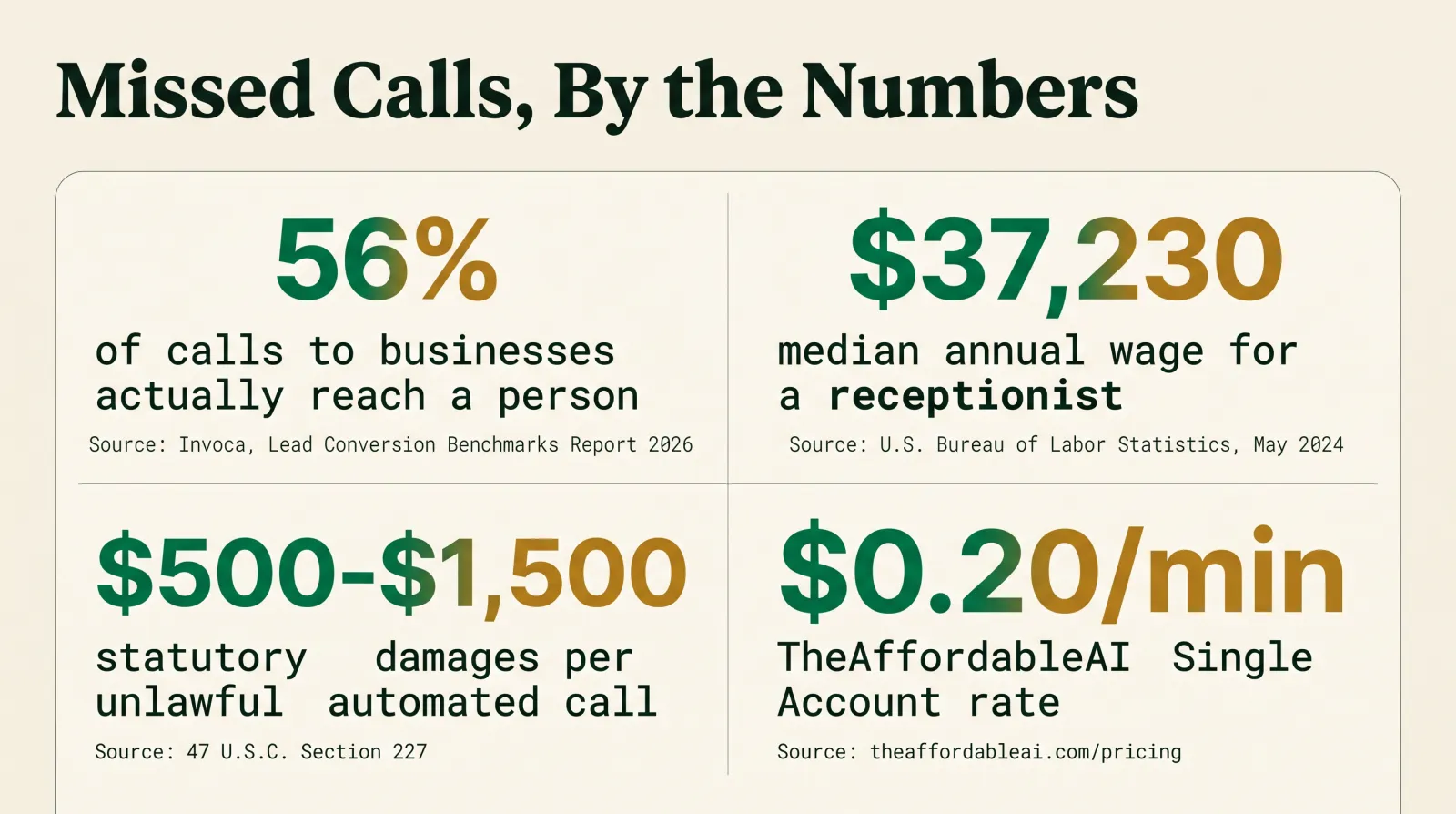
There’s a compliance cost worth naming too, separate from the missed-lead cost. Under 47 U.S.C. § 227(b)(3), a person can recover actual damages or $500 per unlawful automated call, whichever is greater, tripled to as much as $1,500 for a willful or knowing violation. That statute governs unlawful automated calls, not a reactive text sent to the number that just called you, but it’s the backdrop against which any automated communication in this space gets evaluated, and it’s why the next section spends real time on where a text-back workflow sits legally.
Do the Math on Your Own Missed Calls
The numbers above are industry-wide. Your agency’s real exposure is a function of your own call volume, your own miss rate, and what a contacted lead is actually worth to you, three inputs you already have sitting in your phone system or call tracking dashboard.
The arithmetic is simple once you have those three numbers: multiply your monthly inbound call count by your miss rate to get missed calls per month, then multiply that by whatever share of a missed caller you honestly believe becomes a customer if reached promptly. A worked illustration, using round numbers rather than a sourced industry average, makes the shape of it concrete:
| Input | Illustrative value | Where to find your real number |
|---|---|---|
| Inbound calls per month | 400 | Your phone system or call tracking platform's monthly call log |
| Share unanswered | 30% | Missed vs. answered calls in the same log, filtered by outcome |
| Resulting missed calls | 120 | 400 x 30% |
| Estimated close rate if reached live | 10% | Your own CRM's close rate on contacted leads from this source |
| Policies plausibly lost to the gap | 12/mo | 120 x 10% |
Swap in your agency’s real call volume, real miss rate, and real close rate on contacted leads, and the same arithmetic tells you what the gap is actually worth in your business, not a generic one. Whatever that final number is, it’s the figure to hold up against $200 a month and $0.20 a minute before deciding whether closing the gap is worth paying for.
Is an Automated Text Reply Actually Legal?
This is the question agency owners ask least and should ask first, and the honest answer takes a specific Supreme Court case to explain properly, not a general “consult your lawyer” wave.
The TCPA restricts calls, and by FCC interpretation, texts, made using an “automatic telephone dialing system.” For years, courts split on what that meant: some read it broadly, covering any system that could store numbers and dial them automatically. That question reached the Supreme Court in Facebook, Inc. v. Duguid, decided April 1, 2021. The Court held that to qualify as an ATDS, a device has to have the capacity to either store or produce telephone numbers using a random or sequential number generator, not just store and auto-dial a list someone already assembled. Merely being able to send automated messages to stored numbers, the Court said, isn’t enough on its own.
That holding matters directly here. A missed-call text-back system doesn’t generate the number it texts randomly or sequentially. It reacts to whatever number just called your business line, one at a time, in direct response to an inbound call the person themselves placed. Under the narrowed definition Duguid established, that mechanism sits outside what most courts now treat as an ATDS, which puts it on meaningfully different legal ground than an outbound marketing campaign blasting a purchased list.
This narrows the risk. It doesn't eliminate it.
A reactive text-back sitting outside the post-Duguid ATDS definition is a real, sourced legal point, not a loophole to lean on carelessly. Content still matters: a message that pivots from acknowledging the call into marketing a specific plan changes the analysis. A working opt-out still matters. State-level mini-TCPA laws, several of which regulate automated messages more broadly than the federal ATDS definition, may still apply depending on where your caller is. This is general information, not legal advice for your specific setup; confirm the details with counsel before you scale a text-back program past a handful of test messages.
The state layer is worth taking seriously rather than treating as background noise. States including Washington, Oklahoma, and Florida have each enacted their own telemarketing statutes that regulate automated dialing and messaging devices independently of the federal ATDS definition, some using broader language than the narrowed Duguid standard. Washington’s law, for one, defines a regulated “automatic dialing device” as a system that automatically dials numbers and transmits a message once a connection is made, wording that doesn’t turn on random or sequential number generation the way the federal statute now does. None of that automatically sweeps in a reactive, one-to-one missed-call reply, but it means the safe assumption is state-by-state, not a single federal answer applied everywhere a caller might be.
How to Fix It: Building Missed-Call Text-Back the Right Way
None of this requires buying anything new. If you’re set on missed-call text-back as your first layer, here’s the full method for doing it correctly, whether you’re on HighLevel or building it in Twilio.
- Turn on the native feature if you’re on HighLevel. Go to your sub-account’s Business Profile settings and enable Missed Call Text Back. Write a message that acknowledges the call specifically, states who you are, and gives the caller a way to reach a person, a callback number or a scheduling link, rather than just “sorry we missed you.”
- Use the workflow version for more control. Under Automation, build a workflow with a “Missed Call” trigger tied to your business number. This lets you branch the response by time of day, tag the contact so you can see who’s been texted, and chain a task for a team member to follow up personally rather than letting the automation be the whole plan.
- If you’re not on HighLevel, build it in Twilio. Use TwiML to detect a
no-answerorbusystatus on the dial attempt, and branch into an outbound SMS through Twilio’s Messaging API, sent from the same number that received the call. Twilio’s own tutorial on handling no-answer scenarios walks through pairing this with aGatherstep for a callback request and aRecordstep for a transcribed voicemail as additional fallbacks. - Write the message to invite a real reply, not just acknowledge the miss. “Sorry we missed you” tells the caller nothing useful. “This is [Agency], we saw your call about Medicare plans, text back a good time to call you or click here to grab a slot” gives them an actual next step.
- Staff the reply, not just the trigger. Whoever owns your CRM inbox needs to treat an inbound text reply to a missed call with the same urgency as a ringing phone, because functionally, that’s what it is. A text that sits for three hours accomplishes nothing.
- Test it from the caller’s side every month. Numbers get reassigned, workflows get edited, and message content drifts. Call your own line, let it ring out, and confirm the text still arrives fast and still makes sense.
- Route by time of day if your volume supports it. A missed call at 2pm on a Tuesday and one at 11pm on a Saturday deserve different messages: the daytime version can promise a callback within the hour, the overnight version should set a realistic expectation for the next business morning, or point to a scheduling link the caller can use immediately without waiting on anyone.
- Track reply rate and time-to-human separately from messages sent. “Text sent” is a vanity metric; it tells you the automation fired, not that it worked. Pull a monthly count of how many missed-call texts got a reply, and of those, how long it took a person to respond. If that second number regularly exceeds a few hours, the text-back program is functioning as a delay mechanism, not a recovery one.
Hear the difference between a text and a live answer
There's a live demo call on the homepage. Put your number in and hear an AI voice agent answer, qualify, and offer a transfer, in real time, on your own phone.
Text-Back vs AI Phone Answering, Side by Side
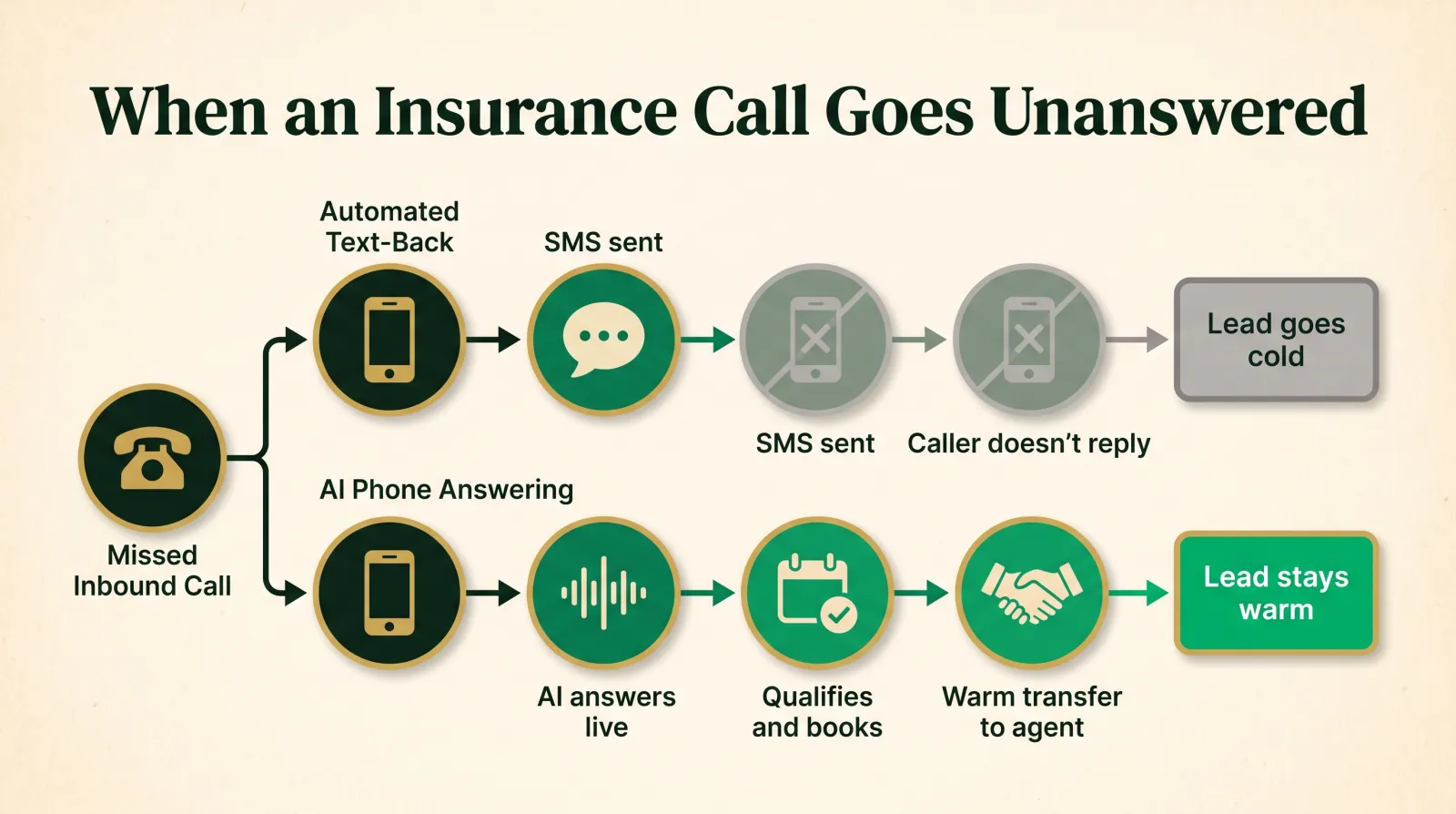
Both approaches start at the same trigger, an inbound call, and diverge from there. Neither is a scam or a gimmick; they’re built to do different jobs, and knowing which job you actually need solved is most of the decision.
| What you're comparing | Missed-call text-back | AI phone answering |
|---|---|---|
| What the caller experiences | A text message, sent after the call goes unanswered | A live spoken answer, on the same call, no wait |
| Can it qualify the caller? | Only if they reply and someone types back fast | Yes, in the same conversation, by voice |
| Can it book an appointment against real availability? | Not on its own; needs a human or a link the caller clicks | Yes, checks a live calendar during the call |
| Warm transfer to a licensed agent | No mechanism for this | Yes, while the caller is still on the line |
| Typical cost | Free to low-cost, often included in a CRM you already pay for | Monthly platform fee plus a per-minute rate |
| Best fit | Low call volume, or as a fallback layer behind something else | Any volume where a missed call is a missed sale |
The honest read of that table: text-back is a cheap, easy acknowledgment layer, not a lead-recovery system. It’s worth having regardless, because a caller who gets nothing at all is worse off than one who gets a text. It just isn’t the thing that closes the gap Invoca’s 56% figure describes.
A Worked Example: Two Callers Named Carlos
Picture two versions of the same caller, a man named Carlos, calling an agency’s published number at 6:40 on a Wednesday evening about a Medicare Advantage plan his mother needs before a deadline.
On the text-back path, the call rings four times and goes to voicemail. Twenty seconds later, a text arrives: “Sorry we missed your call! We’ll get back to you soon.” Carlos, driving to pick up his mother from an appointment, glances at it, doesn’t recognize the number, and doesn’t reply. Nobody follows up, because nobody’s watching for a reply that never came. Three days later, someone at the agency notices the missed call in a report and calls back. Carlos already worked with a different agent his sister recommended.
On the AI answering path, the same call is picked up on the first ring by a voice that identifies itself, confirms it’s an automated assistant, and asks what he’s calling about. Carlos explains the deadline. The system checks the calendar, confirms a licensed agent has an opening Thursday morning, offers it, and Carlos takes it. Before he’s hung up, the appointment is on the calendar with his name, number, and a note about his mother’s deadline, and the agent has it in the CRM before their coffee’s cold the next morning.
Nothing about Carlos changed between the two versions. The only variable was whether anything on the other end of that specific call could actually talk back.
Where TheAffordableAI Fits
We don’t sell missed-call text-back, and a native workflow on whatever CRM you already run costs nothing extra to turn on; there’s no reason not to have it running as a baseline. What we build is the layer in front of it: an AI voice agent that answers an inbound call live, on the first ring, so that most calls never reach the “missed” state a text-back workflow exists to patch.
Answers on the first ring
No wait, no voicemail prompt, no hoping the caller texts back. The AI picks up and starts the conversation immediately.
Qualifies by voice, in real time
Asks what the caller needs and gathers the details a human receptionist would, in the same call, not across a text thread.
Books against real calendar availability
Checks live availability and puts a confirmed appointment on the calendar before the call ends, rather than a message for someone to act on later.
Warm transfers when someone's free
Rings 20+ agents at once on the Agency plan; first to answer takes the live caller, right then, instead of a callback task.
Native HighLevel sync
Transcript, disposition, and booking land on the contact record automatically, on the same CRM your text-back workflow already lives on.
24/7, including the hours a text can't fix
Answers live at 9pm on a Sunday the same way it does at 9am on a Tuesday, no shift schedule to manage.
What You Actually Get
A caller phones your published number. Instead of ringing out to a text they may never open, the call is answered immediately by a system that identifies itself, listens to what the caller actually needs, checks a real calendar, and either books the appointment directly or, if a licensed agent is free right now, connects them live while the caller is still holding the phone. The whole interaction, transcript included, is sitting on the contact record in HighLevel before anyone on your team has had to do anything. The mechanical part of the call, answering it and gathering the basics, happened without a person. The part that requires a license, advice and the sale, still goes to one.
What “Good” Coverage Looks Like
Default missed-call setup
- A generic "sorry we missed you" text, sent after the call rings out
- No one specifically watching for replies to that text
- Caller has to switch from a phone call to typing to continue
- Nothing books an appointment without a human doing it manually
- After-hours calls sit until someone checks the report the next day
AI answering as the first line
- The call is picked up and handled in the same conversation the caller started
- Qualifying questions happen by voice, in seconds, not over a text thread
- A confirmed appointment lands on a real calendar before the call ends
- A free agent gets a live warm transfer instead of a callback task
- Coverage doesn't depend on the hour or who's on shift
Where This Is the Wrong Tool
Be straight about the limits. If your agency fields a handful of inbound calls a week, paying a monthly platform fee and a per-minute rate to answer them is more infrastructure than the problem justifies; the free native text-back feature on your CRM, paired with a person who checks voicemail promptly, probably closes most of that gap already. And if your actual volume problem is that too few people are calling in the first place, no answering system, AI or human, fixes a demand problem; that’s a different conversation about where your leads come from. This piece is about what happens after the phone rings. If it isn’t ringing much, look elsewhere first.
A text tells a caller you noticed. Only a voice on the line tells them you're listening.
Mike MooreMissed-call text-back is worth having, and it costs almost nothing to turn on if you’re already on a platform like HighLevel. Just be honest with yourself about what it does: it acknowledges a call, it doesn’t answer one. If your agency’s inbound volume is high enough that Invoca’s 44% unanswered figure would sting to see in your own numbers, the fix isn’t a better text, it’s something that picks up. Build the text-back workflow as your fallback layer either way, and price a live-answering system against what a caller like Carlos, driving home with a deadline and a decision to make, is actually worth to you this month.
Frequently asked
What is missed-call text-back, and does it work for insurance agencies?
Missed-call text-back is a workflow, built natively into platforms like HighLevel and buildable in Twilio, that automatically sends an SMS to a caller the moment an inbound call to your business number goes unanswered. It works in the narrow sense that it does what it says: a text goes out fast, usually within a minute, telling the caller you saw the call. It doesn't put anyone on the phone, though, and a caller who dialed an insurance agency because they wanted to talk to someone about a plan may not want to switch to texting a stranger back. Treat it as an acknowledgment, not a recovery.
Is an automated text reply to a missed call legal under the TCPA?
The clearest answer comes from the Supreme Court's 2021 ruling in Facebook, Inc. v. Duguid, which held that an automatic telephone dialing system under the TCPA must have the capacity to store or produce numbers using a random or sequential number generator. A missed-call text-back system doesn't generate numbers at all, it reacts to the specific number that just called your specific business line, so it falls outside the narrowed ATDS definition the Court adopted. That's a meaningfully different legal posture than a marketing blast to a purchased list. It isn't a blanket green light, though: content still matters, an unsubscribe path still matters, and if the reply text pivots into marketing rather than acknowledging the call, you're in different territory. This is not legal advice; confirm your specific setup with counsel.
How much does an AI phone answering system cost compared to missed-call text-back?
Missed-call text-back is close to free if you're already on a platform like HighLevel, since it's a built-in feature you toggle on. A managed AI voice answering system is a different price category because it's doing more: TheAffordableAI's Single Account plan runs $200 a month plus a $500 one-time setup, billed at $0.20 a minute (down to $0.15 at bulk volume); the Agency plan is $500 a month plus a $1,000 one-time setup, at $0.18 a minute (down to $0.16 at bulk), both with no long-term contract. Verify current numbers on the pricing page before budgeting. The honest comparison isn't cost per feature, it's cost per lead actually reached, since a free text nobody answers converts at zero.
Do I have to disclose that an AI is answering the phone?
There's no finalized federal rule as of August 2026 requiring a specific disclosure script for inbound AI voice answering. The FCC's February 2024 declaratory ruling (FCC 24-17) confirmed that AI-generated voices count as an artificial voice under the TCPA, which matters most for outbound calling and consent language, and a separate 2024 proposed rulemaking on AI robocall disclosure hasn't been finalized. Regardless of what's strictly required, telling a caller plainly that they've reached an AI assistant is the safer and more brand-honest choice, especially the first time a given caller encounters it.
Can HighLevel's missed-call text-back and an AI voice answering system run together?
Yes, and for many agencies that's the right setup rather than an either-or choice. Configure the AI voice system to answer first, on the first ring, so most calls never reach the missed-call trigger at all. Keep the native text-back workflow as a fallback for the rare case where the AI system itself is down or a call comes in through a number it doesn't cover, so a caller still gets some acknowledgment rather than dead air.
What happens to a call an AI phone system can't handle?
A well-built system recognizes the edge of its own competence rather than guessing. That means routing a complex coverage question, an angry caller, or anything touching actual insurance advice to a live, licensed agent, either through a warm transfer if someone's available or a flagged callback with the transcript attached if not. If a vendor can't describe what happens when their AI doesn't know the answer, ask before you sign anything.
Does using an AI to answer calls change who's liable for compliance?
No. Whether a call is answered by a human receptionist or an AI voice agent, the licensed agent and agency stay responsible for consent, disclosure, and opt-out obligations, and for Medicare business, the CMS marketing rules including the TPMO disclaimer and call-recording retention. A vendor's technology doesn't carry any of that responsibility away from you.
Is AI phone answering worth it for a small agency with low call volume?
Not always. If your agency gets a handful of inbound calls a week, the free native missed-call text-back feature on whatever CRM you already run, paired with someone who checks voicemail promptly, may close nearly all of the gap for close to nothing. The math starts favoring a managed AI answering system once missed calls happen often enough, nights, weekends, or during business hours when the phones are already busy, that a text-and-hope approach is visibly losing leads you can count.
Sources
- Invoca — The Invoca Lead Conversion Benchmarks Report 2026 (published July 2026; 70+ million calls and 600 million minutes analyzed across 10 industries including insurance)
- U.S. Bureau of Labor Statistics — Occupational Outlook Handbook: Receptionists (data as of May 2024)
- Supreme Court of the United States — Facebook, Inc. v. Duguid, 592 U.S. 395 (decided April 1, 2021)
- Cornell Law School Legal Information Institute — 47 U.S.C. Section 227, Telephone Consumer Protection Act, statutory damages
- Federal Communications Commission — Declaratory Ruling FCC 24-17, AI-Generated Voices and the TCPA (released February 8, 2024)
- HighLevel Support — Call Tracking and Missed Call Text Back Through Google Business Profile
- HighLevel Support — Business Profile Settings (native Missed Call Text Back toggle)
- Twilio — How to Handle No-Answer/Pickup Scenarios with Voicemail and Callback using Twilio Voice
- Twilio Docs — Set up an SMS Autoresponder with Twilio Studio
- CMS — Medicare Communications and Marketing Guidelines
- Washington State Legislature — Engrossed Substitute House Bill 1051, Session Law (automatic dialing device definition, effective July 23, 2023)
- TheAffordableAI — Pricing
Put this on your own phone line
See the AI dial, qualify, and warm-transfer a live call in under a minute. No contract, no dev work.
Keep reading

After-Hours Insurance Leads: The 128-Hour Gap
An agency staffed 9 to 5 on weekdays is unstaffed 128 hours a week. Here is what that costs in after-hours insurance leads, and how to close the gap in 2026.

AI Receptionist for Insurance Agencies: The 2026 Cost Guide
An AI receptionist answers every insurance lead call, day and night. Real 2026 pricing against a live answering service and a receptionist's wage, sourced.

Speed to Lead in 2026: Why the First 60 Seconds Decides Who Writes the Policy
The lead you paid for is not lost to a better agent. It is lost to a faster one. Here is what response time actually does to contact and conversion rates, and how to get to sixty seconds without hiring a dialer team.