Florida Telephone Solicitation Act: Agent Guide 2026
Florida's FTSA does not exempt licensed insurance agents. Here is what a violation costs in 2026, what changed in 2023, and how to stay compliant.
If you sell insurance to Florida consumers, the state’s Telephone Solicitation Act does not exempt you, and that is easy to get backward because a different Florida statute does. Section 501.059, the Florida Telephone Solicitation Act (FTSA), lists no carve-out for licensed insurance brokers, agents, customer representatives, or solicitors anywhere in its text. The older Florida Telemarketing Act, at Section 501.604(8), does exempt licensed insurance producers, but only from that statute’s registration and bonding requirement, a completely different obligation. An agent who reads “insurance agents are exempt in Florida” somewhere and stops there is reading about the wrong law.
That mix-up matters because the FTSA is one of the more aggressively litigated state telemarketing statutes in the country, and it carries a private right of action, meaning a consumer, not just a regulator, can sue directly. This guide walks through what the statute actually regulates, what changed the last time the Legislature touched it, what two bills tried and failed to change in 2026, what a violation costs in real dollars, and how to build a Florida calling program that survives contact with all of it.
Picture the ordinary version of this. Your agency buys a batch of Florida ACA or Medicare Advantage leads, the vendor’s onboarding page says the leads are “TCPA compliant,” and your dialer starts an eight-touch cadence the same way it does for every other state on your list. Nothing about that workflow looks different from what works fine in Georgia or Pennsylvania. Three weeks later a demand letter shows up citing Section 501.059, and the vendor’s compliance promise turns out to have covered federal consent, not Florida’s separate statute. That gap, between what a vendor calls “compliant” and what Florida’s own law actually requires, is where most of this exposure comes from.
The short version
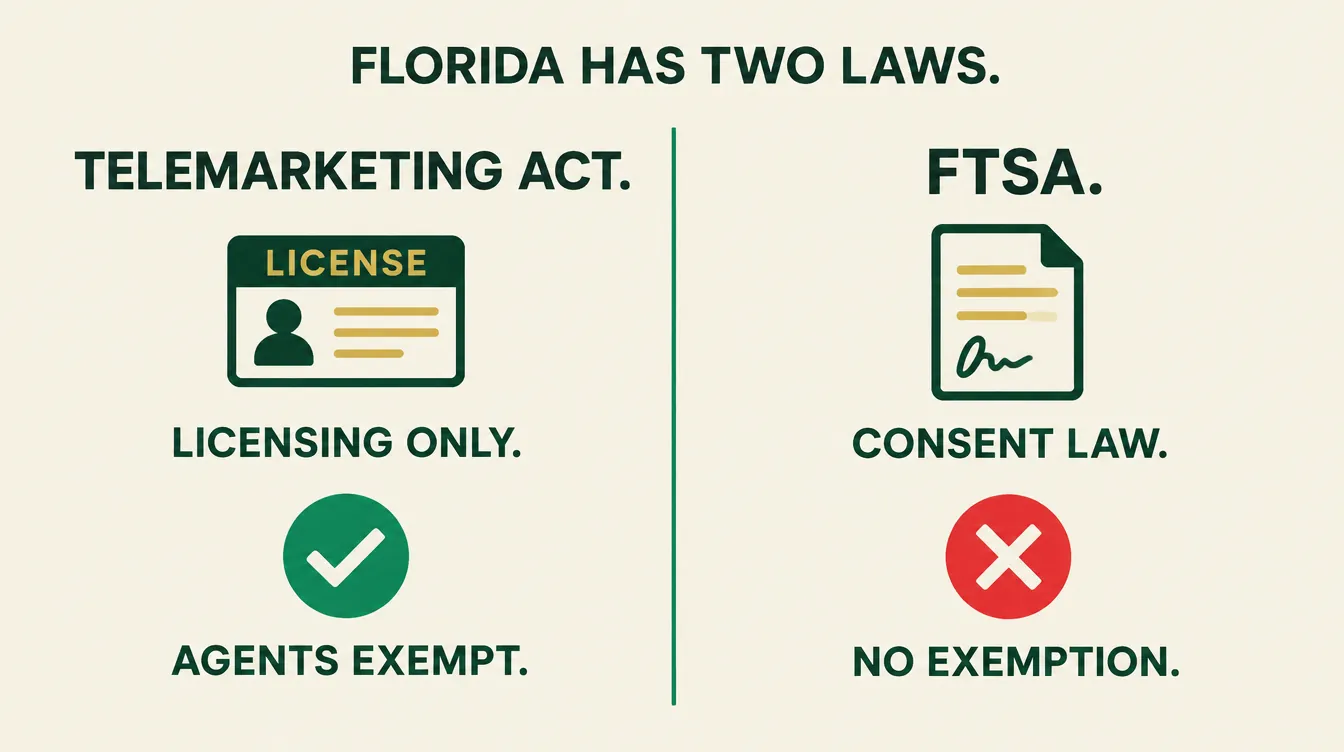
- Florida runs two separate telemarketing statutes. The Telemarketing Act (Section 501.604) is a licensing law that exempts insurance agents. The FTSA (Section 501.059) is a consent law that does not.
- The FTSA's last substantive change was CS/CS/HB 761, effective May 25, 2023, which narrowed the automated-system definition and broadened accepted signature methods for consent.
- Two 2026 bills, SB 134 and SB 1516, tried to change FTSA definitions and add a state caller ID law. Both died in Senate committee on the same day, March 13, 2026.
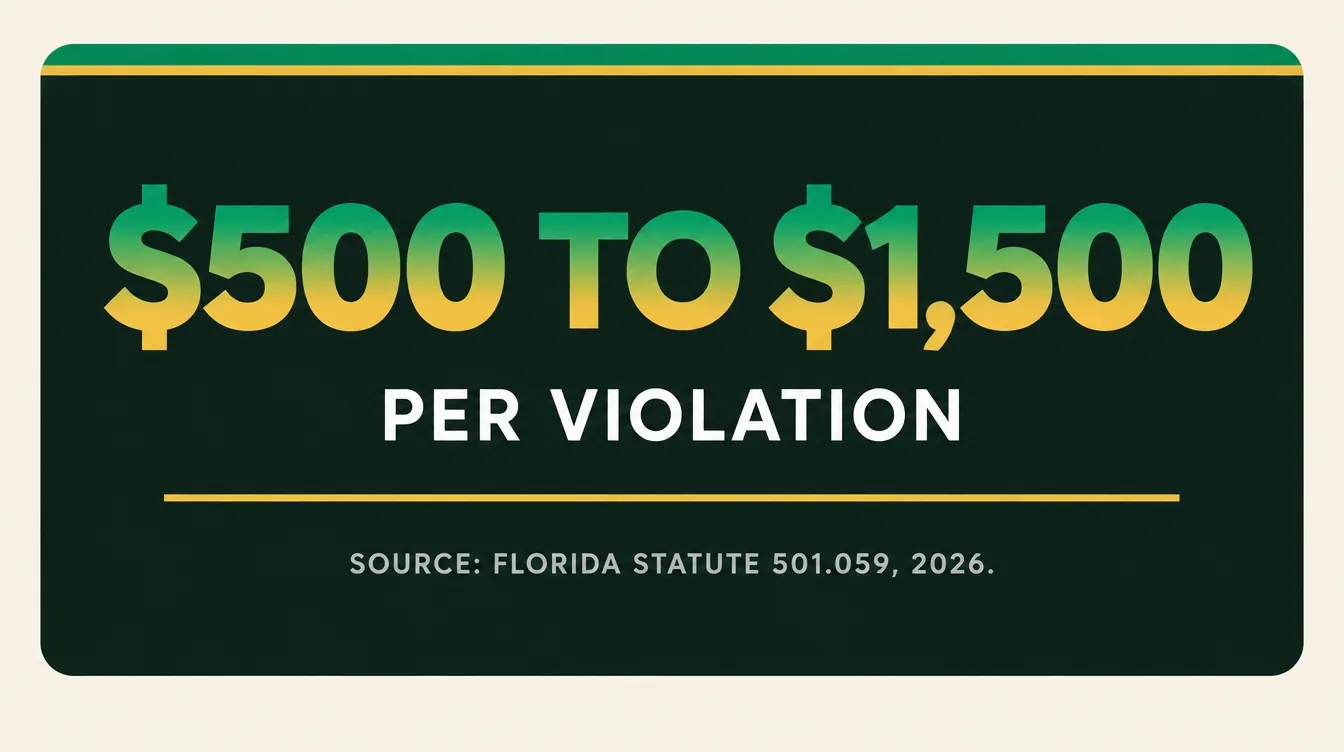
- A violation carries actual damages or $500, whichever is greater, per call or text, tripled to $1,500 for a willful or knowing violation, plus attorney fees for the prevailing party.
- The federal TCPA's own statutory damages apply independently on top of Florida's, and Florida runs its own Do Not Call list separate from the national registry.
What Florida’s Telephone Solicitation Act Actually Covers
The FTSA regulates any “telephonic sales call,” a term the statute defines to include a phone call, a text message, or a voicemail transmission made to solicit a sale of goods or services. It does not just cover live cold calls. If your agency’s dialer drops a voicemail, or your CRM fires an automated text about a plan comparison, both fall inside the same definition a ringing autodialer does.
The operative rule sits in Section 501.059(8): a person may not make, or knowingly allow to be made, an unsolicited telephonic sales call using an automated system for the selection or dialing of numbers, or an artificial or prerecorded voice, without the called party’s prior express written consent. “Prior express written consent” means a signed agreement that names the specific number the consumer authorized, states plainly that consent is not a condition of any purchase, and, since the 2023 amendment, accepts an electronic signature or an affirmative act like checking a box as a valid signature.
Section 501.059’s own exemption list, at subsection (1)(k), is four items long and specific: a call made in response to the consumer’s own express request, a call primarily about an existing debt or contract that has not yet been completed, a call to someone the solicitor already has “a prior or existing business relationship” with, and a call from a newspaper publisher or its agent. Insurance is not on it, and neither is any general “you’re a licensed professional” carve-out. That is the detail that trips up agents who have read a state telemarketing guide written with Oklahoma, Georgia, or a dozen other states in mind, most of which do carve out a licensed producer from their own consent statute the way Florida’s separate Telemarketing Act does. Florida drew that line differently, on purpose, when it added a private right of action to the FTSA in 2021.
Two things about that exemption list are worth sitting with. First, the “prior or existing business relationship” exemption has no defined time limit in the statute’s own text, unlike some other states that cap an established relationship at a fixed window, commonly 18 or 24 months. That absence cuts both ways: it means Florida’s text does not force you to stop treating a client as an existing relationship after two years the way it does elsewhere, but it also means you cannot point to a bright-line rule if a claim turns on how “existing” the relationship actually was. Second, the signature definition that HB 761 broadened lives right next to that exemption list, at subsection (1)(h), and it now recognizes “an electronic or digital signature” valid under applicable law, or “an act that demonstrates express consent, including, but not limited to, checking a box indicating consent or responding affirmatively to receiving text messages.” A checkbox on a real quote form, properly worded, clears that bar. A purchased list with no record of what the consumer actually saw and clicked does not.
The Other Florida Law Everyone Confuses With It
Florida’s Telemarketing Act, codified separately at Chapter 501, Part IV, Sections 501.601 through 501.626, is where the actual insurance exemption lives, and it is a registration statute, not a consent statute. Section 501.605 requires a “commercial telephone seller” to obtain a license from the Florida Department of Agriculture and Consumer Services (FDACS) before soliciting Florida consumers by phone. Section 501.604 then lists 28 categories of callers exempt from that licensing requirement, and category (8) reads: “Any licensed insurance broker, agent, customer representative, or solicitor when soliciting within the scope of his or her license.” That exemption is real, and it means a properly licensed producer does not need a separate FDACS telemarketer license to call a Florida prospect.
What it does not do is touch Section 501.059 at all. These are two different parts of the same chapter, built for two different problems, and reading one statute’s exemption into the other is the single most common mistake I see in how agencies think about Florida. The table below lays out where each one actually applies.
| Statute | What it regulates | Insurance agent exemption | Enforcement |
|---|---|---|---|
| Telemarketing Act (§§ 501.601–501.626) |
Registration and bonding of commercial telephone sellers with FDACS | Yes — § 501.604(8), for a licensed producer soliciting within scope of license | FDACS licensing and complaints |
| FTSA (§ 501.059) |
Consent before an automated call, text, or voicemail; opt-out handling | No — not listed in the statute's own exemptions | Private right of action, consumer or class |
| Florida Do Not Call (FDACS registry) |
Statewide do-not-call list, separate from the national registry | Not stated as a blanket carve-out on the public FDACS page | FDACS complaints |
| Federal TCPA (47 U.S.C. § 227) |
Consent for autodialed or artificial-voice calls nationwide | No blanket exemption in the statute | Private right of action; FCC |
Notice that three of the four rows in that table apply to a Florida insurance agent regardless of licensing status. The one exemption that does exist covers a licensing fee and a registration form, not whether you can legally dial the number in front of you.
How Florida Stacks Up Against States You May Have Already Read About
If you sell across state lines, you have probably already read a version of this guide for Oklahoma, Georgia, Maryland, Pennsylvania, Virginia, or Oregon, and in most of those, the headline finding was that a licensed insurance producer gets a real carve-out from the state’s own TCPA-style consent law. Oklahoma’s Telephone Solicitation Act of 2022, for instance, exempts a licensed insurance broker or agent soliciting within scope of license from its own consent, calling-hours, and frequency-cap rules. Florida is the state in that list where the equivalent carve-out does not exist in the consent statute at all.
| State | Consent statute | Insurance carve-out from consent rules |
|---|---|---|
| Oklahoma | Telephone Solicitation Act of 2022 | Yes, for consent, hours, and frequency |
| Florida | FTSA, § 501.059 | No exemption in the statute's own text |
The lesson is not that Florida is uniquely hostile to the industry. It is that “am I exempt as a licensed agent” is a state-by-state, statute-by-statute question, and the answer you got from a different state’s guide, even one written about a different Florida-sounding law like the Telemarketing Act, does not transfer. Treat every new state on your calling list as its own research project, not an extension of the last one.
What the 2023 Amendment Changed, and What It Didn’t
CS/CS/HB 761 passed the Florida House 99 to 14 and the Senate 29 to 10, and Governor DeSantis signed it on May 25, 2023 as Chapter 2023-150. It is still the current law, and understanding what it actually did keeps you from either overestimating your protection or underestimating your exposure.
Before the amendment, the FTSA applied to a system that could select or dial numbers automatically, a broad definition that swept in software many businesses did not think of as an autodialer. HB 761 changed that “or” to “and”: the statute now applies only to a system that both selects and dials automatically. A platform where a human picks which contact to call, and the software only handles the dialing, arguably falls outside the narrower definition. A platform that pulls the next number from a queue and dials it without a human choosing that specific number does not.
The bill also fixed a practical problem with the original consent language, which some courts had read narrowly enough that even a signed application form did not clearly count as consent to be called about that application. The amended statute now explicitly accepts an electronic or digital signature, or an affirmative act like checking a consent box or replying yes to a text asking whether the consumer wants to receive texts, as a valid signature for prior express written consent.
For text-message claims specifically, HB 761 added a real precondition: a consumer generally cannot sue over an unwanted text unless they replied “STOP” and then received at least one more automated text within the next 15 days. That is meant to filter out a claim based on a single unwanted text with no follow-up, but it does not touch calls or voicemails, and it does not change anything about a caller’s own obligation to honor a stop request immediately once one comes in.
What HB 761 did not do
It did not add an insurance exemption. It did not change the $500 to $1,500 statutory damages range. It did not touch attorney fees. It narrowed one definition and clarified consent mechanics, and both 2026 bills that tried to go further than that died in committee.
What a Violation Actually Costs
Section 501.059(10) sets the damages: a called party can recover actual damages or $500, whichever is greater, for each violation, and a court may award up to three times that amount, $1,500, if it finds the violation was willful or knowing. Section 501.059(11) lets the prevailing party recover reasonable attorney fees and costs on top of that. Those numbers are per violation, meaning per call or per text, and a follow-up cadence that would be completely ordinary in most industries turns into compounding exposure fast if consent was never properly captured in the first place.
Statutory-floor arithmetic on a routine follow-up cadence
Built directly from the § 501.059(10) minimum and treble figures, not a reported settlement or filing statistic.
One consumer's cadence, one statute. A shared list of a few hundred Florida numbers called without valid consent multiplies this per contact, before attorney fees under § 501.059(11).
$500
Minimum statutory damages per violation, § 501.059(10)(a)
$1,500
Treble damages if the violation was willful or knowing
0
Insurance exemptions written into the FTSA's own text
2023
Year of the last amendment the Legislature actually passed
Two 2026 Bills Died in the Same Committee Meeting
Two bills tried to move Florida’s telemarketing framework this session, and both stalled on the exact same day, which is worth knowing if you are relying on a compliance guide written before March 2026 or expecting a change that never arrived.
SB 134, filed by Senator Polsky, would have revised the FTSA’s definitions of “telephone solicitor” and “telephonic sales call,” and would have tightened when a prevailing party in a state-initiated action could recover attorney fees. It was introduced on January 13, 2026, and died in the Senate Commerce and Tourism Committee on March 13, 2026.
SB 1516, with a companion in the House as HB 1299, took a different angle entirely: caller ID, not consent. It would have required voice service providers to authenticate caller identification using the STIR/SHAKEN framework, banned transmitting misleading or inaccurate caller ID information with intent to defraud, cause harm, or wrongfully obtain something of value, and set an effective date of October 1, 2026. It cleared the Commerce and Tourism Committee 9 to 0 on February 11, 2026, a strong first showing, then died in the Regulated Industries Committee on March 13, 2026, the same day SB 134 did.
Neither becoming law means the current FTSA, as HB 761 left it in 2023, stays exactly where it is for now. It also means the caller ID authentication requirement some agencies were bracing for did not arrive this year, though the underlying federal STIR/SHAKEN framework under the FCC’s own rules already applies to voice service providers regardless of what Florida’s Legislature does with it next session.
How to Get Florida Consent Right Before You Dial
None of this requires a law degree to manage. It requires a documented process, applied every time, before a Florida number gets an automated call or text.
| Check | Why it matters here |
|---|---|
| Signature on file | Electronic signature, a checked consent box, or an affirmative text reply — vague "I agree to be contacted" language on a purchased list rarely meets this bar. |
| The specific number authorized | Consent under § 501.059 attaches to the number the consumer named, not to the consumer in general. |
| "Not a condition of purchase" disclosure | Required language in the consent capture itself, not something you can add after the fact. |
| Federal DNC and reassigned-number check | The national registry and the FCC's Reassigned Numbers Database sit on top of Florida's own rules. |
| Florida's own Do Not Call list | A separate FDACS-run registry a consumer may have joined without ever touching the federal one. |
| Timestamp and source logged | If a claim comes in, the burden of proving consent existed sits with the caller, and a dialer's memory is not a record. |
| STOP handled the same day | Immediate, not eventual — the 15-day text precondition in HB 761 protects a caller who honors it, not one who ignores it. |
If you buy third-party leads that claim Florida-compliant consent, verify it the way you would verify any other vendor claim: ask what the actual opt-in language said, when it was captured, and whether you can get a copy of the record, not just a checkbox that a vendor’s own onboarding form told them to check.
Shared leads carry the most exposure, not the least
Shared leads, the kind sold to three or four agencies at once, are where this goes wrong most often, because the consent capture happens once, upstream, at a lead form you never saw, and every buyer downstream inherits whatever that form actually said. “TCPA compliant” on a vendor’s landing page is a marketing claim, not a legal fact, and it almost never distinguishes federal consent from Florida’s separate FTSA requirement. Before you load a shared Florida list into an automated cadence, ask the vendor for the exact consent language shown to the consumer, the date range the leads were captured, and whether the disclosure named your agency or only said “insurance partners.” A vendor that cannot produce that on request is not a vendor whose compliance claim should carry your exposure.
The mistakes that actually show up in practice
A few patterns account for most of the real Florida exposure I see agencies walk into, and none of them require bad intent, just an assumption that turned out to be wrong.
- Assuming the licensing exemption covers consent too. Section 501.604(8) and Section 501.059 are different statutes with different purposes. Being properly licensed and registered does not make an automated call to a non-consenting number legal.
- Treating “existing business relationship” as automatically permanent. The FTSA sets no fixed time limit on it, but a relationship that ended years ago, with no other consent on file, is a weak position to defend a claim from.
- Skipping Florida’s own Do Not Call list. Checking the federal registry and calling it done misses a state-specific list a Florida consumer may have joined without ever touching the national one.
- Not building for the STOP precondition either way. HB 761’s 15-day rule limits when a consumer can sue over texts, but it never limits your own obligation to stop texting the moment someone asks. Building your system around the exception instead of the obligation gets the incentive backward.
- Scaling a Florida campaign before the consent record exists. Volume multiplies whatever gap is already there. A hundred calls on a shaky consent record is a hundred separate exposures, not one bigger one.
Manual, memory-based compliance
- Consent lives in a vendor's word, not a stored record
- Nobody checks Florida's own Do Not Call list separately
- STOP requests get honored whenever someone notices
- Which of two Florida statutes applies is a guess
Logged, automatic compliance
- Consent, source, and timestamp attached to the contact record
- Opt-out honored immediately across call and text
- A documented cadence you can produce if a claim ever comes in
- The licensed agent still makes the judgment calls that matter
The Federal Layer Still Sits on Top of All of This
Figuring out where Florida’s own statutes land you does not settle the question. The federal TCPA, at 47 U.S.C. Section 227, requires prior express consent for an autodialed or artificial-voice call to a wireless number, written consent specifically for a marketing call, independent of anything Florida does with its own exemptions. Its own damages structure mirrors Florida’s almost exactly: actual loss or $500 per violation, tripled to $1,500 for a willful or knowing one.
Before you automate a single dial into Florida
- Prior express written consent, captured and stored with the contact record, not assumed from a purchased list.
- Clear disclosure of what the call or text is, and a working opt-out honored the same day.
- Check both the federal Do Not Call registry and Florida's own FDACS list.
- For Medicare business, current CMS marketing rules, including the TPMO disclaimer and call recording retention, apply in addition to everything above.
- Using an AI caller does not transfer liability. The licensed agent and agency stay responsible for consent, disclosure, and every calling decision made on their behalf.
This is general information, not legal advice. Confirm current requirements against the statute text and your own counsel before building a calling program around it.
The FTC’s Advisory Opinion 03-1, from 2003, addresses a related but separate question: whether the federal Telemarketing Sales Rule applies to insurance telemarketing at all, given the McCarran-Ferguson Act’s deference to state insurance regulation. The FTC’s answer there turns on whether the specific activity qualifies as “the business of insurance” under a three-part test and is itself state-regulated, not on who happens to be making the call. It is a useful piece of the federal picture, but it does not touch Florida’s own FTSA, which exists entirely outside the Telemarketing Sales Rule question.
Where TheAffordableAI Fits
Nothing above changes if you switch from a human dialer to an AI one, and I want to be direct about that instead of pretending a piece of software makes a state statute disappear. What a well-built AI calling setup can do is make the process in the checklist above actually happen every time, instead of depending on someone remembering it during a busy afternoon. The full feature list covers how each piece works together; the six that matter most for a Florida calling program are below.
Consent logged at the contact
Source, timestamp, and the number authorized attach to the CRM record automatically, not to a dialer's session memory.
Disclosure and opt-out, every call
The same disclosure runs on every contact, and a stop request is honored immediately across call and text.
Number warmup and spam defense
A gradually ramped calling pattern instead of a cold number blasting a Florida list on day one.
Warm transfer to a licensed agent
The AI qualifies and discloses. Advice, plan selection, and the sale stay with the licensed producer, where the law puts them.
HighLevel CRM sync
Transcript, disposition, and consent notes land on the contact automatically instead of living in someone's inbox.
No contracts
Single Account runs $200 a month plus a $500 one-time setup, $0.20 a minute. Agency runs $500 a month plus $1,000 setup, $0.18 a minute. Cancel anytime.
See the consent trail before you commit to anything
Put your own number in on the homepage and the AI will call you in seconds, disclosure and all. It is the fastest way to see what a Florida lead actually experiences.
Being exempt from one Florida statute never means being exempt from the other one sitting right next to it.
Mike MooreWhere to Start This Week
You do not need outside counsel to get the basics right, though it is worth having counsel review your actual consent language before you scale a Florida campaign. Do these three things first.
- Pull your Florida contact list and check what consent actually exists for each number. Not what a vendor promised, what you can produce: a signature, a timestamp, and the specific number authorized.
- Separate your two Florida obligations. Confirm you are properly licensed (or exempt under the Telemarketing Act’s Section 501.604) for registration purposes, and separately confirm every automated call or text has valid FTSA consent. They are not the same checkbox.
- Check Florida’s own Do Not Call list through FDACS, not just the federal registry, and build a process that honors a STOP request the same day it arrives, on every channel.
Watch the next session, not just this one
SB 134 and SB 1516 both died in committee, not on the floor, which is often where a bill comes back the following session in slightly revised form. If you do meaningful volume into Florida, it is worth a standing habit of checking flsenate.gov each spring rather than relying on a guide written in a prior session.
Florida did not carve insurance out of its telephone solicitation law the way several other states have, and two 2026 attempts to change the surrounding rules both stalled in committee. That leaves the statute exactly where HB 761 set it in 2023: no exemption, real statutory damages, and a private right of action that does not wait for a regulator to act. Build the consent record before the first automated call goes out, not after a demand letter arrives.
Frequently asked
Are insurance agents exempt from the Florida Telephone Solicitation Act?
No, not from the part that actually creates lawsuit exposure. Florida Statute 501.059, the Florida Telephone Solicitation Act (FTSA), lists no exemption for licensed insurance brokers, agents, customer representatives, or solicitors in its own text. That is different from Florida's older Telemarketing Act, at Section 501.604(8), which does exempt a licensed insurance broker or agent soliciting within the scope of their license, but only from that separate statute's registration and bonding requirement. Agents routinely confuse the two and assume the licensing exemption covers the consent law too. It does not.
What is the difference between Florida's Telemarketing Act and the FTSA?
The Telemarketing Act, Chapter 501 Part IV of the Florida Statutes, is a licensing and bonding statute. It requires a commercial telephone seller to register with the Florida Department of Agriculture and Consumer Services, and Section 501.604 lists 28 categories of callers, including licensed insurance producers, exempt from that registration requirement. The FTSA, at Section 501.059, is a separate consent statute. It governs whether you can legally call, text, or leave a voicemail for a consumer using an automated system in the first place, and it carries a private right of action with statutory damages. A caller can be fully exempt from one and fully exposed under the other.
What changed in Florida's telemarketing law in 2023?
CS/CS/HB 761, signed into law on May 25, 2023 as Chapter 2023-150, amended Section 501.059 in three ways that matter for a caller. It narrowed the definition of a regulated automated system to one that both selects and dials numbers automatically, replacing an earlier 'or' that had made the statute apply more broadly. It broadened what counts as a valid signature for prior express written consent to include an electronic signature or checking a consent box. And it added a precondition for text-message lawsuits: a consumer generally has to allege they replied 'STOP' and then received another automated text within 15 days before they can sue over it.
Did Florida pass new telemarketing or caller ID rules in 2026?
No, not this session, though two bills tried. SB 134 would have narrowed the FTSA's definitions and limited when a prevailing party could recover attorney fees; it died in the Senate Commerce and Tourism Committee on March 13, 2026. SB 1516, a companion to House Bill 1299, would have required voice service providers to authenticate caller ID using STIR/SHAKEN and banned transmitting misleading caller ID with intent to defraud, with an October 1, 2026 effective date; it passed its first committee 9 to 0 but died in the Regulated Industries Committee, also on March 13, 2026. The FTSA in effect today is still the version HB 761 produced in 2023.
How much can a Florida FTSA violation actually cost an agency?
Under Section 501.059(10), a called party can recover actual damages or $500, whichever is greater, for each violation, and a court can award up to three times that, $1,500, if the violation was willful or knowing. That figure applies per call or text, not per lawsuit, so a short automated sequence to a list of Florida numbers without proper consent can produce a violation count in the hundreds before a single conversation ever happens. A prevailing party can also recover reasonable attorney fees and costs under Section 501.059(11), and the federal TCPA's own $500 to $1,500 per-violation exposure applies independently on top of it.
Does Florida have its own Do Not Call list separate from the federal registry?
Yes. The Florida Department of Agriculture and Consumer Services (FDACS) maintains a state-specific Do Not Call list, free for consumers to join, in addition to the FTC's national registry. FDACS is also the agency that licenses commercial telephone sellers under the Telemarketing Act and handles complaints and enforcement for both. A Florida calling program that only checks the federal registry is checking one of two lists a consumer may be on.
Does using an AI voice caller change FTSA liability for an agency?
No, and if anything it raises the stakes on getting the automated-system definition right, since HB 761's narrowed 'select and dial' language was written with software-driven calling in mind. The FCC's February 8, 2024 declaratory ruling already established that an AI-generated voice counts as an 'artificial' voice under the federal TCPA. Consent, disclosure, honoring a STOP request, and figuring out which Florida statute applies to a given call stay with the licensed agent and agency, whether a person or a piece of software places the call.
What counts as prior express written consent under Florida law?
Since the 2023 amendment, it means a signed agreement, and the statute now reads 'signed' broadly enough to include an electronic or digital signature, or an affirmative act like checking a consent box or replying yes to a request to receive texts, so long as the consumer clearly authorized calls or texts from an automated system to the specific number given, and was told that consent is not a condition of any purchase. A purchased lead list with generic 'I agree to be contacted' language is not the same thing, and the burden of proving the consent existed sits with the caller, not the consumer.
Sources
- Florida Senate — The 2026 Florida Statutes, Section 501.059, Telephone Solicitation
- Florida Senate — The 2026 Florida Statutes, Section 501.604, Telemarketing Act Exemptions
- Florida Senate — CS/CS/HB 761 (2023), Chapter 2023-150, Telephone Solicitation
- Florida Senate — SB 134 (2026 Regular Session), Telephone Solicitation
- Florida Senate — SB 1516 (2026 Regular Session), Telecommunications Caller Identification
- Cornell Law School Legal Information Institute — 47 U.S.C. Section 227, Telephone Consumer Protection Act
- Federal Communications Commission — Declaratory Ruling FCC 24-17, AI-Generated Voices in Robocalls (February 8, 2024)
- Federal Trade Commission — Advisory Opinion 03-1, Telemarketing Sales Rule and Insurance (August 19, 2003)
- Florida Department of Agriculture and Consumer Services — Florida Do Not Call
- TheAffordableAI — Pricing
Put this on your own phone line
See the AI dial, qualify, and warm-transfer a live call in under a minute. No contract, no dev work.
Keep reading
Oklahoma Telemarketing Law for Insurance Agents (2026)
Oklahoma's 2022 telemarketing law exempts licensed insurance agents from its own consent and calling-hour rules. Federal TCPA and DNC rules still apply.
Georgia Telemarketing Law for Insurance Agents (2026)
SB 73 added vicarious liability and class actions to Georgia's telemarketing law. What changed, what a violation costs, and how agents stay compliant.
Florida Insurance Leads: Speed to Lead Under the FTSA
Florida sold more 2026 ACA plans than any state, yet its telephone law adds exposure on top of federal TCPA. How agencies follow up fast and compliant.