Disability Insurance Leads: Why Nobody Calls Twice
Only 18% of adults who say they need disability insurance have it, per LIMRA. Here's why these leads go cold from neglect, not speed, in 2026.
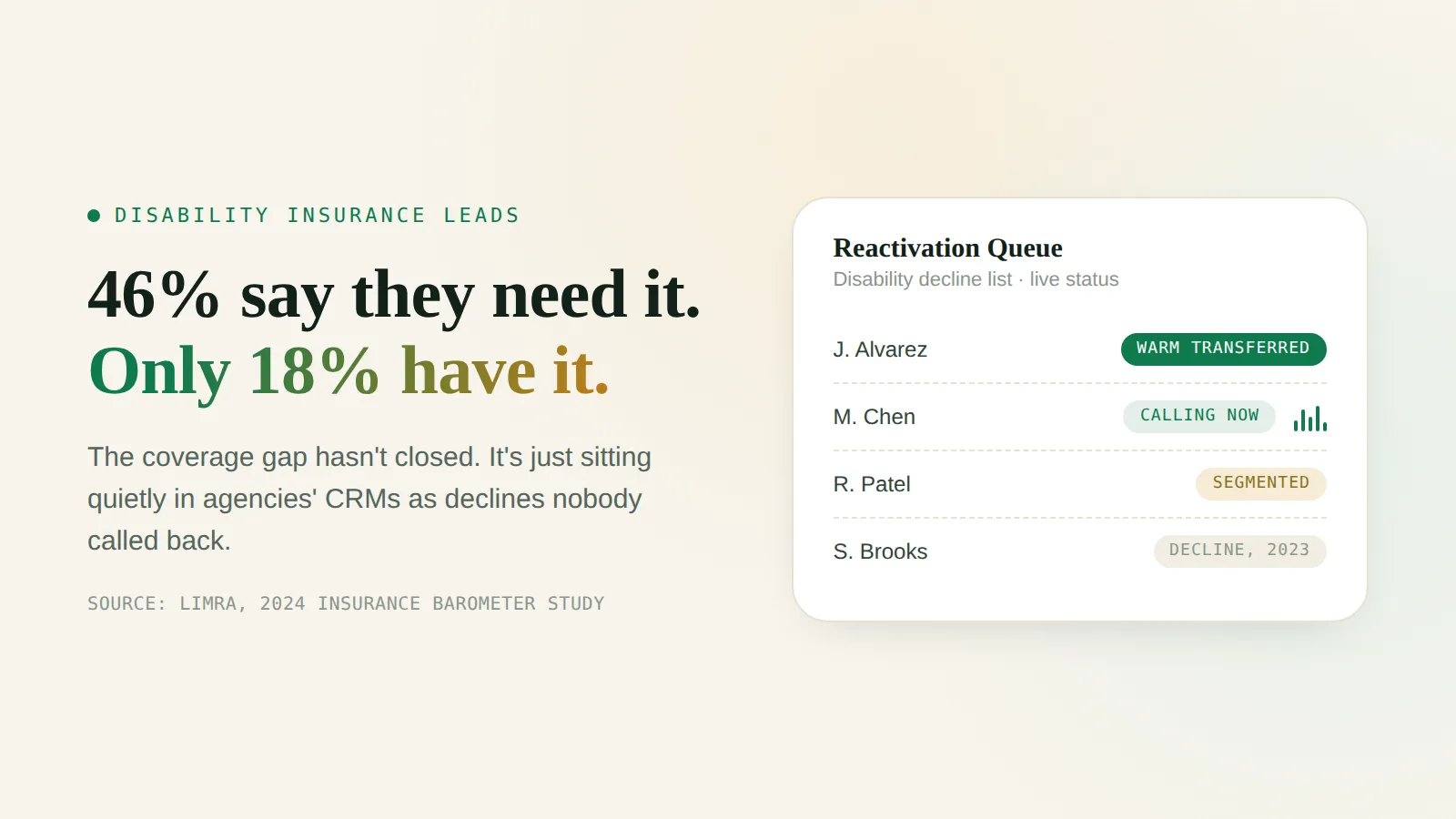
An employee checks the disability insurance box during open enrollment, gets a pop-up asking for more information, and closes the tab because it’s 4:45 on a Friday. A life insurance client asks their agent, almost in passing, “what happens if I get hurt and can’t work for six months,” and the agent says “good question, let me get back to you,” and doesn’t. A 1099 contractor fills out a quote request after a slow month with no sick pay, then never hears from anyone. None of these people got an answer, and unlike an auto or home quote, nobody else called them either. The lead didn’t die from speed. It died because nobody ever tried a second time.
This is about why disability insurance leads behave differently from every other lead type on this site, what the coverage gap actually looks like using numbers pulled and verified this year, how to build a reactivation process yourself with the CRM you already have, and where a managed AI caller is genuinely useful for this specific product, and where it isn’t.
The short version
- 46% of U.S. adults say they need disability insurance, but only 18% have it, according to LIMRA's Insurance Barometer research.
- Only 31% of private industry workers have long-term disability insurance through their employer, per U.S. Census Bureau data cited by the NAIC.
- More than 1 in 4 of today's 20-year-olds will become disabled before reaching retirement age, a Social Security Administration figure independently cited by both LIMRA and the NAIC.
- Disability leads rarely die from a slow first call the way auto or home leads do. There's no competing insurer racing for the same prospect, so the record just sits, uncontacted, for months.
- The fix isn't faster first-touch. It's building a second and third touch that most agencies never build at all.
What a disability insurance lead actually is
Disability insurance, sometimes called disability income insurance, replaces a portion of someone’s paycheck if an injury or illness keeps them from working. The National Association of Insurance Commissioners draws a clear line between the two main types: a short-term disability income policy generally pays a benefit for up to five years on an individual policy, or up to one year under a group plan, while a long-term policy pays for more than five years individually, or more than a year under group coverage, arising from either accident or sickness. A typical policy replaces roughly 60% of pre-disability earned income, based on the income level at the time of purchase, per the same NAIC consumer guide.
A disability insurance lead, in practice, is anyone who touched that conversation and didn’t finish it. That includes someone who checked the box during benefits enrollment and abandoned the form, a client who asked about it inside a different conversation, a self-employed person or 1099 contractor with no employer plan at all, and a past client whose group coverage lapsed when they changed jobs. It also includes worksite or voluntary benefits enrollees who declined coverage during open enrollment, a group this article treats as a lead too, since a decline made once during a rushed 15-minute enrollment window isn’t the same thing as an informed no.
| Factor | Short-term disability | Long-term disability |
|---|---|---|
| Benefit period, individual policy | Up to 5 years | More than 5 years |
| Benefit period, group policy | Up to 1 year | More than 1 year |
| Typical income replacement | ~60% of pre-disability earned income | ~60% of pre-disability earned income |
| Common source | Employer benefit, voluntary worksite plan | Employer benefit or individual policy |
Source: National Association of Insurance Commissioners, Consumer Insight: A Worker's Most Valuable Asset.
The coverage gap hasn’t closed, it’s just quiet
Here’s the part that should reframe how an agency treats an old disability lead: the need this product answers hasn’t gone anywhere, and most of it is still unmet. LIMRA’s 2024 Insurance Barometer Study found that 46% of U.S. adults say they need disability insurance, while only 18% say they actually have it, a gap LIMRA’s 2025 Disability Insurance Awareness Month research restates as still current. On the employer side, the NAIC cites U.S. Census Bureau data showing that only 31% of private industry workers carry long-term disability insurance through their job, meaning even someone with employer benefits is more likely than not to be without this specific one.
The risk underneath that gap isn’t small or hypothetical. Both LIMRA and the NAIC separately cite Social Security Administration data for the same figure: more than one in four of today’s 20-year-olds will become disabled before reaching retirement age. That’s two independent organizations, in two different articles, both pointing back to the same government estimate, which is about as much corroboration as a single widely-cited figure gets when the original agency page itself wasn’t reachable to verify directly this session.
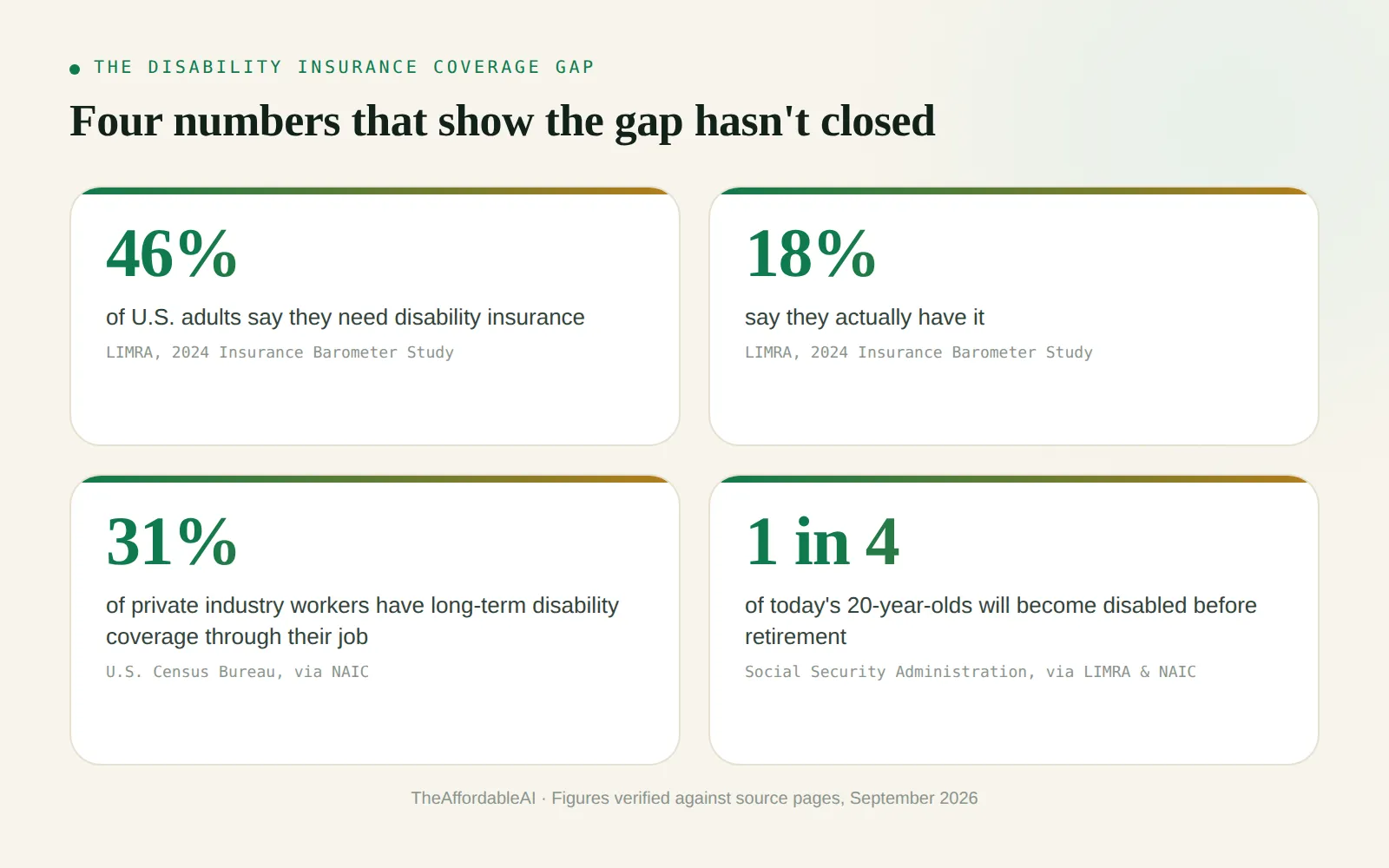
Every one of those numbers describes a person who is currently uninsured against a real risk, not a hypothetical prospect. When one of them shows up in your CRM as a decline from eight months ago, the gap this section just described hasn’t shrunk in the meantime. The lead is still exactly as relevant as it was the day it went cold.
Why these leads go cold from neglect, not speed
Every other lead-type article on this site is built around a version of the same idea: whoever calls first wins, because someone else is calling too. Disability insurance mostly doesn’t work that way. Nobody is racing an agency to close the same disability prospect the way three carriers compete for the same auto or home quote in the same afternoon. That absence of competition is exactly why the lead survives for months instead of minutes, and exactly why agencies treat it as safe to ignore.
Three things compound. First, the product feels ancillary. It’s rarely the reason someone called the agency in the first place, it comes up alongside a life, health, or benefits conversation, and it gets treated as a follow-up item that never gets followed up. Second, the commission is smaller than the life or health sale sitting next to it, so when a producer is triaging a call list, disability drops to the bottom every time. Third, and this one doesn’t get said enough: a lot of agents don’t know the product well enough to explain it cleanly in sixty seconds, elimination periods, benefit periods, own-occupation versus any-occupation definitions, none of that fits into a quick call, so the conversation stalls on the agent’s side, not the prospect’s.
The lead isn't lost to a faster competitor. It's lost because nobody ever tried a second time.
That’s a fundamentally different failure mode than the one this site usually writes about, and it means the fix is different too. Faster first-touch dialing doesn’t solve a problem that isn’t about speed. What actually closes the gap is building a second, third, and fourth touch, a real reactivation cadence, for a category of lead most agencies never revisit after the first no.
What it costs when nobody calls twice
There’s no single published figure for “the cost of an un-reactivated disability lead,” and this article isn’t going to invent one, because the number depends entirely on how many declines and half-finished conversations sit in a given agency’s own CRM. What’s measurable is the labor cost of doing the reactivation work, and the size of the list worth working.
Take an agency or benefits broker with 800 disability declines and incomplete applications sitting in its systems, going back as far as its data retention and consent policy allows, an illustrative number for this example, not a measured industry average. A single reactivation call, confirming interest, re-explaining the coverage, and either transferring to a producer or booking a review, runs about six minutes on average, another illustrative assumption. That’s 4,800 minutes, 80 hours, of calling to work the entire list once.
At the U.S. Bureau of Labor Statistics’ median hourly wage for an insurance sales agent, $29.94 as of May 2025, a producer personally working that list absorbs $2,395.20 in wage cost for the calling alone, on top of whatever time they’re not spending on new business or renewals while they do it. On TheAffordableAI’s Single Account plan, the same 4,800 minutes of outbound calling run $960 at the standard $0.20-a-minute rate, plus the $200 monthly subscription, for about $1,160 to work the full list once, warm transfer to a producer included. On the Agency plan, the same volume runs $864 in per-minute cost at $0.18 a minute plus the $500 base, for about $1,364, with routing across a full producer roster included rather than priced separately.
| Option | Approx. one-time cost | What it buys |
|---|---|---|
| Producer's own time (BLS median wage) | ~$2,395 | Just the talk time; no redials, notes, or lost new-business hours counted |
| TheAffordableAI, Single Account | ~$1,160 | Outbound reactivation calling, warm transfer, HighLevel sync, one calling line |
| TheAffordableAI, Agency | ~$1,364 | Same, routed across 20+ producers with round-robin and availability toggles |
Illustrative arithmetic using the BLS median hourly wage for insurance sales agents (May 2025) and TheAffordableAI's published per-minute rates (fetched September 2026), at an assumed 800-lead list and 6-minute average handle time. Not a measured industry average or a guarantee of any agency's actual spend or close rate.
That arithmetic only prices the calling. It says nothing about what any of those calls turns into, because this article isn’t going to promise a close rate on work that hasn’t happened yet. What it does show is that reactivating a list an agency already paid to acquire once, through a benefits enrollment platform, a life sale, or an old campaign, costs a fraction of what it costs to generate 800 brand-new leads from scratch.
Why people decline coverage they say they need
If 46% of adults say they need this coverage and only 18% have it, the gap in the middle isn’t full of people who evaluated the product and said a firm no. LIMRA’s 2025 Insurance Barometer Study asked people without disability coverage how they’d actually cover a loss of income, and the answers describe hope, not a plan: 51% said they’d rely on personal savings, 32% said they’d turn to family, 26% said they’d draw from retirement accounts, and 20% said they’d take loans or use credit cards.
How people without disability insurance say they'd cover lost income
LIMRA, 2025 Insurance Barometer Study, respondents without disability coverage
Source: LIMRA, 2025 Insurance Barometer Study, as cited in LIMRA's 2025 Disability Insurance Awareness Month research. Respondents could select more than one option, so figures don't sum to 100%.
None of those are a plan. They’re what’s left when there isn’t one. That’s the actual content of a reactivation call, not a cold pitch, but a real question: “when we talked before, you mentioned relying on savings if something happened, does that still feel like enough coverage for you?” That’s a specific, honest follow-up question, not a script gimmick, and it’s the kind of thing a declined lead from eight months ago is still a legitimate person to ask.
The other side: people who had it and dropped it
Declines aren’t the only source of a cold disability lead. Some of the best candidates for a reactivation call are people who had employer-sponsored disability coverage at some point and stopped paying for it, a different problem with a different opening line. LIMRA’s 2025 research on why employees drop voluntary disability benefits found three reasons doing most of the work: 31% cited increasing costs, 30% said they felt the benefit was underutilized, meaning they never used it and stopped valuing it, and 27% wanted to reduce their overall spending across all their voluntary benefits, not disability specifically.
| Stated reason | Share citing it |
|---|---|
| Rising cost of the benefit | 31% |
| Felt underutilized, never filed a claim | 30% |
| Wanted to reduce overall benefits spending | 27% |
Source: LIMRA, as cited in LIMRA's 2025 Disability Insurance Awareness Month research. Figures reflect stated reasons for dropping voluntary disability benefits and don't sum to 100% because other reasons exist outside the top three.
That “felt underutilized” answer is worth sitting with, because it describes someone confusing not having filed a claim with not having needed the coverage, the same logic that leads people to drop homeowners insurance after a decade with no fire. A reactivation call to this group isn’t re-explaining the product from zero; it’s a shorter conversation about whether the reason they dropped it still holds up, which is often an easier sell than the original one.
The awareness side compounds the confusion. LIMRA’s 2025 BEAT Study found that only 55% of workers can definitively say whether their employer even offers disability insurance, which means close to half the workforce is guessing about coverage they may or may not already have. On the employer side, the same research found real appetite for offering it: 63% of employers in LIMRA’s 2025 Harnessing Growth Study believed their employees would be interested in short-term disability coverage, and 58% believed the same about long-term coverage. The gap isn’t a lack of interest on either side. It’s a lack of anyone closing the loop.
The self-employed gap nobody’s calling
There’s a source of disability leads most agencies never think to mine: their own book of business outside the disability line. The U.S. Bureau of Labor Statistics’ Employment Situation report put the number of unincorporated self-employed workers in nonagricultural industries at 8.78 million as of August 2026. None of those people have an employer benefits enrollment to check a box on. A freelancer, a sole proprietor, a 1099 contractor, and an independent salesperson all carry the same income-loss risk as a W-2 employee, without the 31% employer-coverage figure cited earlier applying to them at all, because there’s no employer plan in the picture to begin with.
An agency that writes commercial auto for contractors, business owner’s policies for sole proprietors, or health coverage for freelancers is already talking to a large share of this population for a different product. Every one of those relationships is a legitimate disability insurance conversation that most agencies never start, not because the prospect said no, but because nobody asked. That’s not a decline sitting in a CRM waiting to be reactivated; it’s a client relationship that never got a disability conversation attached to it in the first place, and it’s arguably the least contested lead source in this entire article, since there’s no prior no to overcome.
How to build a reactivation process yourself
None of this requires new software, and an agency that builds it with what it already has will understand the list better than one that buys a tool first.
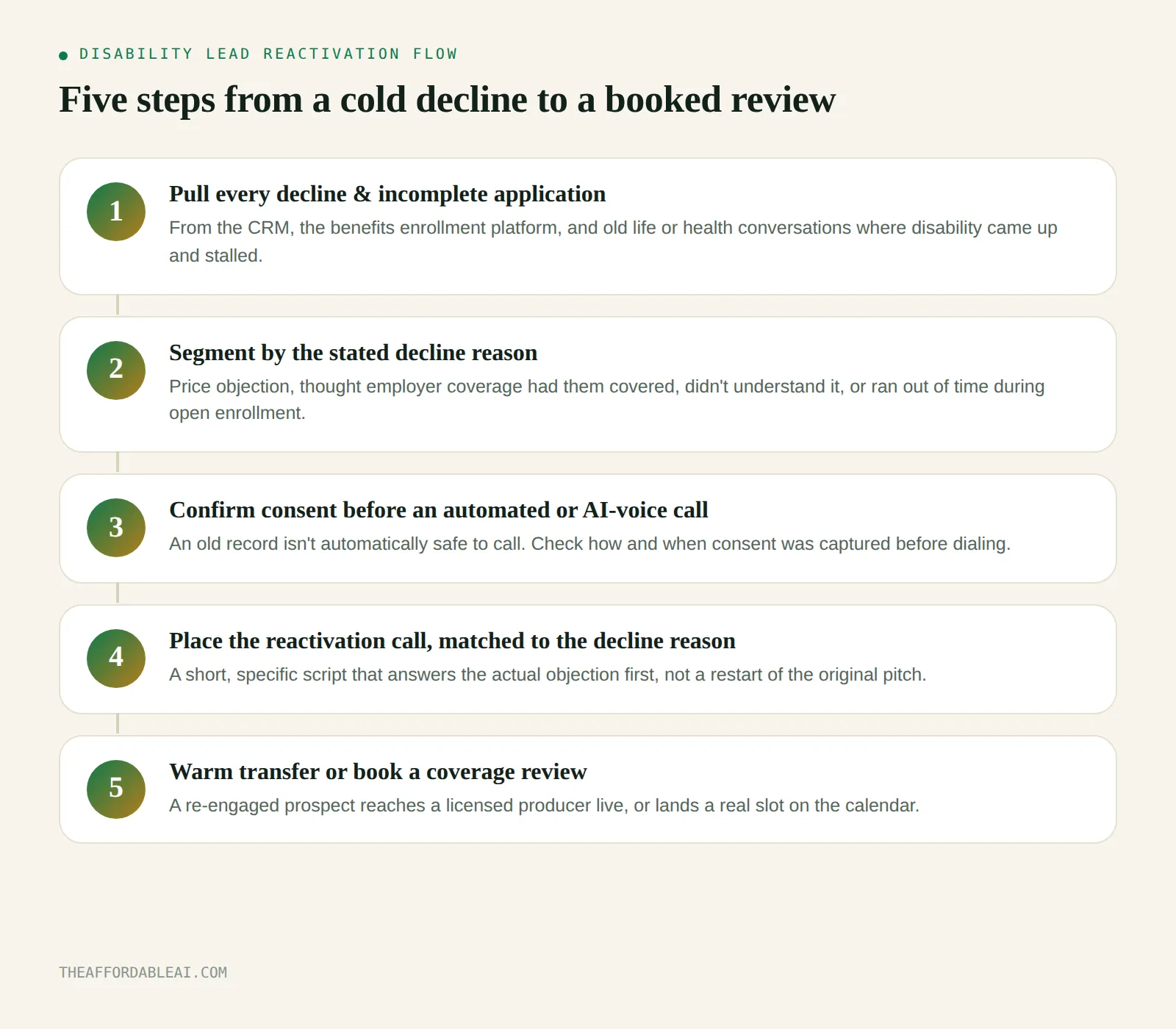
1. Pull every disability decline and incomplete application you can find. Your CRM, your benefits enrollment platform if you broker group business, and your own notes from life and health conversations where disability came up and never got resolved. Go back as far as your consent and data-retention policy allows, not just the last thirty days.
2. Segment by why they said no. “Too expensive,” “thought I had it through work,” “didn’t understand it,” and “ran out of time during open enrollment” are four different conversations. A script that treats all four the same way wastes the one advantage a reactivation call has over a cold one: you already know what stopped them.
3. Write a script that answers the actual objection first. If someone declined because they thought employer coverage had them covered, open with the coverage-confusion angle, referencing that only 31% of private-industry workers actually have long-term disability through their job, not a generic “checking in” line. If it was price, open with the fact that a typical policy replaces roughly 60% of income, not all of it, so the conversation should start with what gap that actually leaves, not a fixed premium number this article can’t responsibly quote without a real underwriting quote behind it.
4. Confirm consent before an automated or AI-voice call goes out. An old record isn’t automatically safe to call the same way a fresh opt-in is. Check how and when the original consent was captured, and treat a number you can’t confirm consent for as a live call from a real person instead of an automated one, or leave it off the list.
5. Log every attempt and disposition. A reactivation list is worth working more than once. If the first pass doesn’t reach someone, log why, no answer, wrong number, asked to be called back later, so the second pass is smarter than the first, not a repeat of it.
6. Plan for more than one attempt, spaced out, not stacked. A single reactivation call that goes to voicemail isn’t a completed pass at the list. Give a record two or three attempts across different days and times before moving it to a longer-cycle nurture, and don’t burn all three attempts in the same 48 hours, since that reads as pressure rather than a genuine follow-up on an old conversation. This is also where the self-employed and lapsed-coverage segments described above deserve their own cadence: a client relationship that never had a disability conversation attached to it can sit in a slower, quarterly check-in cycle instead of the tighter multi-day cadence a recent decline gets.
An agent who reads those six steps and thinks “I could run this myself with our CRM’s tagging system and an afternoon” is right, and should start there. What a platform buys past that point is doing it at volume, consistently, without a producer’s selling time going into the redials.
Where a managed AI caller fits, and where it stops
TheAffordableAI doesn’t explain disability insurance terms, recommend a policy, or quote a premium, and any platform that implies it can do that should be treated with real skepticism. What it does well for this specific product is the reactivation layer described above, run at volume: an outbound call works through a segmented decline list using your agency’s own script for that decline reason, and the moment a real prospect re-engages, it either warm-transfers into a live licensed producer or books a real coverage-review slot against actual calendar availability. Every call and disposition syncs to your own HighLevel CRM, which matters here specifically because the whole point of this exercise is knowing which of 800 old records have already been re-contacted and which haven’t.
You can also build a version of this yourself with your CRM’s task and calling features and a person to run the list. Plenty of agencies do exactly that, especially on a smaller decline list, and the five-step process above is the same one either path runs on. It’s worth pricing both against your own list size before deciding. If you want to hear what the calling side actually sounds like first, there’s a demo call on the homepage.
Works the list you already have
Built for reactivating declines and incomplete applications already sitting in your CRM, not cold prospecting.
Segmented by decline reason
Run a different script for a price objection than for someone who thought employer coverage already had them covered.
Warm transfer, not a pitch
The AI never explains coverage terms or recommends a policy. A re-engaged prospect reaches your licensed producer live.
Every disposition logged
Know exactly which of your old declines have been re-contacted, so the next pass at the list is smarter than the last.
Price your own reactivation list
The worked example above uses 800 leads at six minutes a call because it's an illustrative, round number. Swap in the actual size of your decline list and see where it lands.
What actually changes when a decline gets a second call
An agency that builds this isn’t buying a higher close rate; nobody can promise you that, and any pitch that does deserves suspicion. What changes is more specific: a decline from eight months ago gets treated as the still-valid lead it actually is instead of a closed file, a dropped policy gets a real conversation about whether the reason for dropping it still holds, and a self-employed client already on the books for a different line finally gets asked the disability question at all. None of that guarantees a sale. It guarantees that the 46%-need, 18%-have gap this article opened with stops being purely a national statistic and starts being a specific list of names your agency can actually call.
The compliance layer this article can’t skip
Automated or prerecorded calls, and calls using an artificial or AI-generated voice, to a cell phone require prior express consent under the Telephone Consumer Protection Act, 47 U.S.C. Section 227, and an old lead doesn’t get a pass on that requirement just because it’s been sitting in a CRM for a while. If anything, an aged record deserves more scrutiny, not less: numbers get reassigned, consent captured for one purpose doesn’t automatically cover a different kind of outreach months later, and a lapsed relationship raises real questions about whether the original basis for contact still applies.
Using AI does not transfer liability
Prior express consent, clear disclosure that the caller may be an AI where required, and a working opt-out honored immediately are the licensed agent's and agency's responsibility no matter what places the call. None of that moves to a platform, ours or anyone else's, because the lead is old instead of new.
A statutory violation under 47 U.S.C. Section 227(b)(3) carries actual damages or $500 per violation, whichever is greater, and a court can raise that to as much as three times that amount, up to $1,500, for a willful or knowing violation, per call, not per campaign. This site’s guide on reactivating aged insurance leads and its companion piece on what’s legal to call in an old database go deeper on consent basis for stale records than this article has room for; read one of those before working a list you haven’t touched in over a year.
Disability insurance doesn’t carry the Medicare-specific TPMO disclaimer that a Medicare Advantage or Part D call requires, since it isn’t a Medicare product, but a call using a synthetic or AI-generated voice can still trigger a state-level disclosure requirement independent of anything Medicare-related. Several states have passed their own rules requiring an AI caller to identify itself as artificial at the start of the call, and those requirements vary by state rather than following one federal standard. This site’s guide to AI voice disclosure laws breaks down which states require it and what the disclosure has to say; check it against every state a reactivation list touches, since an old CRM record for a client who’s since moved is easy to overlook when confirming which state’s rule actually applies.
When AI calling is the wrong tool for disability insurance
Some of this conversation needs a licensed advisor’s judgment, not volume. A business owner asking about disability buy-sell funding, a high earner who needs a real income-replacement calculation instead of a rule-of-thumb percentage, or someone comparing an individual policy against imperfect employer coverage, those conversations need a producer who can actually walk through the numbers and the contract language. Pushing that kind of decision through any high-volume calling tool, human or AI, tends to produce a worse outcome, not a faster good one.
There’s also a volume floor. An agency with a dozen disability declines sitting in its CRM probably doesn’t need a platform to reactivate them; a producer with a free afternoon and the segmentation approach above can work that list personally. The math in this article starts to make sense at hundreds of records, not a handful, and the honest answer for a small list might be that your existing team, working the five-step process directly, is already the right tool.
Pull your own decline list, segment it by the actual reason people said no, and price the reactivation cost against your own numbers rather than the illustrative ones above. The coverage gap this article opened with hasn’t closed on its own, and neither will the list sitting in your CRM.
Frequently asked
What counts as a disability insurance lead?
It's anyone who inquired about income protection coverage and didn't buy, or bought and let it lapse: someone who checked the disability box during a benefits enrollment and then didn't finish, a life insurance client who asked 'what happens if I get hurt and can't work' and never got a real answer, a 1099 contractor or small business owner who has no employer plan at all, or a past client whose group long-term disability coverage ended when they changed jobs. It also includes short-term disability inquiries, which are a different product than long-term: per the National Association of Insurance Commissioners, short-term disability income policies generally pay a benefit for up to five years on an individual policy or up to one year under a group plan, while long-term policies pay for more than five years individually or more than a year under group coverage. Most of these leads never come from a single urgent form fill the way an auto or home quote request does. They accumulate quietly, in CRMs and benefits platforms, as declines and half-finished conversations.
Why do disability insurance leads go cold differently than other insurance leads?
Speed still matters on the first call, but it isn't the thing killing most disability insurance leads. There's no second agency racing to close a disability prospect the way three carriers compete for the same auto quote in the same afternoon, so a disability lead doesn't vanish in an hour. It sits, valid and uncontacted, for months, because nobody treats it as worth a second attempt. The product feels ancillary next to a life or health sale, the commission is smaller, and a lot of agents genuinely don't know the coverage well enough to explain it clearly on a first call, so the conversation stalls and never gets revisited. The lead isn't lost to a competitor. It's lost to neglect.
How big is the disability insurance coverage gap right now?
Wide, and stable. LIMRA's 2024 Insurance Barometer Study found 46% of U.S. adults say they need disability insurance, while less than one in five, 18%, say they actually have it, a gap LIMRA's own 2025 Disability Insurance Awareness Month research restates directly. On the employer side, the National Association of Insurance Commissioners cites U.S. Census Bureau data showing only 31% of private industry workers have long-term disability insurance through their job. Both LIMRA and NAIC separately cite Social Security Administration data for the same underlying risk: more than one in four of today's 20-year-olds will become disabled before reaching retirement age. Three separate sources, all pointing at the same unclosed gap.
Do I need consent to call an old disability insurance lead that's been sitting in my CRM?
Generally yes, if the call or text is automated, uses an autodialer, or uses a prerecorded or AI-generated voice, and it's reaching a wireless number, which describes most cell phones. The Telephone Consumer Protection Act's prior express consent requirement, at 47 U.S.C. Section 227(b)(1)(A)(iii), applies to that kind of call regardless of how old the record is. An aged lead is not automatically safer to call than a new one; if anything, a stale record raises harder questions about whether the original consent still covers a call placed a year or two later, or whether the number has been reassigned to someone else entirely. This site's separate guide on [aged insurance leads](/blog/aged-insurance-leads-2026/) covers reactivation consent in more depth than this article can; read that before you dial a list you haven't touched in a while.
Can an AI voice agent explain disability insurance coverage to a prospect?
No, and be skeptical of any platform that implies otherwise. A managed AI caller like TheAffordableAI can place the reactivation call, ask the qualifying questions your agency sets, such as whether someone still has employer coverage, whether they're self-employed, or why they didn't finish enrolling, and then warm-transfer a real prospect to your licensed producer or book a real appointment on the calendar. It does not explain elimination periods, benefit periods, or income-replacement percentages, and it does not recommend a policy. That conversation, the one that actually sells or re-sells disability coverage, stays with a licensed human. The tool only changes whether that human's calendar has anyone on it to talk to.
Is disability insurance a good product for a managed AI caller to prospect for?
It's a good product for reactivation, a weaker one for cold outbound. The whole opportunity here is that agencies already have declined or half-finished disability conversations sitting in a CRM or benefits platform, people who raised their hand once. Calling that list back at volume, with a consistent script, is exactly the kind of repetitive first-touch work a managed caller is built for. Cold-calling strangers about disability insurance with no prior relationship or inquiry is a different, harder problem this article isn't recommending, and running that kind of list also raises separate consent and Do Not Call Registry questions that a reactivation list, built from people who already engaged with your agency, mostly avoids.
What's the fastest way to start reactivating disability insurance leads without new software?
Pull every record in your CRM or benefits enrollment platform tagged as a disability decline, an incomplete application, or a 'maybe later,' going back as far as your consent and data-retention policy allows. Sort by how the coverage was declined, price objection, thought they had it through work, didn't understand it, ran out of time during open enrollment, since each reason needs a different opening line. Write one script per reason that answers the actual objection in the first thirty seconds instead of restarting the pitch from scratch. Confirm your consent basis before an automated or AI-voice call goes out to any number on that list. Plan for two or three spaced-out attempts per record before moving it to a slower nurture cycle, rather than treating one unanswered call as a completed pass. None of that requires buying anything; it requires someone, or something, actually working the list a second time.
Sources
- LIMRA — Disability Insurance Awareness Month: Is Your Income Protected? (published 2025, citing the 2024 Insurance Barometer Study, the 2025 Insurance Barometer Study, the 2025 BEAT Study, the 2025 Harnessing Growth Study, and Social Security Administration 2024 data)
- National Association of Insurance Commissioners — Consumer Insight: A Worker's Most Valuable Asset (citing U.S. Census Bureau and Social Security Administration data)
- U.S. Bureau of Labor Statistics — Occupational Outlook Handbook: Insurance Sales Agents (data as of May 2025)
- Cornell Law School Legal Information Institute — 47 U.S.C. Section 227, Telephone Consumer Protection Act
- U.S. Bureau of Labor Statistics — The Employment Situation, Table A-8, Employed people by class of worker (August 2026 data)
- TheAffordableAI — Pricing (fetched September 2026)
Put this on your own phone line
See the AI dial, qualify, and warm-transfer a live call in under a minute. No contract, no dev work.
Keep reading

Insurance Lead Database Reactivation Guide 2026
Your CRM has leads you already paid for and never worked. Here's how to legally reactivate an insurance lead database in 2026, and what it's actually worth.

Aged Insurance Leads in 2026: What's Legal to Call
The FCC's one-to-one consent rule for insurance leads is dead. Here's what changed, what still applies, and how to reactivate an aged database correctly.

Life Insurance Leads: Why the First Call Wins
Life insurance leads run $0.60 to $160 each, and they decay fast. Here's what 2026 pricing and sales data actually show, and how to fix follow-up.