Aged Insurance Leads in 2026: What's Legal to Call
The FCC's one-to-one consent rule for insurance leads is dead. Here's what changed, what still applies, and how to reactivate an aged database correctly.

Yes, you can legally call your aged insurance leads again in 2026, under the same prior express written consent standard that applied before 2023. The rule that was supposed to make that harder, the FCC’s one-to-one consent requirement, never actually took effect. It got postponed twice, then a federal appeals court threw out the part of it that mattered, and the FCC has since deleted the rule text from its own books. That does not mean an aged database is a free pass. It means the compliance question that matters now is the same one that always mattered: what consent do you actually have, and does the phone number on file still belong to the person who gave it.
Most agencies never got the news that the rule died. They heard, sometime in 2023 or 2024, that a stricter consent standard was coming for anyone who bought leads through a comparison-shopping site or a shared lead generator, and a lot of agencies quietly stopped touching their older lead lists rather than risk it. That caution turned out to be aimed at a rule that a federal court struck down before it ever applied to a single phone call. Meanwhile, the database of leads sitting untouched in a CRM somewhere, the ones from six months ago, a year ago, longer, kept aging without anyone revisiting whether they were actually still off-limits.
The short version
- The FCC's one-to-one consent rule was postponed twice and never took effect. The Eleventh Circuit vacated the underlying provision on January 24, 2025, and the FCC formally deleted the rule text in a final order published August 29, 2025.
- The consent standard for calling an aged lead in 2026 is the same prior express written consent standard that applied before 2023, not a stricter one.
- The real risk in an old database is not the consent rule. It is whether the phone number has been reassigned since you got that consent. The FCC's Reassigned Numbers Database holds more than 361 million numbers for exactly this check.
- A single non-compliant automated call still carries $500 to $1,500 in statutory exposure under the TCPA, a fact the one-to-one rule's demise did not change.
- Medicare leads in a mixed aged database carry additional CMS rules on top of the TCPA, including mandatory call recording and restrictions on unsolicited contact.
What the FCC’s one-to-one consent rule actually was, and why it’s dead
The rule came out of the FCC’s Second Text Blocking Report and Order, adopted in December 2023, which revised 47 CFR § 64.1200(f)(9), the section of the TCPA rules defining prior express written consent. The revision added two new conditions: consent had to be given to one identified seller at a time, not a group of unnamed marketing partners, and the resulting calls or texts had to be logically and topically associated with whatever interaction prompted the consent in the first place. The target was the comparison-shopping and lead-generator business model, where a single consent checkbox on one website could get resold to dozens of buyers under a broad, vague authorization.
The Insurance Marketing Coalition, an industry group representing insurance lead generators and marketers, petitioned the Eleventh Circuit for review, arguing the FCC had exceeded its authority by redefining what “prior express consent” means under the plain text of the statute. While that case was pending, the FCC itself got cold feet about the compliance timeline. On January 24, 2025, the agency’s Consumer and Governmental Affairs Bureau issued Order DA 25-90, postponing the rule’s effective date by 12 months, to January 26, 2026, citing serious concerns raised by commenters about their ability to comply and the fact that oral argument before the Eleventh Circuit had already happened. The order noted, explicitly, that the previous, pre-2023 prior express written consent requirements would remain in effect in the meantime.
That same day, the Eleventh Circuit ruled. In Insurance Marketing Coalition Limited v. FCC, No. 24-10277, the court granted the petition for review and vacated the one-to-one and logically-and-topically-associated provisions, holding that the FCC’s interpretation went beyond the ordinary meaning of “prior express consent” under the statute, and remanded the matter back to the agency. With the rule vacated, the FCC’s own postponed effective date became moot. The agency later made the removal official: a final order, adopted July 14, 2025 and published in the Federal Register on August 29, 2025, formally deleted the vacated language from the Commission’s rules.
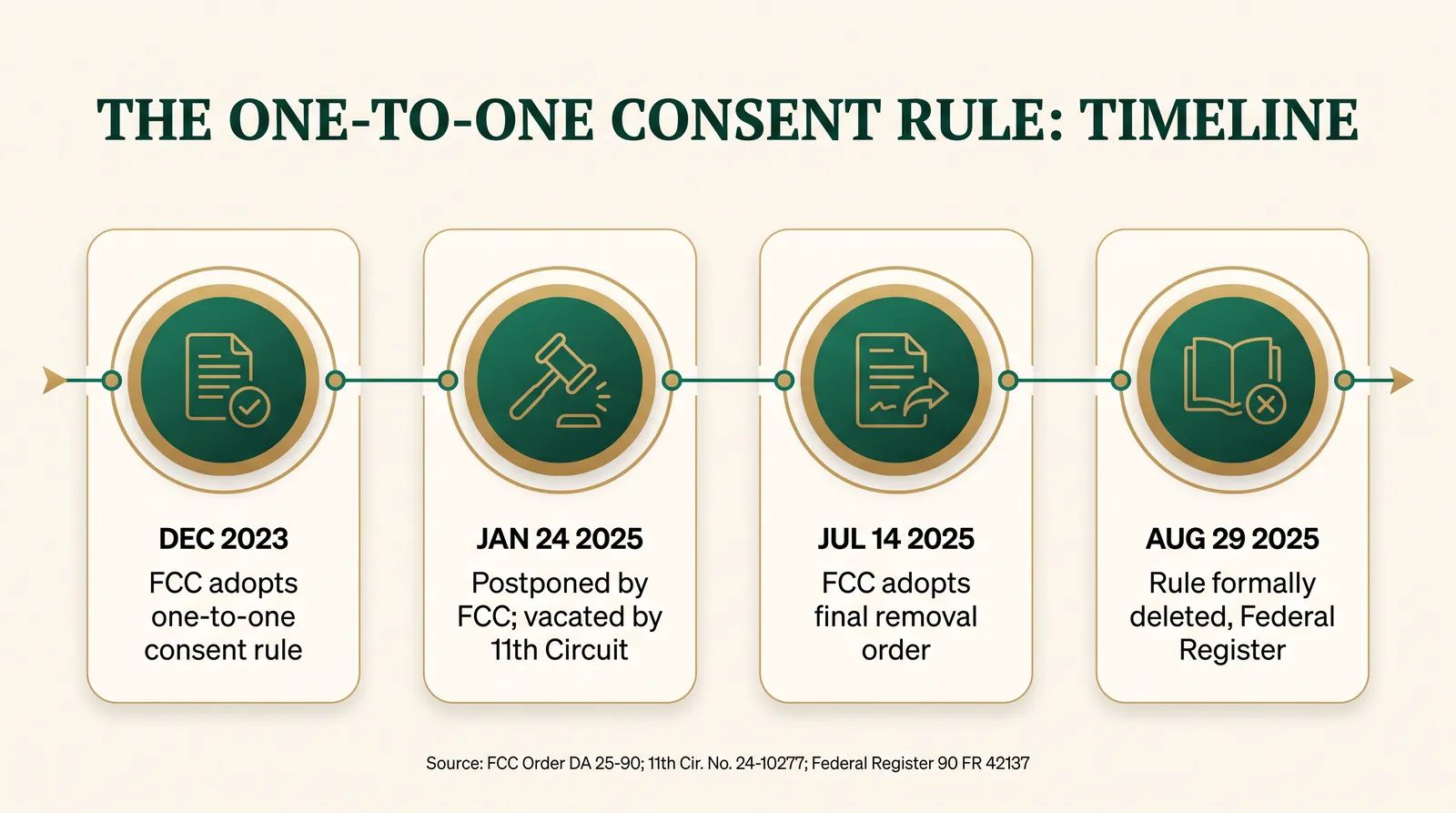
| Date | Event |
|---|---|
| December 2023 | FCC adopts the Second Text Blocking Report and Order, revising 47 CFR § 64.1200(f)(9) to require one-to-one, topically-associated consent |
| January 26, 2024 | Revised rule published in the Federal Register; Insurance Marketing Coalition files its petition for review the same day |
| Original effective date: January 27, 2025 | Postponed by the FCC's own Order DA 25-90, issued January 24, 2025, to January 26, 2026 or a sooner court decision |
| January 24, 2025 | Eleventh Circuit vacates the one-to-one and topical-association provisions in Insurance Marketing Coalition v. FCC, No. 24-10277 |
| July 14, 2025 / August 29, 2025 | FCC adopts, then publishes in the Federal Register, a final order formally deleting the vacated rule text from 47 CFR § 64.1200(f)(9) |
The practical upshot: the stricter standard that made a lot of agencies nervous about their older lead lists was never actually in force for a single day. The consent standard that applies to an aged lead in 2026 is the same one that applied in 2022, before any of this started.
So is it legal to call your old leads again? What “prior express consent” requires now
Prior express written consent, under the surviving version of 47 CFR § 64.1200(f)(9), still requires a clear, written agreement, which can be an electronic signature or an equivalent action like checking a box, authorizing automated or prerecorded calls or texts to a specific number, with a clear disclosure that the agreement is not a condition of any purchase. What went away is the extra layer that would have required that agreement to name one specific seller and restrict the topic of the resulting calls to whatever prompted the consent. A consent record that would have failed the 2023 rule, because it was given to a lead-generation site rather than to your agency by name, is not automatically invalid now. It just has to meet the standard that existed before the 2023 revision, which is a lower bar than agencies spent the last two years bracing for.
That is good news for a database of leads that already has decent consent documentation attached to it. It is not a reason to skip checking. Two things are worth verifying on any batch of aged leads before an automated outreach campaign touches them:
- Does a real consent record exist, and what does it actually say? A vague note like “opted in” with no timestamp, no disclosure language, and no record of what number was authorized is not the same as a signed or checkbox-confirmed agreement naming a specific number.
- Is the underlying phone number still assigned to the person who gave that consent? This is the part the one-to-one consent debate mostly distracted from, and it is the part that actually creates risk in an aged database.
The one-to-one rule and reassignment risk are two different problems
The one-to-one consent rule was about who the consent named. Number reassignment is about whether the person on the other end of the line is even the same person who gave consent at all. The first problem went away in court. The second one was never affected by that ruling, and it gets worse the older your database gets.
The bigger risk in an aged database: the person on the other end may not be who you think
Phone numbers get recycled. A carrier disconnects a number when a subscriber cancels service or stops paying, holds it for a minimum period, and then reissues it to a new customer. That is completely ordinary telecom housekeeping, and it has nothing to do with insurance leads specifically, but it creates a real problem for anyone sitting on a list of numbers that are a year or two old: some meaningful share of those numbers no longer belong to the person who originally gave consent.
The FCC built the Reassigned Numbers Database to solve exactly this. Carriers report permanently disconnected numbers to the database, and a caller can query it to check whether a specific number has been reassigned since a date they specify, typically the date consent was captured. As of this writing, the database’s own published FAQ states it contains more than 361 million geographic and toll-free numbers, a figure that grows every month as carriers file their required reports. The same FAQ confirms that a disconnected number generally has to sit unused for at least 45 days before a carrier can reassign it to a new subscriber, which is the minimum aging window built into the system to reduce accidental collisions.
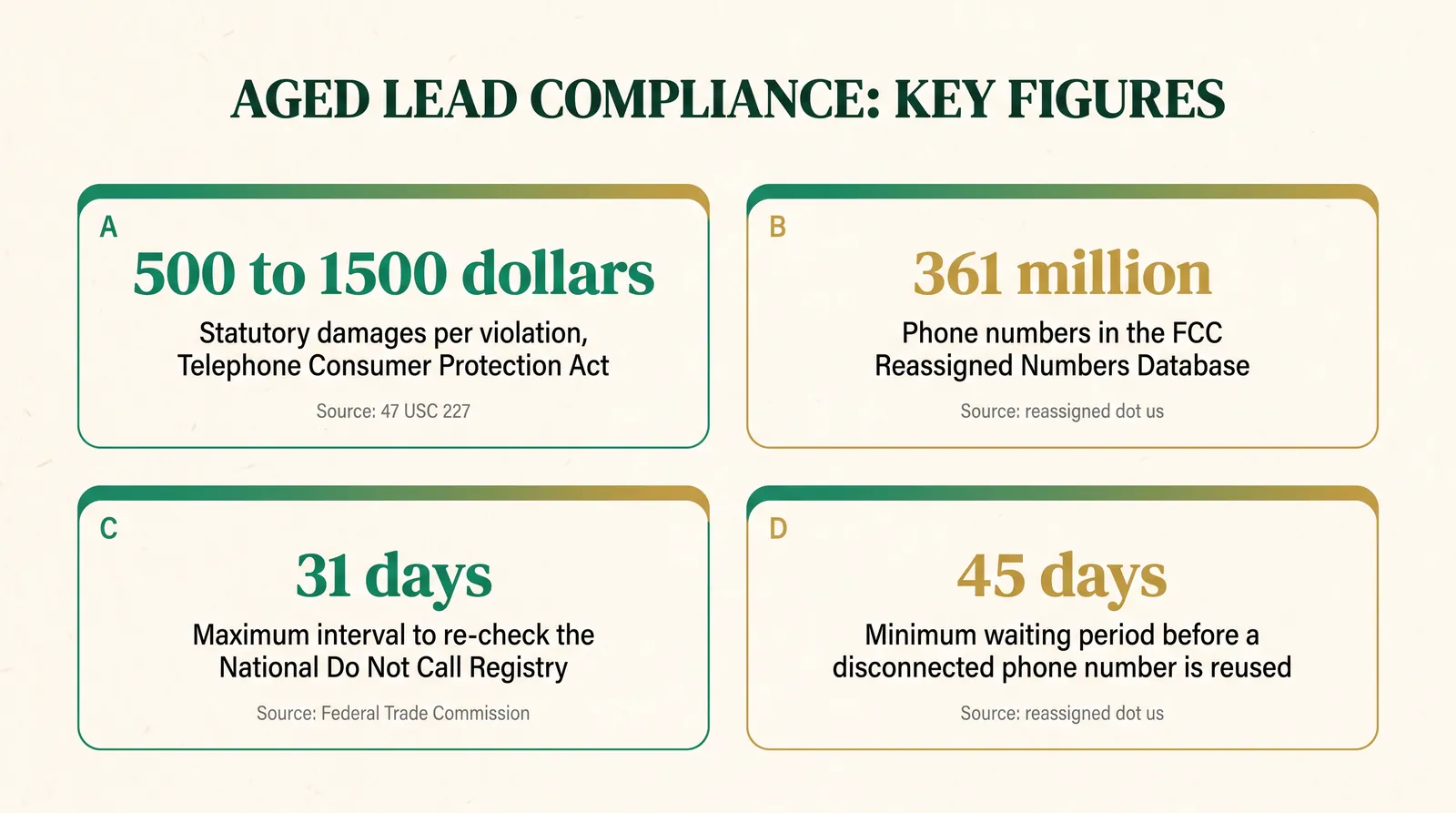
$500
TCPA statutory damages floor, per violation
Source: 47 U.S.C. § 227(b)(3)
361M+
Phone numbers in the FCC's Reassigned Numbers Database
Source: reassigned.us FAQ, accessed 2026
31 days
Maximum interval before telemarketers must re-scrub against the National DNC Registry
Source: FTC, effective January 1, 2005
45 days
Minimum aging period before a disconnected number can be reassigned
Source: reassigned.us FAQ
Here is why that matters legally, not just operationally. Consent under the TCPA attaches to the person who gave it, not to the ten digits they gave it from. If a number has been reassigned since your lead gave consent, the current subscriber never agreed to anything, and a call to that number is a call to someone with zero relationship to your agency. The Reassigned Numbers Database gives you a safe harbor specifically for this: if you had consent, checked the database before calling, and it returned a “no” indicating the number had not been reassigned since the date you specified, you have a documented defense if that determination later turns out to be wrong through no fault of your own. Skip the check, and an aged database with even a modest churn rate on its phone numbers is a database with an unknown number of calls waiting to happen to strangers.
The same logic extends to the National Do Not Call Registry. Under the Telemarketing Sales Rule, telemarketers have to access the registry and purge newly registered numbers from their call lists no more than 31 days before they call, a requirement the FTC put in place effective January 1, 2005 specifically because a number can join the registry at any time, including after your last scrub. A lead who did not mind marketing calls a year ago may have registered their number on the DNC list six months ago. An aged database that has not been re-scrubbed recently is a database that may include numbers you no longer have a clear right to cold-call, separate entirely from whatever original consent you have on file.
What one mistake actually costs
None of the FCC’s rulemaking history changes the penalty structure for getting a call wrong. Under 47 U.S.C. § 227(b)(3), a person who receives a call that violates the TCPA can sue for actual monetary loss or $500 in statutory damages, whichever is greater, and a court has discretion to treble that amount, up to $1,500 per violation, if it finds the violation was willful or knowing. That is per call, not per campaign, and it is not tied to whether the call led to a sale.
Cost of one call, done right versus done wrong
Illustrative, built from this article's sourced figures: TheAffordableAI's published Single Account per-minute rate against the federal statutory damages range for one non-compliant automated call.
Per-minute rate from TheAffordableAI's published pricing. Statutory damages per 47 U.S.C. § 227(b)(3). This is not legal advice and does not estimate your actual exposure, which depends on your own consent records and calling practices.
Put next to each other, the math is not subtle. A single reactivation call, priced at TheAffordableAI’s published Single Account rate of $0.20 a minute, costs about sixty cents for a typical three-minute conversation. A single call made without valid consent to a reassigned or DNC-registered number carries a statutory floor more than 800 times that cost, before anyone even calculates actual damages or attorney’s fees. The rule change did not touch this number. It never applied to it in the first place.
How to reactivate an aged database correctly, step by step
None of this requires buying anything. You can run this entire process with a spreadsheet, a phone, and staff you already have.
- Pull the original consent record for every lead, not just the phone number. If your CRM cannot produce a timestamp, a disclosure, and the specific number authorized for each lead, that lead does not have a documented consent record, whatever your intake form says now.
- Check every number against the Reassigned Numbers Database before an automated call touches it. This is a per-number query, not a one-time database purchase, and it needs to happen close to your calling date, not months in advance.
- Re-scrub the whole list against the National Do Not Call Registry, no more than 31 days before you call. A lead who was fine with marketing calls a year ago may have registered since then, and the registry does not notify you when that happens.
- Segment out anything with missing or weak consent documentation, and route it differently. A live agent placing a manual, non-autodialed call to a number without a strong autodialed-consent record carries a different legal posture than an automated campaign does. When in doubt, route the lead to the channel with the lower compliance bar rather than assuming the automated one is fine.
- Segment Medicare Advantage and Part D leads separately, and layer CMS’s rules on top. These leads need everything above, plus the Medicare-specific requirements covered next.
- Log every check. The Reassigned Numbers Database safe harbor and the DNC scrub requirement both depend on being able to show you checked, not just that you happened to be right.
You can build all six of these steps yourself with a compliance checklist and a disciplined process, and plenty of agencies do exactly that before every reactivation push.
The Medicare-specific layer: TPMOs, recorded calls, and unsolicited contact
If your aged database includes Medicare Advantage or Part D prospects, CMS layers its own marketing rules on top of everything above, and they apply whether the call is made by an employed agent, an independent broker, or a third-party marketing organization working on a plan’s behalf.
CMS’s 2026 Agent and Broker Training & Testing Guidelines require organizations to ensure that any TPMO operating on their behalf “record all marketing, sales, and enrollment calls, including the audio portion of calls via web-based technology, in their entirety,” under 42 CFR §§ 422.2274(g) and 423.2274(g). Calls that are not related to marketing, sales, or enrollment do not need to be recorded, but a reactivation call to a dormant Medicare lead, if it discusses plan benefits or moves toward enrollment, falls squarely inside that requirement. The same guidelines separately list “unsolicited contact with beneficiaries,” outside of an advertised sales or educational event or mailing, as a prohibited or restricted marketing and communications activity, and they specifically address referrals and lead solicitation as an area with its own requirements and restrictions.
A dormant Medicare lead is not automatically "solicited"
Just because someone filled out a form a year ago does not settle whether a fresh outbound call today counts as solicited contact under CMS's current guidance. Confirm what the original lead source actually disclosed and consented to, and if that documentation is thin, treat the Medicare portion of an aged database with more caution than the ACA or life-insurance portion, not less.
None of this is a reason to avoid Medicare leads in an aged database. It is a reason to route them through their own workflow, with call recording enabled by default and a documented basis for the contact, rather than folding them into a general reactivation campaign built around a lighter compliance bar.
The economics: what a reactivation pass actually costs
The lead acquisition cost on an aged database is sunk. You already paid for those names and numbers months or years ago. The only new cost in reactivating them is the cost of the calling capacity to work through the list, plus whatever time it takes to run the consent and reassignment checks above.
| Database size | Single Account, $0.20/min | Agency bulk, $0.16/min |
|---|---|---|
| 500 leads, 3 min avg. call | $300 | $240 |
| 2,000 leads, 3 min avg. call | $1,200 | $960 |
| 5,000 leads, 3 min avg. call | $3,000 | $2,400 |
Those figures are arithmetic, not a promise of a contact rate or a conversion rate. Not every lead answers, and not every call runs exactly three minutes. What the table is useful for is a floor: the calling cost of reactivating a few thousand dormant leads is a few hundred to a few thousand dollars, against a lead-acquisition cost that was already spent regardless of what you do next. The bigger cost driver, by a wide margin, is the compliance work described above, checking consent, checking reassignment, re-scrubbing the DNC list, which takes staff time whether you run the calls yourself or route them through a managed caller.
The rule that scared agencies away from aged leads never took effect for a single day. The rule that was always there, the whole time, is the one worth actually following.
— The core distinction this article is built aroundBefore and after: the same 2,000 leads, worked two different ways
What most agencies are doing with it right now
- Consent records scattered across old CRM notes, spreadsheets, or not retained at all
- No recent check against the Reassigned Numbers Database or the National DNC Registry
- Medicare and non-Medicare leads mixed together with no separate workflow
- The lead cost is already spent, and no commission opportunity is being tested
UnknownShare of numbers that may now belong to someone else
The same 2,000 leads, run through the process above
- Every number checked against the Reassigned Numbers Database before an automated call goes out
- DNC re-scrub completed within the required 31-day window
- Medicare leads segmented into a recorded-call workflow that matches CMS's rules
- A documented compliance basis for every call, not just a hope that the old consent still holds
DocumentedA defensible record for every call placed
Where TheAffordableAI fits
Running the consent and reassignment checks is a process problem, not a calling-capacity problem, and no vendor, including us, changes that part for you. Where a managed AI caller helps is on the other side of that checklist: once a lead is cleared to call, TheAffordableAI can work through a segmented reactivation list at volume, log every disposition against the CRM automatically, and route anyone who reactivates straight to a warm transfer with a licensed agent rather than a note that sits until someone gets to it. The full list of what is included on every plan is on the features page.
Database reactivation campaigns
Work a cleared, segmented list of aged leads on a standing schedule instead of a one-time push that stalls the moment someone gets busy.
Warm transfers and auto-booking
A lead that reactivates gets connected to a licensed agent live, or booked against real calendar availability, instead of parked in a callback queue.
Number warmup and spam defense
A reactivation push means a burst of outbound volume. Numbers ramp on a schedule so the calling number itself does not get flagged mid-campaign.
Native HighLevel CRM sync
Every call, disposition, and transcript lands in the CRM automatically, which is exactly the documentation trail a reassignment or DNC dispute would ask for.
Hear how a reactivation call actually sounds
There is a live demo call on the homepage. Listen to it, then decide whether an aged database is worth clearing for a reactivation pass on your own numbers.
Pricing is published, not quoted privately: a Single Account runs $200 a month plus a $500 one-time setup fee, at $0.20 a minute, down to $0.15 a minute at bulk volume. An Agency plan runs $500 a month plus a $1,000 one-time setup fee, at $0.18 a minute, down to $0.16 a minute at bulk. Both are month to month with no long-term contract, so testing a reactivation pass against your own database costs, at most, one month either way. If you are already on HighLevel, the CRM sync is usually the first thing agencies ask about, and it is covered on the how it works page.
When aged leads aren’t worth calling at all
It would be dishonest to end this without saying it plainly: not every aged database is worth reactivating, and no amount of calling capacity fixes a list that was low quality the day it was purchased. Agents in insurance forums are genuinely split on this. Some describe year-old leads as underworked, lower-competition inventory that converts fine once someone actually calls them with a real script and enough attempts. Others describe old, cold leads as a poor use of dial time compared to fresher volume, and at least one experienced agent’s advice was blunt: for some verticals, the leads that actually pay off from an aged list are the ones you go see in person, not the ones you call.
Both views can be right at once, because “aged lead” covers a wide range of quality, from a database of people who filled out a detailed quote form eighteen months ago to a list of names that were never a particularly good match for what you sell in the first place. The way to find out which one you have is a small test pass, measured against your own contact rate and your own conversion rate, not an assumption borrowed from a forum post or a vendor’s sales page. If a test batch of 200 leads produces almost no live contacts and zero interest after a real, compliant attempt, that is useful information. It means the money is better spent on fresher volume, and continuing to grind through the rest of the list is not going to change that math.
The compliance layer, one more time
Using AI does not transfer liability
A faster, cheaper way to reactivate a database is a real operational benefit. It is never a transfer of licensing liability. Consent, disclosure, DNC compliance, and CMS marketing rules are still the responsibility of the licensed agent and agency, whether a human or an AI voice places the call, and an automated caller does not carry that responsibility away from you.
The FCC’s one-to-one consent rule is gone, and it was never actually in force. That is a genuinely good piece of news for anyone sitting on an aged database they were too nervous to touch. It is not a green light to skip the parts of TCPA and CMS compliance that were never in question: valid, documented consent, a recent Reassigned Numbers Database check, a current National Do Not Call Registry scrub, and, for Medicare leads specifically, recorded calls and a real basis for the contact. Automated or prerecorded calls to a wireless number still need prior express written consent under 47 CFR § 64.1200, and the caller must disclose it is an AI where required, and every call needs a working opt-out honored immediately. Get those pieces right, and the database sitting untouched in your CRM is not dead weight. It is inventory you already paid for, waiting on a compliance checklist rather than a marketing decision.
You can run that checklist yourself with a spreadsheet, a phone, and a disciplined process, and plenty of agencies do. The question worth asking is whether the hours it takes to check every number, re-scrub the list, and keep the documentation straight cost more than the per-minute rate of a managed caller built to do it at volume. Either way, the leads are legal to call again. Whether they are worth calling is the more interesting question, and it is one you can only answer by actually testing your own list.
Frequently asked
Is it still legal to call my old insurance leads in 2026?
Generally yes, under the same prior express written consent standard that applied before 2023, provided the consent you originally captured is still valid and the number has not been reassigned to someone else since then. The FCC's 2023 rule that would have required consent to be given to one seller at a time never actually took effect. The agency postponed it twice while a court challenge played out, and the Eleventh Circuit vacated the underlying provision on January 24, 2025 in Insurance Marketing Coalition Limited v. FCC. The FCC then formally deleted the rule text from its own regulations in a final order published in the Federal Register on August 29, 2025. None of that erases the baseline TCPA consent requirement, the National Do Not Call Registry, or CMS's Medicare marketing rules, all of which still apply to an aged lead exactly as they apply to a brand-new one.
What was the FCC's one-to-one consent rule, and why did it get thrown out?
Adopted in the FCC's Second Text Blocking Report and Order in December 2023, the rule would have required that a consumer's prior express written consent to receive automated calls or texts be given to one specific seller at a time, and that the resulting calls be logically and topically related to whatever interaction prompted the consent. It was aimed at the lead-generator and comparison-shopping model, where a single consent checkbox on one website could be resold to dozens of buyers. The Insurance Marketing Coalition challenged it, and the Eleventh Circuit agreed that the FCC's interpretation went beyond what the term "prior express consent" means under the plain text of the Telephone Consumer Protection Act, vacating that part of the order and sending it back to the agency.
Do I need to re-verify consent before calling an aged lead?
You need to know what consent you actually have on file, which is a different question than assuming it still exists. Pull the original consent record for each lead in the database: what was disclosed, what box was checked or signature captured, and which phone number it names. If a lead's consent record is missing, vague, or was captured through a since-shuttered third-party site with no surviving documentation, treat that lead as unconsented and route it to a channel that does not require prior express written consent, such as a live agent making a manual, non-autodialed call, rather than an automated or prerecorded outreach.
What is the Reassigned Numbers Database and why does it matter for old leads?
The FCC's Reassigned Numbers Database, built for exactly this problem, lets a caller check whether a phone number has been permanently disconnected and reassigned to a new subscriber since a given date, before placing a call. As of this writing, the database holds more than 361 million geographic and toll-free numbers, according to the database operator's own published FAQ, and a number generally has to sit disconnected for at least 45 days before it can be reassigned and reused. For an aged lead, this matters because consent attaches to the person who gave it, not the phone number itself. If that number has since been given to someone new, your old consent does not cover them, and the database is the tool built to catch that before you dial.
What happens if I call a number that's been reassigned to someone new?
You have called a person who never gave you consent, using their number, which is the exact fact pattern the TCPA's statutory damages provision exists for. Under 47 U.S.C. § 227(b)(3), a private plaintiff can recover actual damages or $500 per violation, whichever is greater, and a court can raise that to as much as $1,500 per violation if it finds the call was made willfully or knowingly. Checking the Reassigned Numbers Database before you call, and keeping a record that you checked, is the safe harbor the FCC built specifically to protect callers who consented in good faith and then had the underlying number change hands without their knowledge.
Are Medicare leads in an aged database subject to different rules?
Yes, on top of everything above. CMS's 2026 Agent and Broker Training & Testing Guidelines require organizations and any third-party marketing organization acting on their behalf to record all marketing, sales, and enrollment calls in their entirety, per 42 CFR §§ 422.2274(g) and 423.2274(g), and the guidelines separately flag unsolicited contact with beneficiaries, outside of an advertised sales or educational event or mailing, as a restricted marketing and communications activity. A mixed aged database that includes Medicare Advantage or Part D prospects needs to segment those leads and route them through a workflow that satisfies both the TCPA consent standard and CMS's own marketing rules, not just one or the other.
How much does it cost to reactivate an aged lead database with an AI caller?
The lead acquisition cost is already spent, so the marginal cost of a reactivation pass is just the calling cost. Using TheAffordableAI's published Single Account rate of $0.20 a minute, a 3-minute average call to requalify a dormant lead runs about $0.60, or roughly $1,200 to make a single pass through a 2,000-lead database, before any bulk discount. At the Agency plan's $0.16-a-minute bulk rate, the same pass runs closer to $960. Compare either figure against the $500 to $1,500 statutory exposure of a single non-compliant call, and the economics point the same direction either way: getting the consent check right costs far less than getting it wrong.
Should I even bother calling leads that are a year old or older?
Sometimes not, and it is worth saying that plainly. Agents in industry forums are genuinely split: some report aged leads as a reliable, underworked source of business precisely because fewer competitors are calling them, while others describe year-old leads as a low-yield exercise not worth the dial time. Both can be true depending on the vertical, the original lead quality, and whether your consent and contact records for that batch actually hold up. The honest approach is a small test pass, measured against your own contact and conversion rate, rather than assuming an aged database is either free money or a waste of time before you have actually worked it.
Sources
- Federal Communications Commission — Order, DA 25-90 (postponing the one-to-one consent rule effective date pending judicial review, adopted and released January 24, 2025)
- United States Court of Appeals for the Eleventh Circuit — Insurance Marketing Coalition Limited v. FCC, No. 24-10277 (decided January 24, 2025)
- Federal Register — Delete, Delete, Delete; Targeting and Eliminating Unlawful Text Messages (Doc. 2025-16641, 90 FR 42137, published August 29, 2025)
- Cornell Law School Legal Information Institute — 47 U.S.C. § 227, Telephone Consumer Protection Act
- Federal Trade Commission — Telemarketers Required to Scrub Their Call Lists Every 31 Days Beginning January 1, 2005
- Reassigned Numbers Database (RND) — Frequently Asked Questions
- CMS — 2026 Agent and Broker Training & Testing Guidelines
- TheAffordableAI — Pricing
Put this on your own phone line
See the AI dial, qualify, and warm-transfer a live call in under a minute. No contract, no dev work.
Keep reading

The True Cost of a Missed Insurance Lead in 2026
A missed insurance lead is not a mystery cost. It is a paid-for lead, a forgone commission CMS puts a real number on, and a seat nobody was watching.

CMS 2027 Medicare Rules: The 48-Hour Wait Is Gone
CMS eliminated the 48-hour Scope of Appointment wait, changed the TPMO disclaimer timing, and cut call retention to 6 years ahead of AEP 2027.

Why Your Outbound Number Says 'Spam Likely' — and How to Get It Clean Again
A flagged number quietly destroys a calling operation. Nobody tells you it happened; the pickups just stop. Here is what causes the label, how carriers decide, and the warmup routine that keeps a number healthy.