Build vs Buy: What an AI Voice Agent Costs in 2026
Should your agency build its own AI voice caller or buy one? Real 2026 rates from GoHighLevel, Twilio, Vapi, Bland AI, and Retell, compared line by line.

Yes, you can build your own AI voice calling agent for insurance lead follow-up, and yes, GoHighLevel already has a native version of one. What almost nobody selling either option tells you is what it actually costs once you add up every metered piece, and what it still does not do for you once you have. This article prices out both sides with the vendors’ own published numbers, fetched and confirmed the day this was written: GoHighLevel’s own AI Products rate card, Twilio’s voice pricing, and the public rate cards for Vapi, Bland AI, and Retell AI, set against TheAffordableAI’s flat published rate. Then it walks through exactly what building one yourself involves, step by step, so you can decide with real numbers instead of a sales page’s version of either side.
This matters because “build it yourself” has quietly become a real option for insurance agencies, not just a developer’s hobby project. GoHighLevel, the CRM a large share of independent agencies already run on, now ships its own outbound AI calling feature. A handful of no-code platforms will sell you a voice agent you can be running by the end of the week. Both of those things are true and worth taking seriously. Neither one is free, and neither one is finished the moment the AI can talk.
The short version
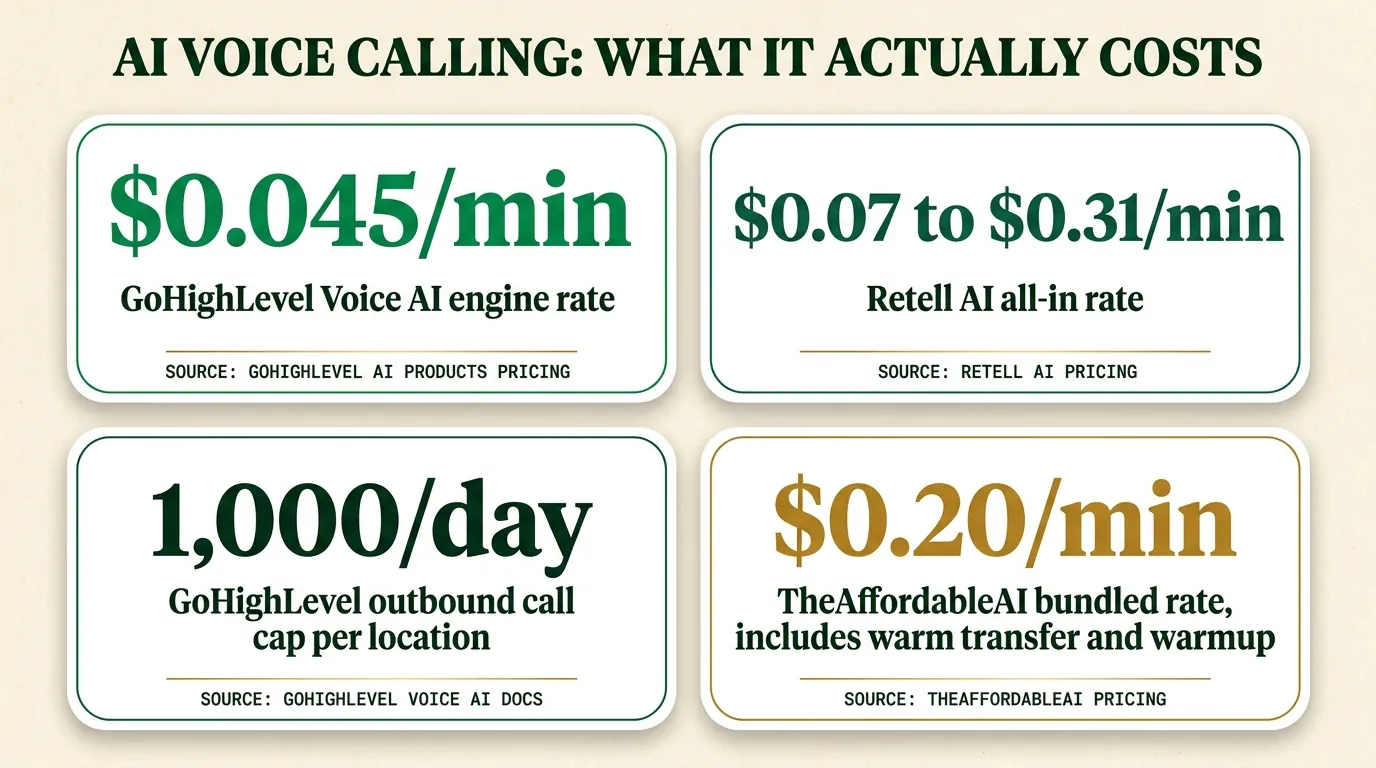
- GoHighLevel's native Voice AI Outbound Calling is real, not vaporware: up to 1,000 calls per location per day, 10 calls per minute, 8 a.m. to 8 p.m. local time, same-country numbers only, gated behind KYC verification.
- GoHighLevel's own pricing is metered across four separate line items: a $0.045-per-minute voice engine, $0.015-to-$0.170-per-minute text-to-speech depending on the voice, roughly $0.0166-per-minute telephony carriage, and per-token LLM cost billed on top of all of it.
- No-code platforms publish real all-in rates: Bland AI runs $0.11 to $0.14 a minute depending on plan, Retell AI publishes $0.07 to $0.31 a minute depending on model and voice, and Vapi charges $0.05 a minute in hosting plus pass-through model costs.
- None of those raw calling rates, DIY or GoHighLevel's own, include warm transfer to a roster of agents, number warmup, spam defense, or native HighLevel sync. Those get built separately, or bought separately.
- GoHighLevel's own support documentation states outright that its Voice AI does not validate contact consent before calling. On every path, DIY, GoHighLevel-native, or a managed platform, TCPA consent and CMS Medicare rules stay the responsibility of the licensed agent, not the software.
What “building your own AI voice agent” actually means
Start with the parts, because every cost comparison later in this article is a comparison of how these parts get priced and who assembles them.
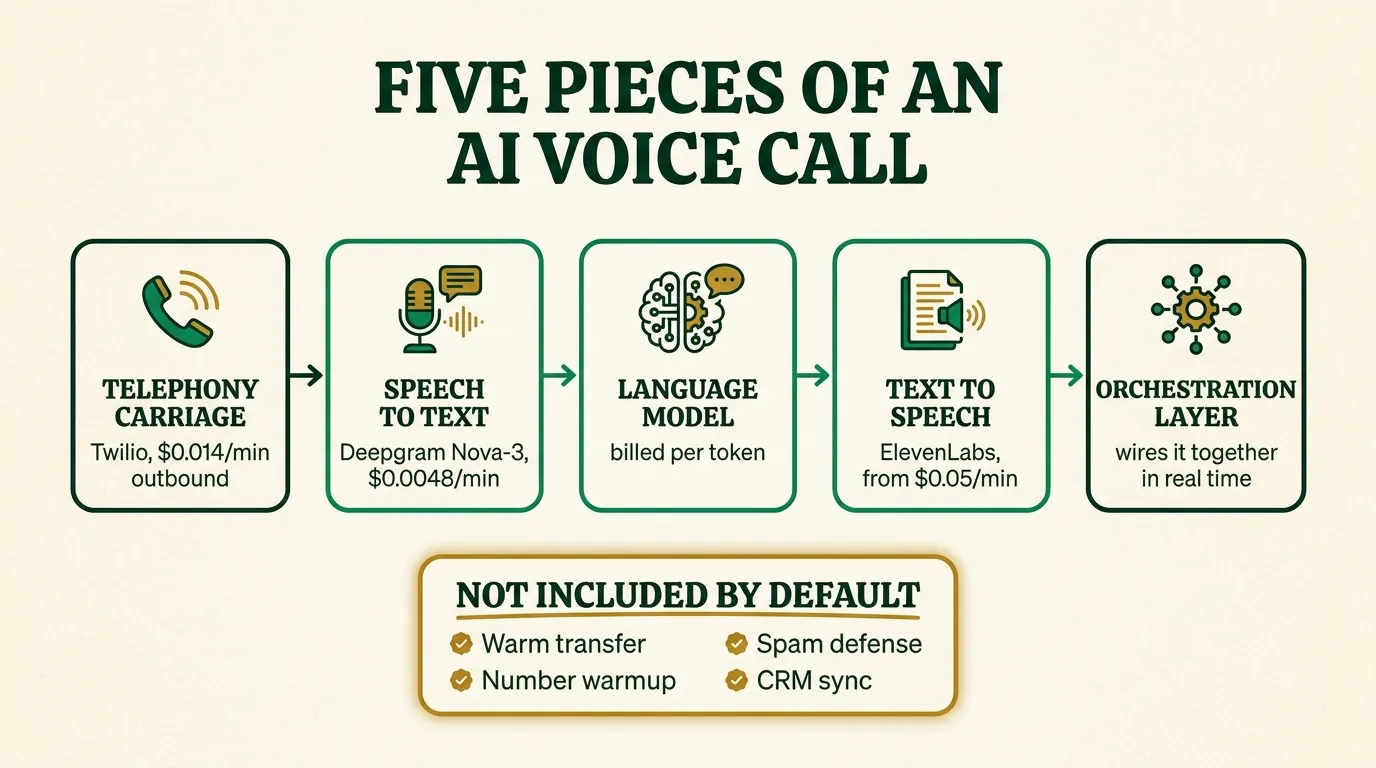
An AI phone call has five moving pieces. Telephony carriage is the actual phone connection: a real phone number, the carrier route that dials or answers a call, and the per-minute charge for the minutes used. Twilio is the most common provider agencies run into, including inside GoHighLevel itself. Speech-to-text (STT) turns the caller’s spoken words into text a computer can read. The large language model (LLM) reads that text, decides what the AI should say next, and generates a response, the same category of model behind ChatGPT or Claude, just wired into a phone call instead of a chat window. Text-to-speech (TTS) turns the model’s text response back into audio the caller hears. And the orchestration layer is the software gluing all four of the above together in real time, fast enough that the conversation doesn’t have awkward multi-second pauses, plus handling things like knowing when the caller has finished a sentence, detecting voicemail, and deciding when to hand off.
If you want the deeper mechanics of how the STT-to-LLM-to-TTS pipeline actually strings together in real time, TheAffordableAI’s guide to how AI voice agents actually work walks through that loop step by step. Here, the focus is narrower: what each piece costs, and who’s selling it.
That fifth piece, orchestration, is where the real work lives, and it’s also where “build it yourself” splits into two very different projects. You can either write and host that orchestration layer yourself, wiring Twilio, an STT provider, an LLM, and a TTS provider together with your own code, or you can rent someone else’s already-built orchestration layer, which is what Vapi, Bland AI, Retell AI, Synthflow, and GoHighLevel’s own AI Employee product all are. Each of those platforms has already solved the real-time wiring problem and sells you access to it, usually per minute.
Neither of those five pieces, on their own or stitched together, includes what an insurance agency’s follow-up process actually needs beyond “the AI can talk”: routing a qualified caller to a specific licensed agent while they’re still on the phone, keeping a phone number’s caller ID from getting flagged as spam under high-volume dialing, booking against real calendar availability across multiple agents, and syncing every call’s outcome back into the CRM automatically. Those are separate systems on top of the five pieces above, on every path, DIY included.
Warm transfer, defined
A warm transfer is when the AI, mid-call, connects a qualified lead directly to a live licensed agent while the lead is still on the line, instead of ending the call and hoping the lead answers a callback later. It is the single feature that turns "the AI can talk to a lead" into "the AI can hand a lead to a human," and it does not exist by default on any of the raw calling platforms compared below. It has to be built, or bought already built.
Does GoHighLevel already have this built in?
Yes, and it’s worth being specific about what “built in” means here, because the honest answer is more nuanced than a feature-list checkmark. GoHighLevel’s own support documentation describes a genuine outbound and inbound AI voice calling capability, referred to as Voice AI, sitting inside its broader AI Employee suite alongside its text-based Conversation AI. It is not a beta waitlist item; it is documented, generally available functionality with stated operating limits.
Those limits are real and worth knowing before you assume you can point it at your full lead volume. Per GoHighLevel’s own support article on the feature, Voice AI Outbound Calling can place up to 1,000 outbound calls per location per day, at a maximum rate of 10 calls per minute (one call roughly every six seconds), restricted to the hours of 8 a.m. to 8 p.m. based on the contact’s own phone-number timezone, and limited to same-country domestic numbers only, meaning no international calling. Turning the feature on requires completing KYC (Know Your Customer) verification first. And in the same documentation, GoHighLevel states directly that the platform does not validate contact consent before placing outbound Voice AI calls; ensuring you have legal consent to call, and honoring opt-outs, is described as the business’s own responsibility.
Read that consent line again
"Does not validate contact consent before placing outbound Voice AI calls" is GoHighLevel's own language about its own feature. It is not a criticism of the platform, every raw calling tool in this article works the same way, but it means the compliance work this article's compliance section below describes does not go away because you're inside a CRM you already trust. The platform dials what you tell it to dial.
Now the cost. GoHighLevel’s AI Products Pricing page lays out a genuine rate card, not a single flat number, and understanding it is the actual point of this section.
| Component | Rate | Notes |
|---|---|---|
| Voice engine | $0.045 / min | Flat, effective May 20, 2026 |
| Text-to-speech, cheapest tier | $0.015 / min | OpenAI or Cartesia voices |
| Text-to-speech, mid tier | $0.035 / min | ElevenLabs V2.5 |
| Text-to-speech, premium tier | $0.170 / min | ElevenLabs V3 |
| Telephony carriage, outbound | ≈ $0.0166 / min | Via LC Phone / Twilio numbers |
| LLM tokens | Billed per token, separately | $0.25-$3.00 per 1M input tokens across published models; varies by model and call length |
Add the first three rows, voice engine plus telephony carriage plus text-to-speech, and before a single LLM token is billed, you land somewhere between about $0.077 a minute on the cheapest voice and about $0.232 a minute on the most expensive one. That is arithmetic on GoHighLevel’s own published per-minute figures, not an estimate. The LLM token cost sits on top of that range, billed per token rather than per minute, so it moves with call length and model choice rather than being a fixed add-on. None of this is a criticism of GoHighLevel; it is simply what “per-minute AI voice pricing” means when a platform bills its underlying components separately instead of quoting one blended rate.
A per-minute rate card with four separate line items is not a price. It's a spreadsheet you have to build before you know your price.
On top of that per-minute stack sits GoHighLevel’s own base subscription, $97 a month for the Starter plan, $297 a month for the Unlimited plan, or $497 a month for the Agency Pro plan, per GoHighLevel’s published pricing page, plus a separate AI Employee add-on: $50 a month per location for the Growth tier, which includes 1,000 Conversation AI responses and 100 Voice AI minutes a month, or $97 a month per location for the Unlimited tier, described as unlimited usage subject to fair use. If your agency already runs GoHighLevel for its CRM, that base subscription is likely a cost you’re already carrying regardless of what you decide about voice calling; the AI Employee add-on and the metered voice components above are the actual incremental cost of turning on native AI voice.
What it actually costs, side by side
Here is the same question in dollars, using every vendor’s own published rate, normalized to a common monthly volume of 2,000 minutes, a reasonable estimate for a solo producer or small team running steady outbound follow-up.
| Platform | Rate | Est. monthly cost, 2,000 min | What's included |
|---|---|---|---|
| TheAffordableAI, Single Account | $0.20/min ($0.15 at bulk) + $200/mo | ≈ $600 (≈ $500 at bulk) | Warm transfer, auto-booking, warmup, spam defense, HighLevel sync, all bundled |
| TheAffordableAI, Agency | $0.18/min ($0.16 at bulk) + $500/mo | ≈ $860 (≈ $820 at bulk) | Everything above, plus routing to 20+ agents, round robin, priority onboarding |
| Bland AI, Scale plan | $0.11/min + $499/mo | ≈ $719 | Calling infrastructure only; routing, warmup, CRM sync are your build |
| Retell AI, example configuration | $0.07-$0.31/min (≈ $0.11 typical) | ≈ $220 (typical config) | Calling infrastructure only; own published range depends on model/voice choice |
| Vapi | $0.05/min hosting + model costs at cost | ≈ $100 hosting + variable model cost | Hosting only; STT/LLM/TTS billed separately at provider rates; +$2,000/mo for HIPAA tier |
| GoHighLevel AI Employee, stitched | $0.077-$0.232/min (before LLM tokens) + $97-$594/mo subscriptions | ≈ $154-$464 + subscriptions + token cost | Calling infrastructure only, capped at 1,000 calls/day; no consent validation |
This is a narrower comparison than AI versus a live human agent, which TheAffordableAI’s cost-per-call guide covers on its own; every row in the table above is some flavor of AI calling, just priced and packaged differently.
Read that table carefully, because the lowest number in it is not the cheapest real option, and this is the part most build-it-yourself pitches skip. Every row except TheAffordableAI’s two rows is a price for phone-call infrastructure alone. Warm transfer to a specific agent, number warmup, spam and voicemail defense, multi-calendar routing, and native HighLevel sync are not line items on Bland AI’s, Retell’s, Vapi’s, or GoHighLevel’s pricing pages, because those platforms are not selling an insurance lead follow-up system. They are selling the ability to place an AI-voiced phone call. Building the rest is a separate project with its own time cost, covered in the next section, that does not show up in any of these per-minute rates.
Per-minute rate, as each vendor publishes it
GoHighLevel's range excludes LLM token cost, which bills separately per token. All other figures are the vendor's own all-in rate.
Sources: GoHighLevel AI Products Pricing rate card; Bland AI Pricing; Retell AI Pricing; TheAffordableAI Pricing. GoHighLevel figures are voice engine + telephony carriage + text-to-speech only; LLM token cost is additional and not included.
The same math at a smaller and a larger volume
The 2,000-minute example above is a reasonable middle case, but the “which option wins” answer moves with volume, so it’s worth checking the edges too.
At 500 minutes a month, roughly what a single producer working a modest lead flow might dial, the fixed costs in TheAffordableAI’s flat monthly fee carry more relative weight: Single Account runs about $200 plus $100 in minutes, or $300 a month. Bland AI’s Start plan, which has no monthly platform fee at all, runs about $70 a month in pure calling cost at that volume, the cheapest raw number in this article by a wide margin, precisely because it has no fixed fee to spread across a small call count. That comparison looks lopsided in Bland AI’s favor until you remember what’s missing from that $70: no warm transfer, no warmup routine, no HighLevel sync, and no consent workflow, all of which cost roughly the same amount of engineering time to build whether you’re placing 500 minutes a month or 5,000.
At 8,000 minutes a month, closer to what a small team or a busy solo agency running heavy outbound might use, the picture shifts the other way. TheAffordableAI Agency at the standard rate runs about $500 plus $1,440 in minutes, or $1,940 a month, dropping to roughly $1,780 at the bulk rate. Bland AI’s Scale plan at that same volume runs about $499 plus $880, or $1,379 a month, still cheaper on paper. The gap between the two narrows sharply compared to the 500-minute case, and at this volume the cost of building and maintaining warm transfer, warmup, and CRM sync yourself stops being a rounding error next to the platform fee and starts being a real second project with its own ongoing time cost, one that scales with call volume the same way the per-minute rate does.
| Volume | TheAffordableAI Single/Agency | Bland AI (matching plan tier) |
|---|---|---|
| 500 min/mo | ≈ $300 (Single, standard rate) | ≈ $70 (Start, no monthly fee) |
| 2,000 min/mo | ≈ $600 (Single, standard rate) | ≈ $719 (Scale, $499/mo + $0.11/min) |
| 8,000 min/mo | ≈ $1,940 (Agency, standard rate) | ≈ $1,379 (Scale, $499/mo + $0.11/min) |
None of these three rows include what it costs, in your own time or a developer’s, to build warm transfer, warmup, and CRM sync on top of the Bland AI numbers. That build cost does not scale down at low volume the way the per-minute rate does; a warmup routine takes about the same amount of work to build whether you’re going to dial 500 minutes a month or 8,000.
A sixth no-code option, and why it isn’t in the table above
Synthflow is another name that comes up in the same conversation as Vapi, Bland AI, and Retell AI, and it’s worth mentioning specifically because its pricing page, unlike the other three, does not publish a self-serve per-minute rate at all. As of this writing, Synthflow’s pricing page shows a single Enterprise tier, starting at $30,000 a year with a custom quote, and no visible starter or pay-as-you-go option. That’s a meaningfully different market position than Bland AI’s $0 platform fee or Vapi’s $0.05-a-minute hosting charge: Synthflow is pricing itself for a business that has already decided it needs a large, custom voice AI deployment, not a solo agent or small agency testing the waters. It’s a useful data point precisely because it shows the no-code voice AI market isn’t one price tier, it’s several, aimed at very different buyers, and “AI voice platforms are cheap” is only true of some of them.
Assembling it yourself from raw components
If you’d rather skip the no-code platforms entirely and wire the five pieces together yourself, here is what that actually involves, in order, so you can price your own time against it honestly.
- Buy phone numbers and telephony carriage. Twilio’s published US voice pricing runs $0.0140 a minute for outbound calls to local and toll-free numbers, $0.0085 a minute for inbound calls to a local number plus $1.15 a month for the number itself, and $0.0220 a minute for inbound calls to a toll-free number plus $2.15 a month for that number. If you want Twilio’s own AI bridge, called Conversation Relay, that runs $0.07 a minute on top of the base call, and you would still need your own LLM and TTS behind it.
- Pick a speech-to-text provider, unless you’re using a combined realtime voice API that handles STT and TTS together. Deepgram publishes $0.0048 a minute for its Nova-3 model in streaming mode, one of the more affordable transcription options on the market.
- Pick a text-to-speech provider. ElevenLabs’ pricing scales from a $6-a-month Starter plan up to a $990-a-month Business plan, with per-minute cost falling as the tier rises; ElevenLabs states its Business tier’s synthesis cost runs as low as $0.05 a minute, a rate that requires committing to that tier’s monthly minimum.
- Pick a large language model, or use a combined realtime API. OpenAI’s Realtime API prices its newest realtime model at $32 per million audio input tokens and $64 per million audio output tokens, a per-token structure rather than a per-minute one, which is exactly the complication that makes DIY component pricing hard to compare cleanly against a flat per-minute rate: your actual per-minute cost depends on how many tokens a given conversation happens to use, and that varies call to call.
- Write or rent the orchestration layer that holds all of the above together in real time, detects when the caller has stopped talking, handles interruptions, and decides when to end the call or hand it off. This is the piece a no-code platform like Vapi, Bland AI, or Retell AI is actually selling you when you pay their per-minute rate instead of building this yourself.
- Build warm transfer logic that can reach a specific licensed agent, know whether they’re available, and connect the live call to them instead of ending it. If you’re already running GoHighLevel workflows for lead routing, TheAffordableAI’s trigger-to-warm-transfer build guide walks through what that specific piece of automation actually requires.
- Build a number warmup and spam-defense routine. Outbound calling at volume on a brand-new number is exactly the pattern carriers flag as robocalling, and neither Twilio, GoHighLevel, Vapi, Bland AI, nor Retell AI ships an automatic warmup routine as part of their core calling product.
- Build the CRM sync, so a call’s disposition, transcript, and outcome land in your CRM automatically instead of living only inside whichever calling tool made the call.
- Build the consent and compliance logging this article’s next section describes, since none of the platforms above validate consent for you.
This is a real option for the right agency
None of the nine steps above are exotic. An agency with an actual software developer on staff, or a founder who can code, can build all of this. The honest question isn't whether it's possible, it clearly is, plenty of companies do exactly this. The question is whether steps six through nine, the parts that make a phone call into an insurance lead follow-up system, are a one-time build or an ongoing maintenance job, because they are the second one, and that ongoing time has a real cost even when the per-minute rate looks cheap.
Before and after: raw AI calling infrastructure vs. a managed insurance calling platform
What a DIY stack or GoHighLevel's native Voice AI gets you
- A phone call that can speak and listen, at a metered per-minute rate across two to four separate vendor line items
- No warm transfer to a specific licensed agent; the call ends or the AI has to book it blind
- No number warmup or spam-defense routine included; a new number dialing at volume is on its own
- No native two-way HighLevel sync unless you build the webhook and mapping yourself
- No consent validation; GoHighLevel's own docs say so directly, and the rest work the same way
2-9 separate systemsTo assemble before it functions like an insurance follow-up tool
What TheAffordableAI bundles into one published rate
- Outbound and inbound calling at one flat per-minute rate, no separate STT, LLM, or TTS line items to track
- Warm transfers to available agents, plus auto-booking against real calendar availability when nobody's free
- Number warmup and spam and voicemail defense run as a standing routine on every plan
- Native two-way HighLevel CRM sync, no custom webhook build required
- No contract; a month-to-month test costs one month, either direction
1 systemSet up once, billed on one rate card
The compliance layer no platform removes
Every path in this article, DIY, GoHighLevel-native, a no-code platform, or a managed service including ours, is a way to place a phone call. None of them are a way to obtain consent to place that phone call. The Telephone Consumer Protection Act requires prior express written consent before an autodialed or artificial-voice call goes to a cell phone for marketing purposes, and that consent is the calling party’s obligation, meaning the licensed agent’s and agency’s obligation, not the software vendor’s. Internal Do Not Call lists and national DNC obligations still apply regardless of which platform dials the number. If you’re calling on Medicare business, CMS marketing rules add another layer on top, including the TPMO disclaimer and call-recording retention requirements.
GoHighLevel’s own documentation for its Voice AI feature makes this unusually explicit for a vendor: it states directly that the platform does not validate contact consent before placing outbound Voice AI calls, and that ensuring you have legal consent and honoring opt-outs is the business’s own responsibility. That is not a gap unique to GoHighLevel. A DIY stack built from raw Twilio, Deepgram, and an LLM API has no consent layer unless you build one from scratch. A no-code platform like Bland AI or Retell AI is selling you a way to place the call, not a way to verify you’re allowed to. This is exactly the category of setup mistake TheAffordableAI’s AI calling mistakes guide catalogs in more detail, and it applies whether the calling infrastructure underneath was built or bought.
Using AI does not transfer liability
Whether the voice on the call is homemade, rented from a no-code platform, built into your CRM, or bought from a managed vendor like TheAffordableAI, the licensed agent and agency stay responsible for prior express written consent, disclosure, Do Not Call compliance, and, for Medicare campaigns, CMS's TPMO and recording-retention rules. No platform in this article verifies your consent for you. That work is yours on every path, and it is worth building before you build or buy anything else.
$0.045
Per-minute rate for GoHighLevel's own Voice AI engine, before TTS, carriage, or LLM tokens
Source: GoHighLevel AI Products Pricing
1,000
Maximum outbound Voice AI calls per location, per day, on GoHighLevel
Source: GoHighLevel Voice AI Outbound Calling docs
$0.07-$0.31
Retell AI's own published all-in per-minute range
Source: Retell AI Pricing
$0.20
TheAffordableAI Single Account rate, fully bundled with warm transfer and warmup
Source: TheAffordableAI Pricing
Where TheAffordableAI fits
We are not trying to talk you out of pricing this yourself; the table above uses real, current numbers precisely so you can. Where TheAffordableAI fits is the gap between “a phone call that can talk” and “a phone call that gets a qualified lead in front of the right licensed agent, without your caller ID getting flagged, without a separate CRM sync project, and without four vendor invoices to reconcile every month.” That gap is real engineering time on every DIY or raw-platform path above, and it’s the thing a single published rate is actually buying you. The full list of what’s bundled into that rate is on the features page.
One rate, not a rate card
$0.20 a minute on Single Account, $0.18 on Agency, down to $0.15-$0.16 at bulk volume. No separate STT, LLM, or TTS line items to track or reconcile.
Warm transfers and auto-booking included
A qualified lead reaches an available licensed agent live, or gets booked against real calendar availability, without you building that logic yourself.
Number warmup and spam defense, standing
Runs as a routine on every plan. No raw calling platform in this comparison ships this by default.
Native HighLevel sync
Two-way, out of the box, no custom webhook build required, whether or not you're already using GoHighLevel's own AI Employee for anything else.
Price it against your own numbers
The math above uses $0.20 a minute because that is what a Single Account costs today. Run it against your own call volume, and listen to a live demo call before you decide anything.
When DIY, or GoHighLevel’s own native Voice AI, genuinely makes sense
Be honest about the other side of this. If your agency already has a developer on staff whose time would otherwise go unused, building this yourself is not a bad decision, it’s a use of a resource you’re already paying for. If you want to test one narrow workflow at low volume before committing any real budget to it, GoHighLevel’s native Voice AI, capped at 1,000 calls a day and 10 calls a minute, is a genuinely reasonable place to run that test, especially if you’re already paying for a GoHighLevel plan that includes it. And if your agency needs behavior no packaged platform offers, some specific model-routing decision tied to a proprietary workflow, building your own orchestration layer may be the only path that actually gets you there.
Where this stops making sense is the point where number warmup, spam defense, warm transfer logic, and compliance logging turn from a project you finish into a system you maintain indefinitely, because that maintenance cost doesn’t show up anywhere on the vendor rate cards in this article, and it’s real.
It’s also worth saying plainly: AI voice calling, built or bought, is the wrong tool for some agencies entirely. If your actual problem is lead quality, not follow-up speed, no calling platform fixes that; a faster caller dialing bad numbers is still dialing bad numbers. If your volume is genuinely low, a handful of leads a week, the fixed costs on any platform here, DIY setup time or a managed plan’s base fee, may not be worth it against just answering the phone yourself. And you can build a version of this yourself with a dialer and a VA instead of AI at all. Plenty of agencies do exactly that. It’s worth pricing that path too, against everything above.
The numbers in this article are what every one of these vendors actually charges today, not what a sales page implies. Whichever direction you take it, price your own call volume against your own real cost of time before you commit to either side.
Frequently asked
Can an insurance agency really build its own AI voice calling agent?
Yes, technically. You need a telephony provider for the phone numbers and call carriage (commonly Twilio), a way to turn speech into text and text into speech, a large language model to decide what to say, and an orchestration layer that wires all of it together and keeps the conversation running in real time. Twilio publishes its own per-minute voice pricing, OpenAI and other providers publish per-token pricing for realtime voice models, and no-code platforms like Vapi, Bland AI, and Retell AI publish per-minute rates that already bundle those pieces. None of it is hidden. What it does not include, on any of these raw paths, is warm transfer routing to your specific agents, number warmup and spam defense, native HighLevel sync, or a consent-logging process built for insurance calling. You would build all of that yourself, on top of the calling infrastructure.
Does GoHighLevel have its own AI voice calling feature?
Yes. GoHighLevel's Voice AI Outbound Calling can place up to 1,000 outbound Voice AI calls per location per day, at a rate of up to 10 calls per minute, restricted to 8 a.m. to 8 p.m. in the contact's local timezone, to same-country domestic numbers only, and it requires KYC (Know Your Customer) verification before it can be turned on. GoHighLevel's own support documentation for the feature states plainly that the platform does not validate contact consent before placing outbound Voice AI calls, and that ensuring legal consent and honoring opt-outs is the business's own responsibility.
What does GoHighLevel's AI voice calling actually cost per minute?
It is metered, not flat. Per GoHighLevel's own AI Products Pricing rate card, the Voice engine itself runs $0.045 per minute, text-to-speech runs $0.015 per minute on the OpenAI or Cartesia voices up to $0.170 per minute on ElevenLabs V3, and telephony carriage through LC Phone or Twilio numbers adds roughly $0.0166 per minute outbound. Summing just those three components, before any large language model token cost, comes to about $0.077 to $0.232 per minute depending on which text-to-speech voice you choose. LLM token usage bills separately per token and is not included in that range, so the real all-in cost per minute is higher and depends on which model you pick and how long each call runs. That is on top of a HighLevel base subscription and a separate AI Employee add-on.
What do no-code AI voice platforms like Vapi, Bland AI, and Retell AI cost?
Each publishes its own rate. Bland AI's Start plan is $0.14 per minute with no monthly platform fee; its Build plan drops to $0.12 per minute plus a $299 monthly fee; its Scale plan drops to $0.11 per minute plus a $499 monthly fee. Retell AI publishes an all-in range of $0.07 to $0.31 per minute depending on the voice and model you choose, built from a $0.055 per minute voice infrastructure charge plus separate text-to-speech and LLM costs. Vapi charges $0.05 per minute for its own call hosting, then passes model provider costs through at cost, plus a $2,000 a month add-on if you need HIPAA-eligible infrastructure. None of these three include warm transfer routing to a roster of licensed agents, number warmup, spam defense, or native HighLevel sync out of the box; you would still build or buy those separately.
Who is responsible for TCPA consent if I build my own AI caller or use GoHighLevel's native Voice AI?
You are, on every path. GoHighLevel's own documentation for its Voice AI Outbound Calling feature states directly that it does not validate contact consent before placing calls. A raw DIY stack built from Twilio and a model provider has no consent layer at all unless you build one. TheAffordableAI does not verify a lead's consent for you either. Prior express written consent under the TCPA, the obligation to honor opt-outs, Do Not Call compliance, and for Medicare campaigns the CMS TPMO disclaimer and call-recording retention requirements, stay the responsibility of the licensed agent and agency placing the call, no matter which calling platform sits underneath it. Using AI, whether homemade or bought, does not transfer that liability away from you.
Is a DIY AI voice agent actually cheaper than a managed platform like TheAffordableAI?
On raw per-minute rate alone, some of the no-code options can look cheaper: Bland AI's Scale plan at $0.11 a minute is below TheAffordableAI Single Account's standard $0.20 a minute. But that comparison is not apples to apples. TheAffordableAI's per-minute rate is fully bundled: warm transfer to available agents, auto-booking against real calendar availability, multi-calendar intent routing, number warmup, spam and voicemail defense, and native HighLevel sync are included on every plan at no extra line item. A raw calling platform's per-minute rate buys you the phone call and nothing past it. Once you price in the engineering time to build warm transfer logic, a warmup routine, and a CRM sync yourself, plus whatever a developer's time actually costs your agency, the gap narrows or reverses, and it narrows fastest for an agency that does not already employ someone who can build and maintain that stack.
When does it make sense to build a DIY AI voice agent instead of buying a managed one?
When your agency already has in-house engineering capacity that would otherwise sit idle, when you want to test a very specific, low-volume workflow before committing any budget, or when you need behavior a packaged platform genuinely cannot offer, such as a custom model routing decision tied to proprietary underwriting logic. It also makes sense to at least price it out yourself before buying anything, since that is the only way to know whether the managed price is actually buying you something. Where DIY stops making sense is the moment number warmup, spam defense, warm transfer, and compliance logging become things you are building and maintaining indefinitely instead of things you are paying a flat rate for.
Is AI voice calling the wrong tool for my agency at all?
Sometimes, yes. If your actual problem is lead quality, not follow-up speed, no calling platform, built or bought, fixes that; you need a better lead source, not a faster caller dialing bad numbers. If your call volume is genuinely low, a handful of leads a week, the fixed and setup costs on any platform, DIY or managed, may not be worth it compared to just answering the phone yourself. And if your state or your specific consent situation makes automated or AI-voiced calling legally risky for a given list, the fix is fixing the consent problem first, not routing around it with a different calling tool.
Sources
- GoHighLevel Support — AI Products Pricing (rate card: Voice engine, TTS providers, LLM token costs)
- GoHighLevel Support — Voice AI Outbound Calling (call limits, hours, KYC, consent disclaimer)
- GoHighLevel Support — AI Voice Agents Overview
- GoHighLevel — Pricing (Starter, Unlimited, Agency Pro plans; AI Employee add-ons)
- GoHighLevel Support — Phone System Pricing & Billing Guide (LC Phone / Twilio carriage rates)
- Twilio — Voice Pricing (US outbound, inbound, Conversation Relay, phone numbers)
- OpenAI — Realtime API Pricing
- ElevenLabs — Pricing
- Deepgram — Pricing (Nova-3 STT, Voice Agent API)
- Vapi — Pricing
- Bland AI — Pricing
- Retell AI — Pricing
- Synthflow — Pricing
- TheAffordableAI — Pricing
Put this on your own phone line
See the AI dial, qualify, and warm-transfer a live call in under a minute. No contract, no dev work.
Keep reading

AI Voice Agents for Insurance: How They Actually Work
An AI voice agent for insurance chains speech recognition, an LLM, and a synthetic voice into one loop: the pipeline, the cost, and where a human is required.

Cost Per Call: Live Agent vs AI Voice Agent in 2026
AI voice agents run about $0.07 to $0.50 a minute in 2026, versus $0.75 to $1.40 for a US live agent. Here is the real cost-per-call math, by volume.

GoHighLevel Insurance Workflows: Trigger to Warm Transfer
Most GoHighLevel insurance workflows stop at 'assign the lead.' Here's the trigger-to-warm-transfer build, GHL's own docs, and where TCPA rules bite.