Insurance Lead Qualification Scripts: What to Actually Say
Generic AI scripts make leads hang up and transfers arrive with no answers. Here is the qualification script insurance agents actually need.

Most AI voice agents sold to insurance agencies ship with the same generic script: a greeting, one open-ended question, and a hope that the caller keeps talking long enough to get transferred. It does not work, and when it does “work,” it fails a step later. The lead either hangs up because the first fifteen seconds sound like a robocall, or the call gets warm-transferred to a licensed agent carrying nothing but a name and a phone number, and the agent has to re-ask everything the caller already answered. A qualification script that actually holds up has four things in order: a compliant identification block, product-specific qualifying questions, a disclosure gate that fires at the right moment instead of a fixed timer, and a handoff that carries real information into the transfer. Here is what belongs in each part, why the rules force the order they do, and where a licensed human needs to take over from the machine.
The short version
- Identification and purpose come first, not a qualifying question. Two separate federal rules require it, and both attach to AI-placed calls the same way they attach to a human dialer.
- The Medicare TPMO disclaimer is no longer tied to the first minute of the call. Current regulatory text requires it before any discussion of plan benefits, wherever that lands in the conversation.
- Three to five qualifying questions is the useful range. Past that, the script is interrogating the caller instead of routing them.
- A warm transfer that only passes a name and number has already wasted the qualifying questions. The handoff needs to carry what the caller already said.
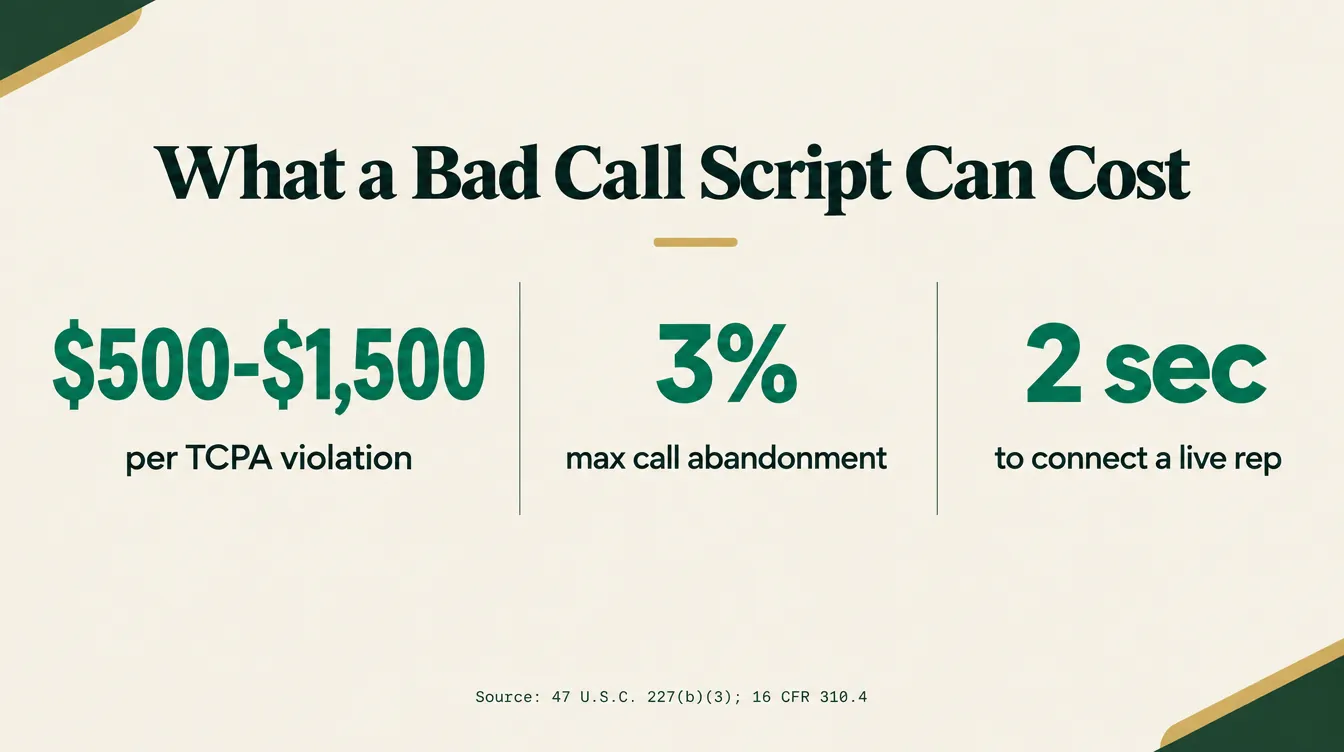
- A TCPA violation runs $500 to $1,500 per call under the statute itself. That number should shape how conservatively the script is written, not just whether consent exists at all.
What should an insurance lead qualification script say first?
It should say who is calling and why, before it asks the caller a single question, because two federal rules require exactly that order and neither one bends for an AI voice.
Under the current text of 47 CFR 64.1200(b)(1)-(2), a call placed using an automatic telephone dialing system or an artificial or prerecorded voice has to “state clearly the identity of the business, individual, or other entity that is responsible for initiating the call,” and either during or after that same message, state the callback telephone number of that business. Separately, under 16 CFR 310.4(d)(1)-(3), a telemarketer has to promptly disclose the identity of the seller, that the purpose of the call is to sell goods or services, and the nature of the goods or services being offered. Put plainly: before the script asks “are you still looking for coverage,” it has to say who is calling, that this is about insurance, and how to call back. That block runs ten to fifteen seconds at a natural pace, and it is not optional padding, it is the part of the call two different federal regulators specifically wrote rules to require.
Here are the terms that matter for the rest of this article, defined once. A qualifying question is a question whose answer changes what happens next in the call or who it routes to, as opposed to small talk. A disposition is the outcome tag applied to a call once it ends, such as “qualified, transferred” or “not interested.” A warm transfer is connecting a qualified, willing caller to a live licensed agent while they are still on the phone, as opposed to a callback promise. A TPMO, or third-party marketing organization, is any organization compensated to generate Medicare Advantage or Part D leads or enrollments, a category that includes most agencies running AI-assisted outbound. Prior express written consent is the specific written permission the TCPA requires before an automated or AI-placed marketing call or text can go to a cell phone, and it has to exist before the first dial, not get negotiated on the call itself.
The script is downstream of consent, not a substitute for it
Everything in this article assumes the lead already gave prior express written consent to be contacted, captured and timestamped against the specific number being dialed, before the qualifying script ever runs. If that consent record is missing, unclear, or unverified for a given lead source, fix that upstream problem first. No script wording fixes a call that should not have been placed.
Why a generic script fails before the qualifying questions even start
It fails because the vendors writing these scripts default to one flow for every product line, and insurance is not one product line, it is at least eight, each with a different first real question.
A caller who filled out a form about a Medicare Advantage plan is not the same conversation as a caller asking about final expense coverage, or a small business owner comparing a BOP quote, or someone whose homeowners policy just got non-renewed. A script that asks “what type of coverage are you interested in” and then runs the identical next four questions regardless of the answer treats all of them the same, and the caller can tell within one exchange that they are talking to a form, not a conversation. That is the mechanism behind AI voice agents sounding robotic: the problem is rarely the voice technology itself, it is a script written as one flat sequence instead of branching by what the caller actually said.
The fix is a branch point immediately after the identification block: one question that routes the rest of the call by product line, then a short, product-specific qualifying set. That single design decision, branch early, is most of what separates a script that gets used and works from one that gets muted three sentences in.
| Product line | Core qualifying questions | Disclosure gate before this point |
|---|---|---|
| ACA / health marketplace | Current coverage status, household size, rough income band for subsidy eligibility, effective-date urgency | Identification + purpose only |
| Medicare Advantage / Part D | Current plan type, county, election-period eligibility, whether they are comparing or already enrolled | TPMO disclaimer before any plan-benefit discussion |
| Life insurance / final expense | Coverage amount sought, existing policy status, age band, decision-maker check | Identification + purpose only; defer health detail to the licensed agent |
| Auto / home (P&C) | Current carrier, renewal or non-renewal date, prior claims in general terms, zip code | Identification + purpose only |
| Commercial / BOP | Business type, employee count band, current coverage gaps, timeline to decision | Identification + purpose only |
Compliance columns reflect 47 CFR 64.1200, 16 CFR 310.4, and 42 CFR 422.2267, current text, verified this session against Cornell Law School's Legal Information Institute.
What it costs to get the script wrong
It costs two different things at once: a statutory exposure per bad call, and a lead who was reachable and is now gone because the first fifteen seconds sounded wrong.
Start with the exposure. Under 47 U.S.C. 227(b)(3), a person harmed by a TCPA violation can recover actual monetary loss or $500 in statutory damages per violation, whichever is greater, and a court can increase that award up to three times, to $1,500, for a willful or knowing violation. That figure is not an estimate from a law firm’s marketing page, it is the dollar amount written into the statute itself. A script that skips the identification block, mishandles an opt-out, or keeps dialing past a revoked consent is not a style problem, it is $500 to $1,500 of exposure per call, and a bad script run across a few thousand calls a month is not a rounding error.
Set that against the cost of writing and maintaining a script properly in the first place. The U.S. Bureau of Labor Statistics’ Occupational Employment and Wage Statistics program reports a median hourly wage of $16.58 for telemarketers as of May 2023, the most recent published OEWS detail for that occupation code, across roughly 81,580 people employed in the role. A managed AI caller running at $0.20 a minute, the published Single Account rate, costs roughly $12 an hour of call time at that per-minute rate, before the platform’s $200 monthly fee and $500 one-time setup are added in. The AI’s per-minute rate is cheaper than a telemarketer’s wage on a pure time basis, which is exactly why it is worth spending real effort getting the script right: a bad script at $12 an hour of AI call time still burns leads and still creates the same $500 to $1,500 per-violation exposure as a bad script read by a $16.58-an-hour human. Cheap minutes do not make a wrong disclosure cheap.
What one non-compliant call can cost, against what an hour of calling costs
Bars are not to the same unit; this compares a per-violation statutory exposure to a per-hour calling cost to show scale, not to suggest they trade off directly
Sources: 47 U.S.C. 227(b)(3) (statutory damages); U.S. BLS OEWS, Telemarketers 41-9041, May 2023 (wage); theaffordableai.com/pricing, verified Sept. 30, 2026 ($0.20/min at 60 calls/hour equivalent). Bars scaled illustratively against the $1,500 figure to show relative order of magnitude, not a direct cost trade-off.
How to build the script: the four-part method, given away in full
Build it in this order and do not skip a part, because each one exists to satisfy a specific rule or to prevent a specific, predictable failure.
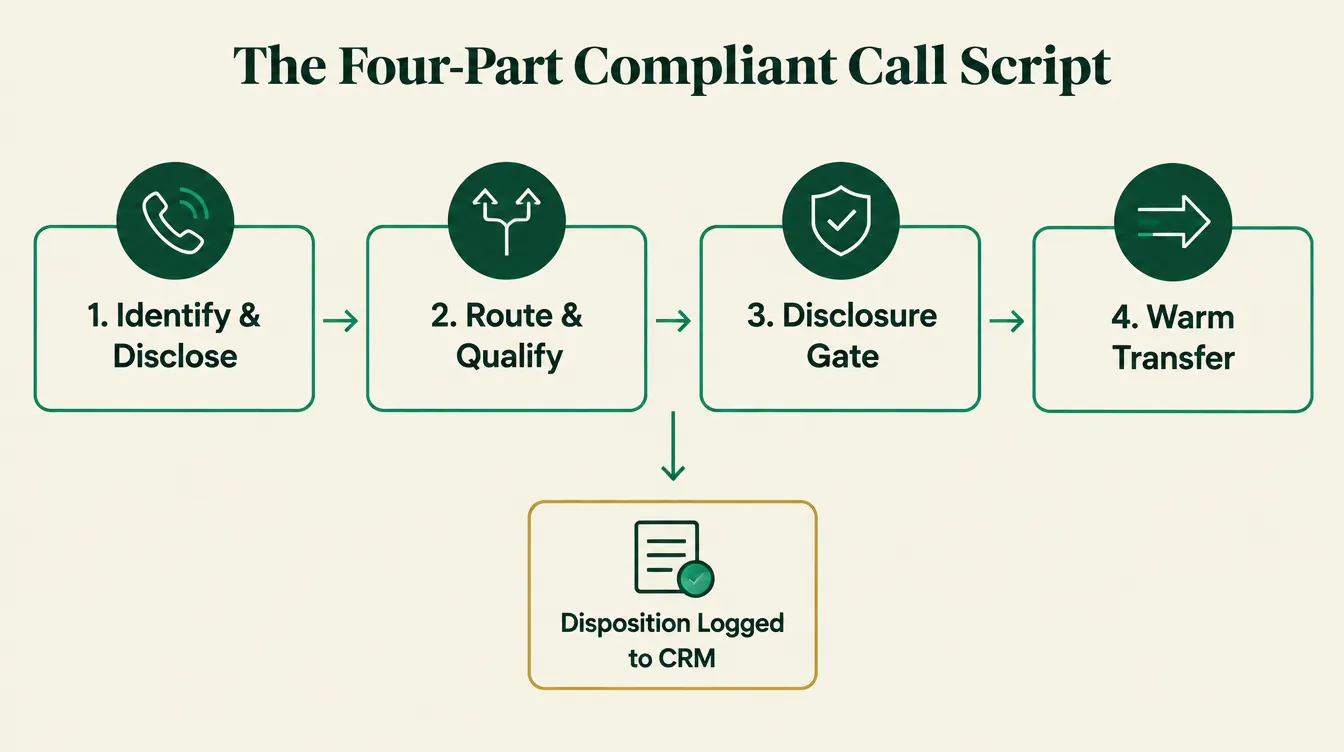
Part one: identification and purpose, every call, no exceptions. State the business name, that the call is about insurance, and a callback number, satisfying 47 CFR 64.1200(b)(1)-(2) and 16 CFR 310.4(d)(1)-(3) in the same breath. Keep it to one or two sentences. This is the part scripts skip most often because it feels like throat-clearing before the “real” conversation, and it is exactly the part both federal rules single out.
Part two: route, then qualify by product line. One routing question, then three to five product-specific qualifying questions from the table above. Stop at five. Every question past that point is marginal information collected at the cost of a caller who is starting to feel processed instead of heard. If the caller volunteers detail beyond what the script asks, let the script acknowledge it briefly and move on rather than ignoring it, because an AI that visibly ignores what was just said is the fastest way to confirm the caller’s suspicion that they are talking to a script.
Part three: the disclosure gate, timed to content, not to the clock. For anything touching Medicare Advantage or Part D, the TPMO disclaimer required under 42 CFR 422.2267 has to be delivered verbally before the conversation discusses any specific plan’s benefits, costs, or coverage, not on a fixed first-minute timer. That means the gate in the script is a conditional: if the next thing the flow is about to say is a benefit statement, the disclaimer fires immediately before it, regardless of how long the call has already run. Build this as a hard gate in the script logic, not a reminder to the AI to “mention it early,” because “early” is not what the current rule requires.
Part four: the warm transfer handoff, carrying everything collected. The moment a caller is qualified and willing to talk to a person, the transfer needs to arrive with the product line, the qualifying answers, the urgency signal, and a disposition code, spoken to the live agent or passed to their screen before they say a word, and synced to the CRM record in real time. A transfer that hands over a name and a callback number has thrown away everything parts one through three collected. This is also where the AI’s job ends and the licensed human’s job starts: coverage advice, plan comparison, and anything resembling underwriting detail belongs to the person taking the transfer, not the qualifying script.
Here is what that looks like laid out as an actual exchange, for a Medicare Advantage call, to make the four parts concrete rather than abstract. This is an illustrative example of the structure, not required legal wording; the exact phrasing is yours to write, but the order and the content of each part is not optional.
| Part | What the AI says, in substance | Rule it satisfies |
|---|---|---|
| 1. Identify | States the agency's name, that the call is about Medicare coverage, and a callback number | 47 CFR 64.1200(b); 16 CFR 310.4(d) |
| 2. Route and qualify | Asks whether the caller currently has Medicare, what county they live in, and whether they are comparing plans or enrolled already | No specific disclosure rule; this is qualification logic only |
| 3. Disclosure gate | Before naming any specific plan's benefits, delivers the TPMO disclaimer in full | 42 CFR 422.2267 |
| 4. Transfer | Tells the caller a licensed agent is joining, then passes the county, current plan status, and disposition to that agent before they speak | No specific disclosure rule; this is handoff design |
Notice that the disclosure gate sits between qualification and transfer, not at the very start. That placement is the direct, practical result of the current rule requiring the disclaimer before benefit discussion rather than on a fixed early timer: the script can ask county and enrollment status first, because neither question discusses a plan’s benefits, and only has to fire the disclaimer once the conversation is actually about to name what a specific plan covers.
Where the script should hand off immediately, no further questions
- The caller asks a specific coverage or premium question that requires a licensed answer.
- The caller volunteers detailed health information beyond a yes/no category signal.
- The caller asks to stop being contacted, on this call or any future one, in which case the opt-out has to be honored and logged immediately, and under 47 CFR 64.1200(a)(10) and (d)(3), no later than ten business days, through any reasonable method the caller uses to state it, not only a specific keyword.
- The caller sounds confused about why they are being called at all, which is usually a sign the identification block failed to land, not a sign to push harder on qualifying questions.
The mechanics under the script: abandonment, ring time, and the answering-machine branch
The qualifying questions are only half the script. The other half is what the system does when nobody answers the way the script expects, and two federal rules specify that in exact numbers.
Under 16 CFR 310.4(b)(4), if a live sales representative, or an AI voice equivalent, is not connected within two seconds of the called person’s completed greeting, the system has to promptly play a recorded message stating the seller’s name and a callback number. Across an entire calling campaign, no more than 3 percent of calls answered by a live person can go unconnected this way, measured on a rolling basis. Separately, an unanswered call has to ring for at least 15 seconds or four rings before the system is allowed to disconnect and move to the next attempt. None of this is about the qualifying script’s wording; it is about what the dialing system is doing in the background, and it is worth confirming with whoever runs your calling platform, human-staffed or AI, exactly how these three numbers are enforced in practice, not just promised in a sales deck.
One flow, every caller
- Same opening, same four questions, regardless of product line
- Disclosure treated as a box to check somewhere "early"
- No defined branch for health detail, objections, or opt-out requests
- Transfer carries a name and a number, nothing else
- Abandonment and ring-time behavior left to the platform's defaults
1Flow, applied to every line of business
Routed, gated, and handed off with context
- Identification and purpose stated before any question
- One routing question, then 3 to 5 product-specific qualifiers
- Disclosure gate fires before benefit discussion, not on a timer
- Transfer carries product, answers, urgency, and disposition
- Abandonment capped at 3%, live connection inside 2 seconds, checked against the platform
5Product-line branches, one identification block
How we solve it
TheAffordableAI runs the branch-and-gate structure above as the default script logic, not an optional add-on, and syncs every qualifying answer to your HighLevel CRM the moment the call ends.
The AI caller identifies itself and the reason for the call before asking anything, routes by product line into the right qualifying set, fires the TPMO disclaimer gate before any Medicare benefit discussion, and warm-transfers a qualified caller to a live licensed agent with the full qualifying context already attached, or books the appointment against real calendar availability if nobody is free that second. Number warmup and spam defense run continuously in the background so the calls keep landing in the first place. A Single Account runs $200 a month plus a $500 one-time setup at $0.20 a minute, down to $0.15 at bulk volume; an Agency plan that routes a warm transfer to 20 or more agents at once runs $500 a month plus a $1,000 one-time setup at $0.18 a minute, down to $0.16 at bulk. Both are month to month, no contracts, cancel anytime. You can write and maintain this branching logic yourself on a dialer platform that gives you script control. Plenty of agencies do, and if you want to hear what the branch-and-gate flow above actually sounds like as a real call before you decide anything, there is a live demo on the homepage.
Hear the script run as a real call
Put your number in on the homepage and the AI calls you in seconds, so you can hear the identification block, the qualifying questions, and the handoff logic for yourself.
What you get from a script built this way
4
Script parts, in order: identify, route and qualify, disclosure gate, transfer
3-5
Qualifying questions per product line, enough to route without interrogating
3%
Maximum call abandonment allowed under 16 CFR 310.4, checked continuously
$0.20/min
Single Account rate, down to $0.15 at bulk volume
theaffordableai.com/pricing, verified Sept. 30, 2026
The lead did not hang up because the AI called. It hung up because the first fifteen seconds never said who was calling or why.
Mike MooreWhere AI is the wrong tool for part of this call
It is worth saying plainly: the qualifying script should never try to be the whole conversation. The moment a caller needs coverage advice, a premium quote, a comparison between specific plans, or wants to disclose detailed health information, that is licensed work, and the script’s only job at that point is to recognize it and hand off cleanly, not to keep going because the AI technically could keep asking questions. A script that tries to extend its own role past qualification, to sound more like a closer than a router, is the version most likely to create both a bad caller experience and a compliance problem, because the deeper into substantive advice an automated flow goes, the closer it gets to activity that requires a license it does not have. Building the hand-off point deliberately, and early, is not a limitation of the technology. It is the correct design.
How to test the script before it goes live on real leads
Run it against a checklist before the first real call, because a script that reads correctly on paper can still fail once it is actually speaking to someone.
Call the AI yourself, on a real phone, and listen for four things in order. First, does the identification block land in the first fifteen seconds, clearly enough that a distracted person answering an unknown number would actually hear who is calling and why? Second, does the routing question correctly send you down the right product-line branch when you answer naturally, in your own words, rather than with the exact phrase the script expects? A branch that only recognizes “Medicare Advantage” and not “my Medicare plan” or “the Advantage thing” will misroute a meaningful share of real callers. Third, if you deliberately steer the conversation toward plan benefits, does the TPMO disclaimer actually fire before the AI says anything about coverage, copays, or premiums, every time, not most of the time? Fourth, when you ask to be transferred, does the live agent’s screen or opening sentence actually reflect what you just told the AI, or does the human start over from zero?
Test the edge cases, not just the happy path
Call in and say nothing for a few seconds, to check the abandonment and answering-machine handling. Say "stop calling me" mid-conversation, to check that the opt-out is recognized and logged immediately rather than only when the exact word "stop" appears in a text. Ask a specific premium question during qualification, to check that the script hands off instead of attempting an answer. Each of these happens on real calls whether or not you have tested for it; the only choice is whether you find out during a test call or during a real one.
Log the results of this test pass with the same disposition and transcript fields a real call would produce, then have someone who was not involved in writing the script review the transcript cold. A script author reading their own transcript tends to hear the intended meaning; a fresh reviewer hears what an actual caller would hear, which is the version that matters.
The compliance part, said plainly
None of the script design above replaces reading and following the actual rules that apply to your calls, and “the AI followed the script” is not a defense if the script itself was built wrong.
Before this script goes live on real calls
- Confirm prior express written consent exists for the specific number being dialed before the first call, not during it. This script assumes consent already exists; it does not create it.
- The identification and purpose disclosure required by 47 CFR 64.1200(b)(1)-(2) and 16 CFR 310.4(d)(1)-(3) has to run on every call, every time, regardless of product line.
- For Medicare Advantage or Part D, the TPMO disclaimer under 42 CFR 422.2267 has to fire before any plan-benefit discussion. Review current CMS Medicare Communications and Marketing Guidelines directly before relying on any specific script wording.
- Call abandonment cannot exceed 3 percent over a rolling 30-day campaign window, and a live or AI representative has to connect within two seconds of the greeting or trigger the recorded fallback message, under 16 CFR 310.4(b)(4).
- Opt-out and consent-revocation requests must be honored through any reasonable method the caller uses, within a reasonable time not exceeding ten business days under 47 CFR 64.1200(a)(10) and (d)(3), and revoking on one channel revokes it for the caller across channels from the same business.
- A TCPA violation carries $500 to $1,500 in statutory damages per call under 47 U.S.C. 227(b)(3), separate from and in addition to any state-level exposure.
- Using an AI voice agent to run this script does not transfer the licensed agent's liability for consent, disclosure, or the advice eventually given. The licensed producer stays responsible.
- This is general information based on the current text of the cited rules, not legal advice. Verify against current FCC, FTC, and CMS guidance, and your own state and carrier requirements, before deploying any script on live calls.
The questions this raises next
Should the script be different for outbound versus inbound calls? The identification and disclosure requirements are written around outbound telemarketing calls specifically, so an inbound call the caller placed themselves does not carry the same identification-block obligation, though disclosing who they have reached is still good practice. The qualifying questions and the product-line branch structure, though, work the same way in both directions, since the goal, routing a caller efficiently without over-asking, does not change based on who dialed first.
What if the caller is calling about more than one product line? Let the routing question capture the primary reason for the call, qualify on that line first, and note the secondary interest in the disposition for a human follow-up, rather than trying to run two full qualifying branches in one call. A script that tries to fully qualify two product lines in a single pass runs long enough that it starts to feel like the interrogation this article warns against.
How often should the script itself be reviewed against current rules? At minimum, whenever CMS updates its Medicare Communications and Marketing Guidelines for a new plan year, and whenever the FCC or FTC amends 47 CFR 64.1200 or 16 CFR 310.4, both of which have changed multiple times in recent years. A script written against last year’s disclosure timing rule and never revisited is exactly how an agency ends up non-compliant on a rule it did follow correctly twelve months ago.
Does a shorter script always convert better? Not necessarily; a script that is short because it skipped the identification block or the disclosure gate is not better, it is exposed. The goal is not minimum length, it is no wasted or redundant questions past what routing and qualification actually require. A compliant four-part script run efficiently is usually still under a minute before the transfer point.
What should the AI do if the caller starts asking underwriting-style questions mid-qualification? Hand off immediately rather than attempting an answer, even a hedged one. A qualifying script’s value comes from staying inside its lane; the moment it starts answering coverage questions it was not designed or licensed to answer, it has taken on the exact risk the handoff point exists to avoid.
A script is not a formality sitting in front of the real conversation. It is the conversation’s first minute, and both federal telemarketing law and CMS’s Medicare marketing rules were written with specific requirements for exactly that minute. Build the identification block first, branch by product line into a short qualifying set, gate the Medicare disclosure to content instead of a clock, and hand the transfer off with everything the caller already said. Everything past that is the licensed human’s job, and the script’s last, best function is knowing exactly when to get out of the way.
Frequently asked
What should an insurance lead qualification script say first?
Identify the caller and the reason for the call before asking anything else. Under 47 CFR 64.1200(b)(1)-(2), an automated or AI-placed call must clearly state the identity of the business responsible for the call, and under 16 CFR 310.4(d)(1)-(3) the telemarketer must also disclose that the purpose of the call is to discuss insurance and name the general type of coverage. Only after that identification block should the script move into qualifying questions. Skipping straight to "are you looking for coverage" without identifying who is calling and why is the single most common script mistake, and it is also the one most exposed under both rules.
Does the TPMO disclaimer have to be read in the first minute of a Medicare call?
No, not anymore. Under the current text of 42 CFR 422.2267, the third-party marketing organization disclaimer has to be delivered verbally before any discussion of plan benefits, not on a fixed early-call timer. That is a sequence rule, not a clock rule. A script can spend the first minute qualifying eligibility and intent as long as it delivers the disclaimer before the conversation touches a specific plan's benefits, costs, or coverage details. A general statement like "some Medicare Advantage plans include dental" is not settled case-by-case by this article; check current CMS guidance for what counts as a benefit discussion before you rely on that line in production.
How many qualifying questions should an AI voice agent ask before transferring the call?
Enough to make the warm transfer useful, and not one question more. For most lines of business that means three to five: the product line, one eligibility or timing fact specific to that product, whether the caller is the decision-maker, and a rough urgency signal like a renewal date or an expiring subsidy. Every question past that point risks making the caller feel interrogated by a machine before they have even talked to a person, which is the fastest way to lose them before the transfer happens.
What happens if the lead does not answer or the line is a voicemail box?
The script needs a defined answering-machine branch, not a guess. Under 16 CFR 310.4(b)(4), if a live sales representative or an equivalent live-sounding AI response is not ready within two seconds of the called person's completed greeting, the system must promptly play a recorded message identifying the seller and a callback number, and overall abandonment across the campaign cannot exceed 3 percent measured over a rolling 30-day window. An unanswered call has to ring at least 15 seconds or four rings before the system can hang up and move to the next attempt.
Can the AI collect health information during the qualifying questions for a Medicare or life insurance lead?
It can collect enough to route and disposition the lead, but it should not go further than that, and the script itself is where you draw that line, not the agent's judgment mid-call. A qualifying question like "do you currently take any prescription medications" edges toward underwriting, which is licensed work. A well-written script asks for category-level signals, such as whether the caller has had a recent hospital stay or diagnosis they would want to discuss with a licensed agent, and routes the detailed answer to the human instead of having the AI collect and hold it. This is also where admitting AI is the wrong tool for part of the call matters: detailed health disclosure belongs with the licensed agent taking the transfer, not in the qualifying script.
Does using an AI voice agent to run the script change who is liable for a compliance mistake?
No. Using AI to place the call or run the script does not transfer the licensed producer's liability for consent, disclosure, or the advice eventually given. The FCC's and FTC's rules on identification, abandonment, and consent revocation apply to the entity responsible for the call regardless of whether a human or an AI voice is speaking, and CMS's TPMO rules apply the same way to any organization compensated to generate Medicare Advantage or Part D leads, human-staffed or automated.
Is it legal to ask qualifying questions before getting prior express written consent?
The qualifying script assumes consent already exists, because prior express written consent for an automated or AI-placed marketing call to a cell phone has to be captured in writing before the first dial, not negotiated live on the call itself. If your lead source's consent capture is unclear or unverified, the fix is upstream of the script: confirm the consent record, its timestamp, and the specific number it covers before the call ever goes out, not during it.
What should the warm transfer handoff actually contain?
Everything the qualifying questions collected, spoken or passed to the live agent before the caller has to repeat themselves: the product line, the one or two qualifying answers, the urgency signal, and the disposition code, synced to the CRM record in real time. A warm transfer that hands over only a name and a phone number has already failed at the one job qualifying questions exist to do, which is to make the human's first sentence sound like a continuation of the call the caller was already having, not the start of a new one.
Sources
- Cornell Law School Legal Information Institute — 47 CFR 64.1200, Delivery restrictions (current text)
- Cornell Law School Legal Information Institute — 16 CFR 310.4, Abusive telemarketing acts or practices (current text)
- Federal Trade Commission — Complying with the Telemarketing Sales Rule
- Cornell Law School Legal Information Institute — 42 CFR 422.2267, Required materials and content (current text)
- Cornell Law School Legal Information Institute — 47 U.S.C. 227(b)(3), Private right of action and statutory damages
- U.S. Bureau of Labor Statistics — Occupational Employment and Wage Statistics, Telemarketers (41-9041), May 2023
- TheAffordableAI — Pricing (verified Sept. 30, 2026)
Put this on your own phone line
See the AI dial, qualify, and warm-transfer a live call in under a minute. No contract, no dev work.
Keep reading

Warm Transfers vs Voicemail Drops: What Actually Gets an Insurance Prospect on the Phone
Voicemail drops feel productive and cost almost nothing. Warm transfers feel expensive and interrupt your day. Only one of them reliably puts a licensed agent in front of a prospect who is ready to talk.

Speed to Lead in 2026: Why the First 60 Seconds Decides Who Writes the Policy
The lead you paid for is not lost to a better agent. It is lost to a faster one. Here is what response time actually does to contact and conversion rates, and how to get to sixty seconds without hiring a dialer team.

AI Voice Agents for Insurance: How They Actually Work
An AI voice agent for insurance chains speech recognition, an LLM, and a synthetic voice into one loop: the pipeline, the cost, and where a human is required.