Commercial Insurance Leads: The Follow-Up Gap
Independent agents place 87.7% of U.S. commercial lines premiums. Here is what slow follow-up on a BOP or workers' comp lead actually costs, sourced for 2026.
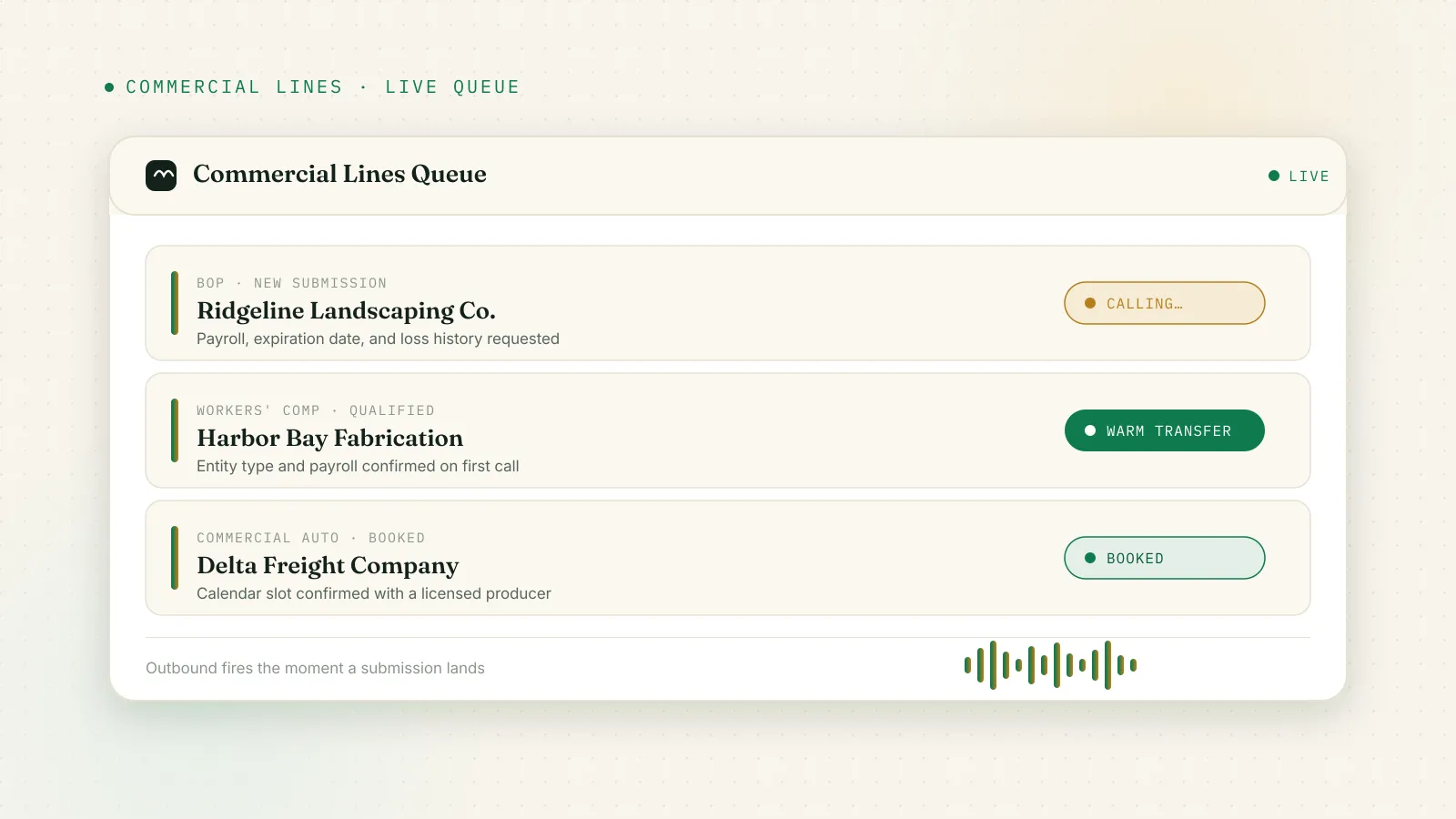
A contractor fills out a quote request for workers’ comp on a Tuesday afternoon. Nobody calls back until Wednesday morning, and by then he’s already talked to two other agencies and picked one. That’s the whole story, and it happens on commercial lines just as often as it happens on a personal auto or home lead, except most agencies still treat commercial submissions like they’ll sit patiently in a queue because the paperwork looks more serious than a personal-lines quote. It won’t sit. The business owner on the other end is shopping the same way anyone shops: fast, in parallel, and with whoever answers first.
This is about why commercial insurance leads go cold on the same clock as personal lines, what a slow follow-up process actually costs using numbers pulled and verified this year, how to build a fast one yourself with no new software, and where a managed AI caller fits into that process, and where it flatly doesn’t.
The short version
- A small business owner shopping for a BOP or workers' comp policy behaves like a retail consumer: several quotes requested in parallel, first real answer usually wins.
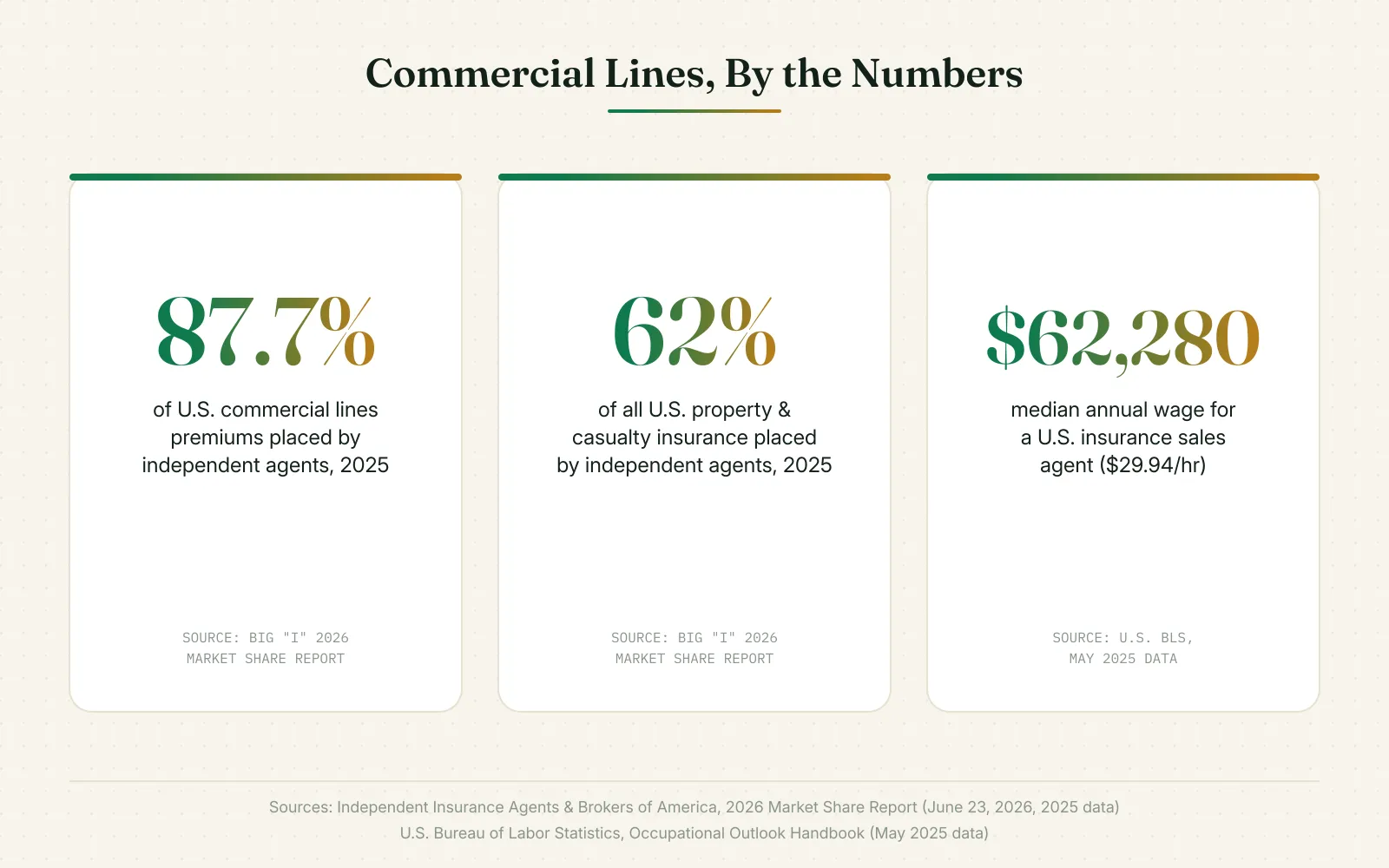
- Independent agents wrote 87.7% of U.S. commercial lines premiums in 2025, per the Big "I"'s own 2026 Market Share Report, so this is not a side market, it's most of the market.
- The U.S. Bureau of Labor Statistics puts the median wage for an insurance sales agent at $62,280 a year, $29.94 an hour, as of May 2025. Every minute a producer spends redialing a cold lead is billed at that rate against their actual selling time.
- First Connect's 2026 survey of 238 independent agencies found carrier-side quote delays are shrinking fast, meaning the agency's own follow-up speed is becoming the bottleneck that's left.
- The Telephone Consumer Protection Act's consent rule for automated or prerecorded calls to a cell phone doesn't have a business exception. A commercial lead's cell number gets the same consent treatment as a personal one.
What makes a commercial insurance lead different from a personal-lines one
A commercial insurance lead is a request for coverage tied to a business rather than a household. That covers a Business Owner’s Policy, usually shortened to BOP, a bundled property and general liability policy built for small businesses; workers’ compensation; commercial auto; general liability sold on its own; and narrower lines like commercial property or a standalone cyber policy for a business that handles customer data. The person filling out the form is the owner, a partner, or an office manager acting on the owner’s behalf, and the request usually needs more information up front than a personal auto or home quote: entity type, current or intended payroll, years in business, current carrier and expiration date, and prior loss history if the business has any claims on record.
That extra information requirement is exactly where agencies talk themselves into treating commercial leads differently than personal ones, and where that reasoning breaks down. A small business owner requesting a BOP quote is not behaving like a large commercial account with a broker relationship built over years. They’re behaving like a retail shopper: filling out two or three quote forms in the same sitting, then moving forward with whoever calls back with a real, informed conversation first. The paperwork is heavier. The buying behavior underneath it isn’t.
| Factor | Personal lines (auto, home) | Commercial lines (BOP, workers' comp, auto) |
|---|---|---|
| Who's on the form | One individual, shopping for themselves | An owner or office manager, often shopping for the whole business |
| Info needed on call one | Address, vehicle or property details, current carrier | Entity type, payroll or revenue, years in business, loss history, current expiration date |
| Buying behavior | Requests several quotes, picks the fastest real answer | Same pattern, with a longer form that agencies mistake for a longer decision window |
| Cost of a slow first call | Loses the lead to a faster competitor | Loses the lead, and delays the whole submission because underwriting-ready details never got collected |
The second row is the part worth sitting with. On a personal-lines call, a slow response mostly costs you the lead. On a commercial call, a slow or shallow first conversation also fails to collect the details an underwriter actually needs, current payroll, prior losses, the exact expiration date on the incumbent policy, which means even a lead you eventually reach again starts the submission process a full step behind where it should have been.
Why commercial leads are going cold even as the market grows
This isn’t a shrinking or niche part of the business. Independent agents wrote 87.7% of U.S. commercial lines written premiums in 2025, comparable to 87.9% in 2024, according to the Big “I“‘s own 2026 Market Share Report, released June 23, 2026 and built from AM Best’s property and casualty premium data. The same report puts the independent channel’s overall share of all U.S. property and casualty insurance placed at 62% in 2025, up from 61.5% in 2024. Whatever agency you run, if you write commercial lines at all, you’re operating inside the segment of the market independent agents already dominate, not a side hustle next to personal lines.
| Line of business | Independent agency share, 2025 | 2024 share, for comparison |
|---|---|---|
| Commercial lines | 87.7% | 87.9% |
| Personal lines | 39.5% | 39.2% |
| All P&C insurance written | 62.0% | 61.5% |
Source: Independent Insurance Agents & Brokers of America, 2026 Market Share Report, released June 23, 2026, data year 2025, built from AM Best property and casualty premium data.
At the same time, the other half of the equation, how the carrier side of the transaction performs, is getting measurably faster. First Connect’s 2026 State of the Industry Report, based on responses from 238 independent agencies and 44 carrier and MGA partners and published June 25, 2026, found that the share of agents reporting significant challenges getting timely quotes from carriers fell from 22% to 11% year over year, roughly cut in half. Agents citing appointment-timing friction as a significant problem fell from 31% to 18%. Carrier appetite clarity improved similarly, from 17% citing it as a significant challenge down to 8%.
Carrier-side friction is shrinking (% of independent agents citing a "significant challenge")
First Connect, 2026 State of the Industry Report, survey of 238 independent agencies, year-over-year comparison
Source: First Connect, 2026 State of the Industry Report, published June 25, 2026, survey of 238 independent agencies and 44 carrier/MGA partners. Figures are the share of agents citing each item as a significant challenge; a lower number means the friction improved year over year.
Put those two data points together and the picture is plain: the carrier side of a commercial submission is getting faster, and the market independent agents dominate isn’t going anywhere. Neither of those trends does an agency any favors if its own first call still goes out a day late. The bottleneck that’s shrinking is the one you don’t control. The one that isn’t shrinking, and is entirely inside your building, is how fast your agency’s own first touch happens after a commercial lead lands.
What slow commercial follow-up actually costs
There’s no single published figure for “the cost of a slow commercial insurance lead,” and this article isn’t going to manufacture one, because agencies vary too widely in call volume, average handle time, and close rate to make one honest number. What is measurable, and worth pricing out, is the labor cost of the person doing the calling.
The U.S. Bureau of Labor Statistics puts the median annual wage for an insurance sales agent at $62,280 as of May 2025, which works out to a median hourly wage of $29.94, across 572,600 people employed in the occupation nationally. That’s the fully loaded number BLS reports for the role, not a stripped-down base rate, and it’s a useful anchor because it’s exactly the rate an agency is paying, in producer time, whenever that producer is the one placing first-touch follow-up calls instead of doing anything else a licensed producer is uniquely positioned to do: writing, advising, and closing.
A worked example, using that published rate
Say your agency handles 300 commercial follow-up calls a month between initial contact attempts and callbacks on submissions still missing information, averaging roughly five minutes each, an illustrative assumption for this example, not a measured industry average. That’s 1,500 minutes, 25 hours, of phone time a month.
If a producer personally absorbs those 25 hours at the BLS median hourly wage of $29.94, that’s $748.50 in wage cost for the calling itself, and that figure only covers the minutes actually spent talking. It doesn’t include the redials that hit voicemail, the time spent looking up a callback number, or the fact that every hour spent dialing is an hour that same producer isn’t spending quoting a bindable submission or closing a renewal, work that generates commission and that a first-touch call generally doesn’t.
On TheAffordableAI’s Single Account plan, the same 1,500 minutes of outbound and inbound calling run $300 at the standard $0.20-a-minute rate, plus the $200 monthly subscription, for about $500 a month covering both directions, warm transfer to your producer included. On the Agency plan, built for routing across a full producer roster, the same volume runs $270 in per-minute cost at $0.18 a minute plus the $500 monthly base, for about $770 a month, with routing to 20 or more agents included rather than priced separately.
| Option | Approx. monthly cost | What it buys |
|---|---|---|
| Producer's own time (BLS median wage) | ~$748.50 | Just the talk time; no redials, notes, or lost selling hours counted |
| TheAffordableAI, Single Account | ~$500 | Outbound + inbound, warm transfer, HighLevel sync, one calling line |
| TheAffordableAI, Agency | ~$770 | Same, routed across 20+ producers with round-robin and availability toggles |
Illustrative arithmetic using the BLS median hourly wage for insurance sales agents (May 2025) and TheAffordableAI's published per-minute rates (fetched September 2026), at an assumed 300 calls/month and 5-minute average handle time. Not a measured industry average or a guarantee of any agency's actual spend; run it against your own call volume.
None of this is an argument that a producer’s time on the phone is wasted. It’s an argument that the specific job of dialing the instant a lead lands, asking the same qualifying questions every time, and getting a real prospect either transferred live or booked on the calendar, is a job that doesn’t require a $29.94-an-hour licensed producer’s judgment to do well. It requires speed and consistency, which is a different problem than expertise.
How to build a fast commercial follow-up process yourself
None of what actually works here is proprietary, and you don’t need to buy anything to do the first version of it.
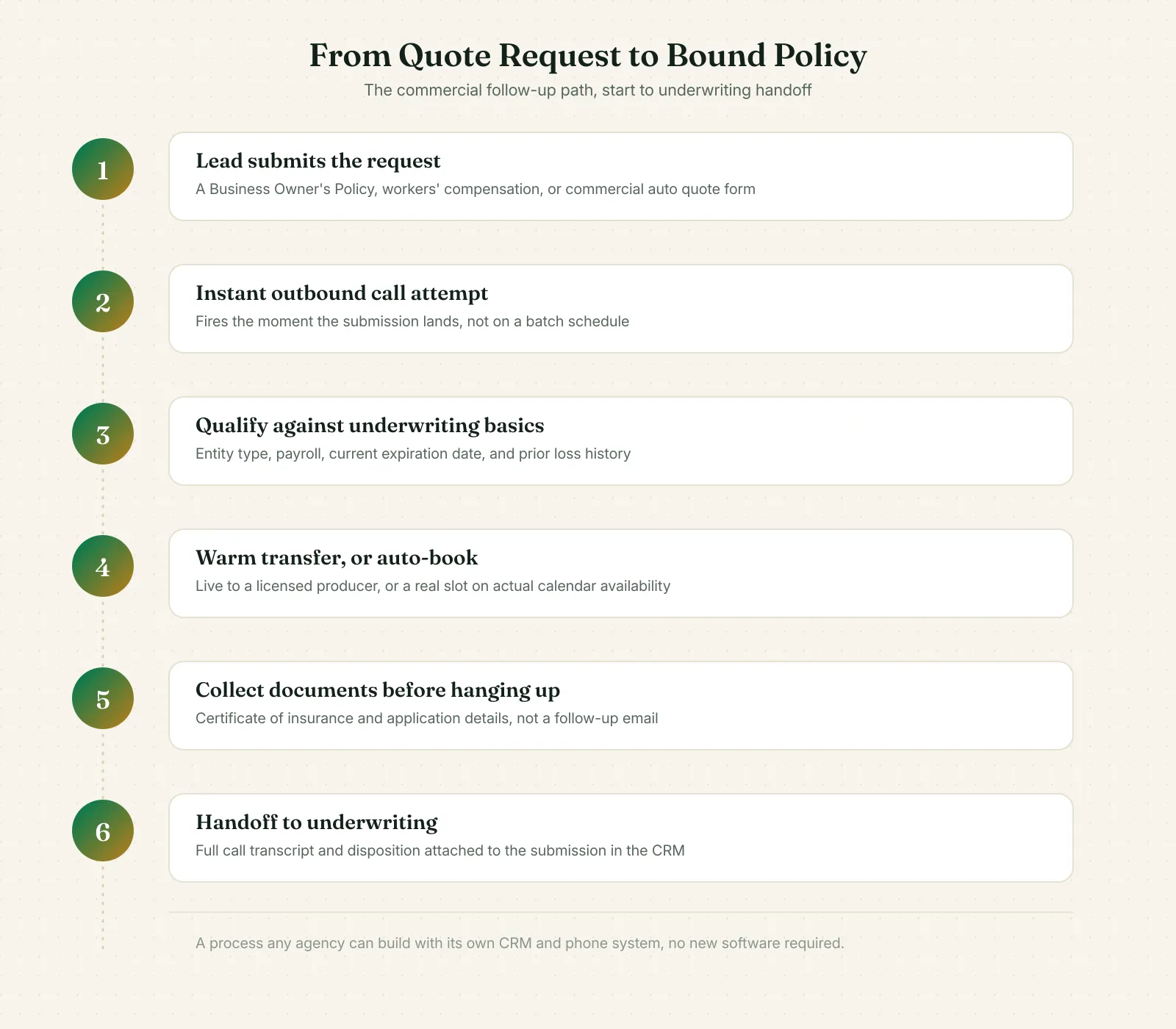
1. Trigger the first call attempt off the submission itself, not a batch job. If your intake form, agency management system, or quoting tool can fire a webhook, a task, or a notification the instant a submission lands, wire it to start a call attempt immediately rather than waiting for someone to check a queue. The gap between “form submitted” and “someone tried to call” is the single biggest lever here, on commercial lines exactly as much as on personal lines.
2. Build one qualifying script per line of business. A BOP inquiry, a workers’ comp submission, and a commercial auto request each need different first-call questions. Write down the four or five things underwriting will ask for on each line, entity type and years in business, current payroll or revenue, current carrier and exact expiration date, and any prior losses, so whoever makes that first call collects real, usable information instead of a friendly conversation that goes nowhere. Any first-touch caller who doesn’t ask these questions on call one is adding a second full call cycle to every submission.
3. Draw the line on what gets an immediate human handoff. Confirming basic details, checking whether the business fits your agency’s general appetite, and booking a calendar slot doesn’t require a license. The moment a caller is explaining coverage specifics, discussing exclusions, or answering “will this actually cover me if,” that’s a licensed conversation, and any high-volume first-touch process, live staff or AI, needs a clean, immediate handoff rule for exactly that moment.
4. Log every attempt and disposition where the next person can see it. A callback attempt that isn’t logged is a callback attempt someone else will duplicate or, worse, never make. Whatever CRM your agency already runs, HighLevel or otherwise, use it to track every dial, every voicemail, and every disposition against that specific submission, so the third follow-up attempt is based on what already happened, not a guess.
5. Price out what your own time is worth against the alternative. Run the math in the worked example above with your own call volume and your own producers’ actual value per hour, not the BLS median if your team runs above or below it. An agency doing forty commercial calls a month has a different answer than one doing four thousand, and the honest answer for a low-volume shop might be that your current staff, working the process above, is already the right tool.
An agent who reads all five of those steps and thinks “I could build this with our existing CRM and a checklist” is right, and is exactly the kind of shop that should build it that way first. What a platform buys you past that point is speed and consistency at volume without someone personally dialing every one of those calls.
Where a managed AI caller fits, and where it stops
TheAffordableAI doesn’t quote, rate, or bind anything, and any calling platform that implies it can should be treated with real skepticism. What it does is the first-touch layer described above, run at volume without someone personally making every dial: an outbound call fires the moment a commercial lead lands in your CRM, the AI works through your agency’s own qualifying script for whichever line of business the lead is for, and the moment a real prospect is qualified, it either warm-transfers into a live licensed producer or books a real slot against actual calendar availability if nobody’s free. Every call, transcript, and disposition syncs to your own HighLevel CRM as it happens, which matters as much for a commercial submission’s documentation trail as it does for a personal-lines consent record.
You can also build a version of this yourself with a dialer, a CRM automation, and a person to run it. Plenty of agencies do exactly that, especially at lower volume, and the five-step process above is the same one either path runs on. It’s worth pricing both before deciding, using your own call volume against the math earlier in this piece. If you’d rather hear what the calling side of this actually sounds like before pricing anything, there’s a demo call on the homepage.
Fires on submission, not a queue check
The outbound call attempt starts the moment a BOP, workers' comp, or commercial auto lead lands, not whenever someone gets to it.
Your script, your qualifying questions
Set the exact entity-type, payroll, and loss-history questions your underwriters actually need, per line of business.
Warm transfer to a licensed producer
A qualified prospect reaches a real, licensed human live. The AI never discusses coverage specifics or gives a quote.
Every call syncs to your CRM
Transcripts and dispositions land in your own HighLevel account in real time, part of the submission's documentation trail.
Run the math on your own commercial call volume
The worked example above uses 300 calls at $0.20 a minute because that's the published Single Account rate. Swap in your agency's actual volume and average handle time and see where the number lands.
What actually changes when the first call is fast
An agency that fixes this isn’t buying a higher close rate; nobody can promise you that, and treat any pitch that does with suspicion. What changes is more specific and more provable: the business owner who filled out three quote requests this afternoon gets a real, informed call from your agency before the other two have dialed, the underwriting-ready details land in the submission on the first attempt instead of the third, and your producers spend their licensed time quoting and closing instead of redialing a list that’s going cold while they do it. Whether that comes from a tighter internal process, a dedicated hire, or a calling platform is a volume and cost decision specific to your agency, not a universal answer.
The compliance layer this article can’t skip
Automated or prerecorded calls to a cell phone require prior express consent under the Telephone Consumer Protection Act, 47 U.S.C. Section 227, and that requirement does not carve out an exception for a business call. The statute’s restriction on using an automatic telephone dialing system or an artificial or prerecorded voice applies to “any telephone number assigned to a … cellular telephone service,” full stop, with no separate business-purpose exemption written into that specific provision. The Telemarketing Sales Rule’s business-to-business exemption is real but narrower than a lot of agents assume: the FTC’s own guidance describes it as reaching a limited set of B2B calls for the National Do Not Call Registry and certain recordkeeping provisions, not the TCPA’s separate wireless-number consent rule.
Using AI does not transfer liability, on commercial lines either
Prior express consent, clear disclosure that the caller may be an AI where required, and a working opt-out honored immediately are the licensed agency's responsibility no matter what places the call, a producer, a BPO seat, or a platform like ours. None of that obligation moves to the tool because the business being called is a corporation instead of a household.
Practically, that means the safest default for a commercial lead’s cell number is the same one that applies to a personal-lines lead: confirm how and when consent was captured before an autodialed or AI-voice call goes out, disclose clearly, and honor an opt-out the moment it’s requested, in whatever channel it arrives through. A statutory violation under 47 U.S.C. Section 227(b)(3) carries actual damages or $500 per violation, whichever is greater, and a court can raise that to as much as three times that amount, up to $1,500, for a willful or knowing violation, per call or text, not per campaign. That exposure doesn’t shrink because the number belongs to a business.
When outsourcing or AI calling is the wrong tool for commercial lines
Some of this work needs a licensed person with judgment, and no calling tool, human or AI, fixes that by being fast. A multi-line renewal for a business with a complicated loss history, a coverage-gap conversation about additional insured requirements on a construction contract, or a fifteen-year client relationship up for renewal, those need a producer who actually knows the account, not a high-volume first-touch layer optimized for throughput. Pushing that kind of conversation through any volume tool tends to produce a worse outcome, not a faster good one.
There’s also a volume floor worth being honest about. If your agency handles a handful of commercial submissions a week, the setup and subscription cost of any calling platform, ours or anyone else’s, may simply not be worth it yet next to your current staff working the five-step process above directly. Every option in this article has a volume where it starts paying for itself, and a volume below which it’s solving a problem you don’t have.
Price out your own commercial call volume against the worked example above, build the qualifying-script and instant-trigger process regardless of what calling tool you end up using, and decide based on your own numbers rather than a sales pitch’s.
Frequently asked
What actually counts as a commercial insurance lead?
A commercial insurance lead is a request for coverage tied to a business rather than a household: a Business Owner's Policy (BOP, a bundled property and liability policy for small businesses), workers' compensation, commercial auto, general liability, or a standalone line like commercial property or cyber. The buyer is usually the business owner or an office manager acting on the owner's behalf, not a single consumer shopping for themselves, and the request often comes with more required information up front, entity type, payroll, years in business, prior loss history, than a personal auto or home quote does.
Why do commercial insurance leads go cold faster than people expect?
Two things compound. First, a small business owner shopping for a BOP or workers' comp policy behaves like a retail consumer, not like a large commercial account: they typically request three or four quotes at once and move forward with whoever responds with a real answer first, the same dynamic that drives speed to lead in personal lines. Second, commercial submissions carry more upfront questions than a personal-lines quote, so a slow or incomplete first call does not just lose the moment, it also fails to collect the information (payroll figures, current carrier, loss runs) an underwriter needs before a real quote can even be built, which pushes the whole submission further behind.
How much does slow commercial follow-up actually cost an agency?
There is no single published number for 'cost of a slow commercial lead' because agencies vary too widely in call volume and average handle time to make one honest figure. What is measurable is the labor cost of the person doing the calling: the U.S. Bureau of Labor Statistics puts the median wage for an insurance sales agent at $62,280 a year, or $29.94 an hour, as of May 2025. A producer who spends real selling hours on first-touch dialing and redialing instead of quoting and closing is spending that hourly rate on a task that a lower-cost or automated first-touch layer can often absorb instead.
Do I need consent to call a business owner's cell phone about commercial coverage?
Yes, if the call uses an autodialer or an artificial or prerecorded voice, and the number is a cell phone. The Telephone Consumer Protection Act's restriction on automated or prerecorded calls to a wireless number, at 47 U.S.C. Section 227(b)(1)(A)(iii), does not carve out an exception for a business call. The Telemarketing Sales Rule's business-to-business exemption is narrower than most agents assume: per the FTC's own guidance, it can exempt some B2B calls from the National Do Not Call Registry provisions and recordkeeping rules, but it does not touch the TCPA's separate consent requirement for automated or prerecorded calls to a wireless number, and a call soliciting an individual, even at a business line, for something the business itself will use is still treated as a business solicitation only when it fits the rule's specific terms. When in doubt, treat a cell number, business purpose or not, as requiring the same prior express consent a personal-lines call would need.
Can an AI voice agent quote or bind a commercial insurance policy?
No, and treat any platform that implies otherwise with suspicion. A managed AI caller like TheAffordableAI handles the calling layer: it can place the first outbound call the moment a commercial lead comes in, ask qualifying questions from a script your agency sets, and warm-transfer or book a real appointment with your licensed producer. It does not rate a risk, generate a bindable quote, or make a coverage decision. Quoting, underwriting, and binding stay with your agency's raters and your licensed staff, exactly as they do today; the calling platform only changes how fast a live human gets involved.
How fast should a commercial insurance lead actually be called back?
As close to immediately as your process allows. There is no commercial-lines-specific published response-time study as rigorous as the personal-lines speed-to-lead research already cited elsewhere on this site, so this article does not repeat a number that was not measured on commercial submissions specifically. What is documented is the trend: First Connect's 2026 State of the Industry Report, surveying 238 independent agencies, found that agents citing significant challenges with carrier quote timeliness fell from 22% to 11% year over year, meaning the carrier side of the transaction is getting faster. A business owner who is used to a faster quote turnaround from the carrier side has less patience for a slow first call from the agency side.
Is a managed AI caller the wrong tool for any commercial lines work?
Yes, for the parts of the job that need judgment rather than volume. A complex multi-line renewal for a manufacturer with a claims history, a nuanced coverage-gap conversation with a contractor about additional insured requirements, or a relationship-driven renewal with a client of fifteen years, those need a licensed producer who knows the account, not a high-volume calling tool. Where a managed caller earns its cost is the repetitive first-touch layer: instant outbound on a new BOP or workers' comp submission, basic qualification, and getting a real prospect to a human fast, the same layer that any high-volume personal-lines operation uses it for.
What's the fastest way to build a commercial follow-up process without buying new software?
Wire your intake form or quote request tool to fire a task or notification the instant a submission lands, not on a batch schedule. Build one qualifying script per line of business, BOP, workers' comp, commercial auto, that captures entity type, current expiration date, payroll or revenue, and prior losses in the first call, and route anything requiring a licensed coverage opinion straight to a producer instead of letting a first-touch caller improvise. Log every attempt and disposition in your CRM so a second or third callback attempt is never a guess. None of that requires new software if you already have a CRM and a phone; it requires someone or something dialing the instant the lead lands instead of hours later.
Sources
- U.S. Bureau of Labor Statistics — Occupational Outlook Handbook: Insurance Sales Agents (data as of May 2025)
- Independent Insurance Agents & Brokers of America (the "Big I") — 2026 Market Share Report, published on IndependentAgent.com (released June 23, 2026, covering 2025 data)
- First Connect — 2026 State of the Industry Report (published June 25, 2026; survey of 238 independent agencies and 44 carrier/MGA partners)
- FTC — Complying with the Telemarketing Sales Rule (business-to-business call guidance)
- Cornell Law School Legal Information Institute — 47 U.S.C. Section 227, Telephone Consumer Protection Act
- TheAffordableAI — Pricing
Put this on your own phone line
See the AI dial, qualify, and warm-transfer a live call in under a minute. No contract, no dev work.
Keep reading

Speed to Lead in 2026: Why the First 60 Seconds Decides Who Writes the Policy
The lead you paid for is not lost to a better agent. It is lost to a faster one. Here is what response time actually does to contact and conversion rates, and how to get to sixty seconds without hiring a dialer team.

Cost Per Call: Live Agent vs AI Voice Agent in 2026
AI voice agents run about $0.07 to $0.50 a minute in 2026, versus $0.75 to $1.40 for a US live agent. Here is the real cost-per-call math, by volume.

Warm Transfers vs Voicemail Drops: What Actually Gets an Insurance Prospect on the Phone
Voicemail drops feel productive and cost almost nothing. Warm transfers feel expensive and interrupt your day. Only one of them reliably puts a licensed agent in front of a prospect who is ready to talk.